Categories
Education Blog

ARIZONA SCHOOLS LEAD THE NATION IN GROWTH ON NATIONAL SCIENCE EXAM

Arizona’s fourth grade students led the nation in points gained on the National Assessment of Educational Progress (NAEP) science exam, according to results released this week by the National Center for Education Statistics.

While we found good news:  Arizona is leading the nation in growth and reduction in the achievement gap between white students and Hispanic students, we also learned Arizona’s proficiency scores are still near the bottom in comparison to other states.

In looking at the Nation’s Report Card for Science, the Association examined the data in three important ways: overall growth from 2009 to 2015, the NAEP achievement gap, and national comparisons of proficiency.

Categories
Education Blog

PROPORTIONAL GAINS – CHARTER GROWTH WITHIN SCHOOL DISTRICT BOUNDARIES, PART II

What does the growth of Arizona’s charter school movement mean for local control? School choice (in its broadest definition) decreases the number of voters with an immediate investment in the passage of local taxation questions because these parents no longer have a direct benefit from passing a bond and override in their local school district. Likewise, the parents of students attending a school district via open enrollment cannot vote for a bond and override that will benefit their child directly.

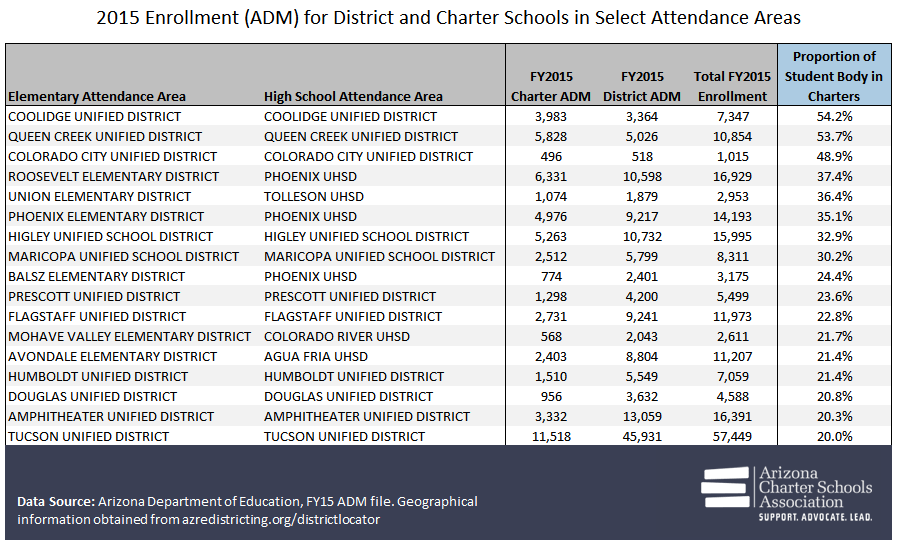
With the continued and steady expansion of charter schools, Arizona now has school districts where the majority of students within district boundaries attend charter schools. Continuing our series on school enrollment trends, in this edition we explore the distribution of students choosing district or charter schools within an attendance area. We found that several district attendance areas now have parity in the population of students attending charter schools and district schools. The Coolidge, Queen Creek and Colorado City School Districts all have seen tremendous charter school growth over the past decade (see our last blog) and now roughly an equal number of students are enrolled in charter schools as district schools within these districts’ boundaries.

FIGURE 1 – 2015 ENROLLMENT (ADM) FOR DISTRICT AND CHARTER SCHOOLS IN SELECT ATTENDANCE AREAS[1]

Figure 1 shows charter and district school enrollment numbers by geographical attendance area (elementary district boundaries in this case). For this analysis, high schools–both district and charter–were mapped to elementary attendance areas because elementary districts provide a more granular frame of reference than high school district boundaries. Where districts do not have a unified system of elementary level and high school level schools, both attendance areas are noted in the table above.

The interactive map below allows us to take a closer look at the Phoenix area, examining which Valley communities have seen the greatest proportional gains in student enrollment in charter schools. The southeast Valley as a region has seen the greatest proportion of student enrollment in charter schools, with Queen Creek and Coolidge School Districts now enrolling less than half of the students attending school in their attendance areas.  That is, these districts no longer contain a majority of students (and their families) who are tied to the local school district governance and decision-making structure.

MAP 1 – PROPORTION OF STUDENTS IN CHARTER SCHOOLS BY ATTENDANCE AREA

(Click on an attendance area in the map above to see the FY2015 details)

IMPLICATIONS

Arizona, like most states, grants households with school-age children a free and appropriate public education based on the district’s boundaries in which the household is located. Additionally, Arizona law allows families the option to attend public schools of their choice (district or charter), so long as seating capacity is available and parents are able to transport their student. Despite this flexibility, school district attendance areas still serve as real and consequential boundaries for political and planning purposes as well as the taxation of households. Though district boundaries and school addresses are fixed locations, families are clearly exercising their freedom of choice within and between attendance areas. These data suggest that significant numbers of families choose to send their students to both charter and neighboring district schools rather than the default of their home’s neighborhood school district.

Why is this finding important?

When the public registers to vote they are asked to participate in governance and taxations issues related to the school district that they are assigned based on the location of their home.  Families choosing charter schools or district schools outside of their home attendance area are not afforded direct say in taxation and governance decisions for the school district or charter where they choose to send their children.  At the same time an increasing number of Arizona families are exercising the proverbial “vote with their feet” with respect to their school of choice, their voting rights are still restricted to their local school district’s elections.  The only exception applies to statewide initiatives, such as Proposition 301 and the recently passed Proposition 123, that are not restricted based on local school district affiliation.

There is a presumption (or at least a common perception) that local district elections provide for strong local control and governance because of the commitment of the voting citizenry which has historically included the voting parents of children who attended their local public schools. These voting parents have been critical to this system as they theoretically had a vested interest in directly supporting their child’s public education.


“Local investment is potentially at jeopardy given these voters no longer have a direct, vested interest in the outcome of elections on their neighborhood schools.”

These data suggest that perhaps this system of local investment is potentially at jeopardy given these voters no longer have a direct, vested interest in the outcome of elections on their neighborhood schools. In other words, school choice (in its broadest definition) decreases the number of voters with an immediate investment in the passage of the bond and override because neither the parents of open enrollment students nor charter schools have a direct benefit from passing the bond and override in their local school district. Likewise, the parents of students attending a school district via open enrollment cannot vote for a bond and override that will benefit their child directly.

It should be noted that the number of students choosing to attend other districts schools through open enrollment is presumed in this blog, and the actual count of students is not reported through existing state data sources.  Anecdotally, some districts report that they receive more than 10 percent of their students from other school districts.  In order to fully understand the impact of the state’s open enrollment statutes on school districts’ total enrollment additional data is necessary.  To date, there is no publicly available information that reports open enrollment numbers or any way to infer this information from available data.

Open enrollment to all schools (charter school and district schools) outside of home attendance areas raises questions about how Arizona citizens can best support, define and participate in the kind of school systems they choose to send their children. The free movement of the Arizona public school student body has implications for our school finance system as well as our role as citizens in the governance of our schools. With the flagging ties to local control of funds and charter schools’ complete dependence on statewide general revenue funds, it seems that reform to the school finance system that funds schools based on school district boundaries and the ability to pass local taxes is warranted.

Footnotes/References

[1] Average Daily Attendance from Arizona Department of Education. Attendance areas for charter schools were assigned using the Arizona District Locator, http://azredistricting.org/districtlocator/

For more on the policy effects of school choice, see The distance between desk and home: the policy and finance implications of school choice policies


Categories
Education Blog

EXCELLENCE IN THE PHOENIX URBAN CORE

By Eileen Sigmund and Lisa Graham Keegan

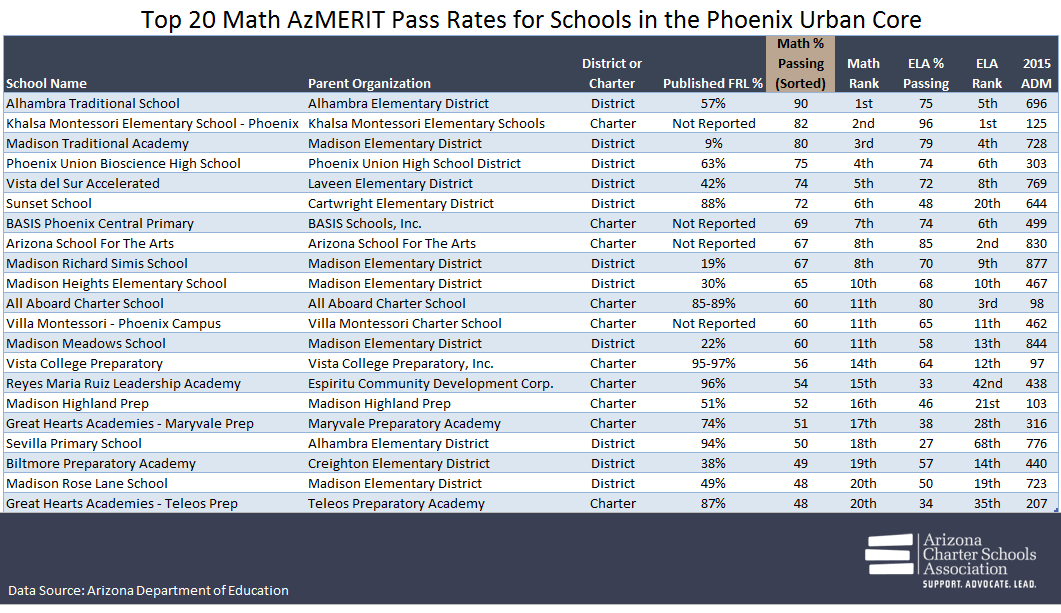
Newly released AzMERIT data show a spectacular picture of what excellence — and emerging excellence — looks like.

Take the Phoenix urban core as an example. There are 219 schools serving nearly 130,000 students. When looking at the top 20 public schools that performed the best in math, we see two REALLY important things: half are district schools and half are charter schools. And most importantly – please set down your coffee and focus – HALF of the schools serve a majority of low-income students, and half serve a higher wealth population.

What this says to us is that excellent school performance is first and foremost a function of the people inside a school who make a decision about what they expect from themselves and their students every day.

Both district and charter schools are offering this level of “great”, and schools serving low-income students are often outperforming much higher wealth schools. The job for parents is to know who is offering quality and to access that for their children. The job for the rest of us is to play whatever role we have in order to get the schools under our influence or in our communities up to these same higher quality levels.

Nothing about this chart of achievement says that we are done – there is plenty of room to grow, and the schools on this list will be the first to say so. But let’s at least focus on some amazing progress and potential. Please let’s not thwart the progress we are making in Arizona schools by pretending that school type or wealth of students alone is what makes a great school.

A great school is a group of people whose commitment is extraordinary and whose skills are enormous.

We send our greatest thanks to all of them.

ABOUT THE AUTHORS

Eileen is the former President and CEO of the Arizona Charter Schools Association. The Association is a non-profit membership and advocacy organization, providing academic, operations and school development support for Arizona’s charter schools. Eileen has a strong advocacy background, having served as a journalist, litigator, and lobbyist. Eileen is a 2013 Pahara-Aspen Education Fellow, an Arizona Chamber Commerce & Industry Board of Directors member, and she sits on the Charter Schools Development Corporation Advisory Council.

Lisa is the founder and Executive Director of A for Arizona, and is honored to serve as Senior Advisor to National School Choice Week, an annual public awareness campaign to advance excellent choices in education. She has spent 14 years as Principal Partner at the Keegan Company, which focuses on emerging excellence in American education. Mrs. Keegan spent a decade from 1991 – 2001 serving as Arizona state representative and then elected state school superintendent. Lisa has received the Milton and Rose D. Friedman Foundation Award for Leadership in Educational Choice, the Arizona Chamber of Commerce 2013 Milton Freidman Award for visionary leadership in Arizona, and was inducted into the Hall of Fame by the National Alliance of Public Charter Schools in 2013. She served as education advisor to John McCain’s campaigns for president, and was interviewed in 2000 by President-Elect Bush for the job of US Secretary of Education. She also serves on many national and local boards committed to providing an excellent education to more students, including the Arizona Charter Schools Association, Teach For America – Phoenix, Corps Knowledge, and America Succeeds.

Categories
Education Blog

NET GAINS – CHARTER GROWTH WITHIN SCHOOL DISTRICT BOUNDARIES, PART I

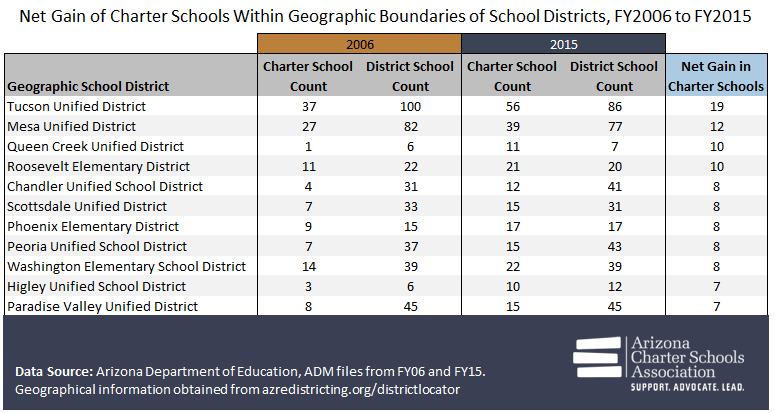
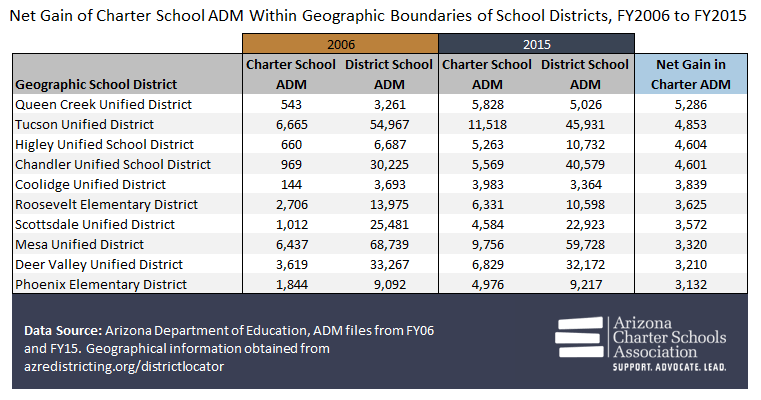
Where has Arizona’s charter school movement grown in the last decade? We found that Tucson Unified School District saw the most new charter schools within its borders, gaining 19while Queen Creek Unified School District gained the most charter students, increasing by 5,286[1].

In Part 1 of our series, we analyzed the net gain of charter schools and students within school district boundaries from FY06 to FY15. In a previous blog we examined overall state attendance trends at the county level.

CHARTER SCHOOL GROWTH WITHIN DISTRICT BOUNDARIES

Figure 1 shows school districts that have had the greatest net gain of charter schools within their geographic boundaries from 2006 to 2015[2]. “Net gain” in charter schools is just that – the difference in number of charter schools within a district’s boundaries in 2006 and 2015. It is possible that any number of schools could have actually opened or closed in the years between these two snapshots in time, but in this blog we focus on the net change in the number of schools within a district attendance area.

FIGURE 1: GEOGRAPHIC SCHOOL DISTRICTS WITH LARGEST NET GAIN IN CHARTER SCHOOLS, FY06 TO FY15

Most of the net growth of charter schools has been focused in school districts surrounding Phoenix and Tucson, with Tucson Unified leading the state. Large districts in the northern and southwestern parts of the state have also seen modest net gains in charter schools within their boundaries, namely Yuma Elementary District (2), Flagstaff Unified District (2), Camp Verde Unified District (2), Humboldt Unified District (3) and Prescott Unified District (3).

Perhaps more intuitive and interesting than the table in Figure 1, though, is a look at how the net gain numbers have actually played out throughout the landscape of the state. Taking a closer look at the Phoenix area, we can examine which Valley communities have seen the greatest gains in charter schools. Mesa Unified leads the way in the Valley, gaining 12 charters from 2006 to 2015, while Queen Creek and Roosevelt had a net gain of 10 each.

The interactive map below shows charter school net gain by school district. School districts with a net change of 0 have been excluded. Click on the markers to see the district’s net gain in charter schools.

MAP 1: NET GAIN IN CHARTER SCHOOLS BY SCHOOL DISTRICT, FY06 TO FY15

CHARTER STUDENT GROWTH WITHIN DISTRICT BOUNDARIES

In a related but slightly different question, the Association also looked at absolute net change in charter school attendance, rather than number of charter schools. Figure 2 shows the top ten school districts for net charter average daily membership (ADM) gain between 2006 and 2015:

FIGURE 2: GEOGRAPHIC SCHOOL DISTRICTS WITH LARGEST NET GAIN IN CHARTER SCHOOL ADM, FY06 TO FY15

Tucson Unified is still near the top of the list, however, cedes its number one spot to Queen Creek Unified when the question is viewed through the lens of total students rather than schools. Notably, the two districts that appear in Figure 2 that do not appear in Figure 1 are Coolidge Unified District and Deer Valley Unified District. This suggests that these two districts either added a small number of larger charter schools within their boundaries, or saw strong growth rates within the existing charter schools from 2006.

Again, to see how total charter attendance has changed the educational landscape of the state, the Association mapped the net gain or loss of charter students within all school districts. The picture was similar to that of charter school net gain. Click on the markers to see the district’s net gain or less of charter students.

MAP 2: NET GAIN OR LOSS IN CHARTER STUDENTS BY SCHOOL DISTRICT, FY06 TO FY15

Focusing on the Phoenix area’s overall net change in charter student enrollment, we see similar patterns that reflect the number of charter schools gained within each district’s geographic boundaries. Queen Creek Unified, Higley Unified and Chandler Unified are represented by blue dots on the southeast side of the Valley, while districts like Deer Valley Unified and Peoria Unified can be seen on the northwest end.

SCHOOL IMPLICATIONS

Just as the past decade of overall K-12 growth in Arizona paints a misleading picture of certain counties with declining enrollment trends, the growth of charter schools and students over the past decade should be understood at a finer level than simply the evaluation of statewide trends. As our state grows in population, the growth of our public schools should meet the needs of families. Policy makers should consider enrollment trends, geography, demographics, and community needs in making K-12 policy decisions.

In our next blog, the Association will take a closer look at the charter landscape within districts. In it we will evaluate charter student market share within traditional school district attendance boundaries. This analysis will highlight those districts that are saturated based on the number of schools as well as the number of charter students and how these districts have changed over time.

FOOTNOTES/REFERENCES

[1] This blog is part one of a larger series which will focus on Average Daily Membership trends and snapshots as they relate to the geographic boundaries of a school district. This blog will primarily focus on total gains (“absolute” terms), rather than consider the increases in terms of a percentage of existing ADM or existing number of schools (“relative” terms).

[2] Schools that do not serve students in a typical fashion in a geographical location have been excluded.  In the case of district schools, the Association used state ADM data gathered at the school and district level. In the case of charter schools, the Association gathered geographical information for all charter schools that are currently open, and assigned them to a geographical school district. For certain types of schools that do not have a geographical location listed with ADE, or whose ADM trends are outside the scope of this blog, data were excluded (such as select online schools, JTEDs, accommodation/transportation schools and select BIA schools). Also, there were 11 total charter schools that existed in FY06 but not in FY15, and these were excluded from the geographical analysis.

Additional Note: The Association also created printer-friendly maps that give an overview of which school districts in the state have seen the most charter school growth within their boundaries. Download our PDF of charter growth in school districts HERE.
Categories
Education Blog

THE CONUNDRUM OF MEASURING SCHOOL QUALITY: RAISE ACHIEVEMENT OR CLOSE THE GAP?

Results of the 2015 AzMERIT testing data show that students in charter schools consistently outperform students in district schools, across all racial and ethnic groups. But does the higher student achievement lead to a closing of the achievement gap between different groups of students? The Association’s analysis shows that the differences in achievement of student subgroups within charter schools actually serves to widen the already large achievement gap.

CHARTER AND DISTRICT DEMOGRAPHICS[1]

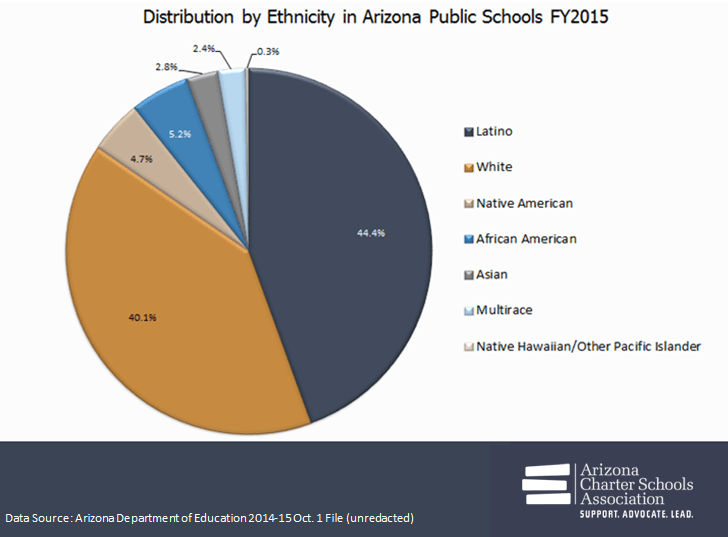
Figure 1 shows the racial and ethnic composition of all Arizona public schools during the 2014-2015 school year.  Latino students comprise the largest group (44 percent) in the state, followed by White students (40 percent). The next largest group, African American students, is only slightly above five percent of the state, followed by Native American enrollment at slightly below five percent, with all other groups reporting fewer than five percent each.

FIGURE 1: DISTRIBUTION BY ETHNICITY IN ARIZONA PUBLIC SCHOOLS FY2015

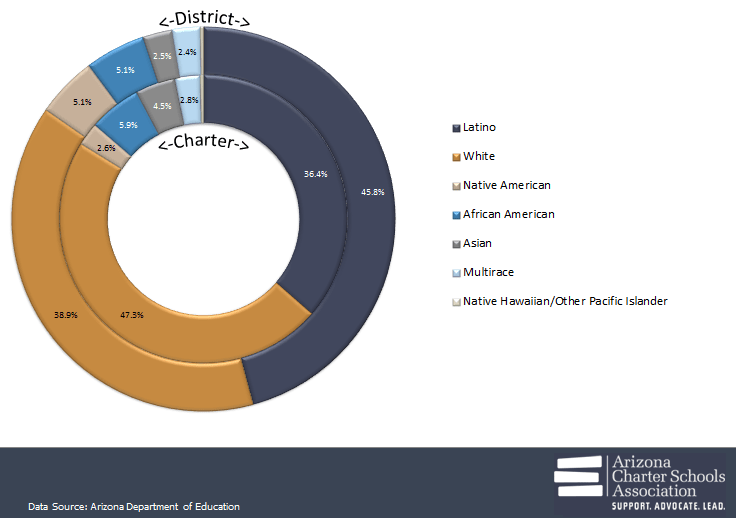
Figure 2 illustrates notable differences in the composition of district and charter school students. Charter schools serve a larger share of White students, 47 percent compared to 39 percent in district schools. Charters also serve a larger share of Asian and African American students than district schools. Conversely, charters serve a smaller share of Latino students, 36 percent compared to 46 percent in district schools, and a significantly smaller share of Native American students.

FIGURE 2: DISTRIBUTION BY ETHNICITY IN DISTRICT AND CHARTER SCHOOLS

These data suggest that White, Asian, and to a smaller extent, African American families are more likely to choose charter schools than other students and families.  When evaluating these students’ overall academic performance, this decision appears to pay off.

AzMERIT RESULTS – THE CHARTER ADVANTAGE

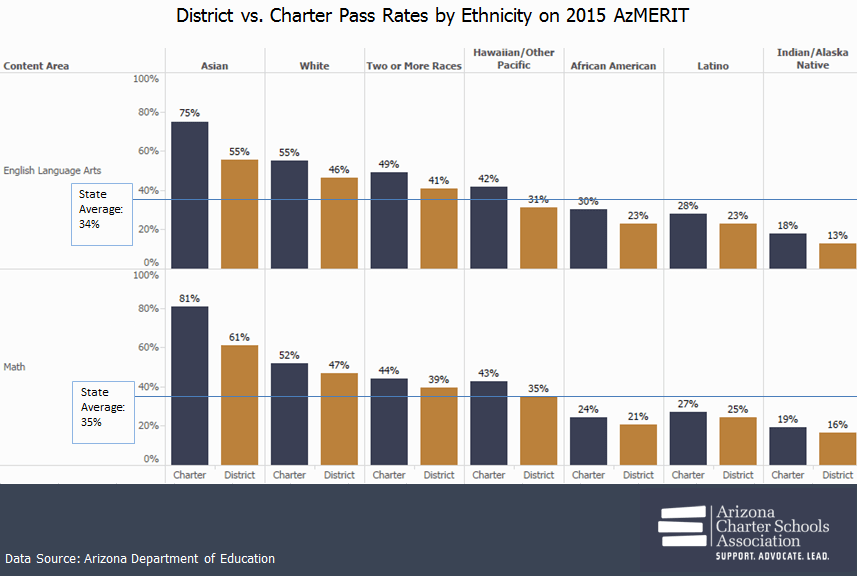
The figure below (Figure 3) shows the percent of students passing the AzMERIT exam in 2015, broken out by school type (district or charter) and student subgroup. These data combine the passing rates across grade levels in English Language Arts (ELA) and Math.  In both content areas, charter students in all subgroups have higher passing rates than their district counterparts.  These data demonstrate that charter schools are providing increased academic outcomes for the students enrolled – at least for the 2014-15 school year. For Arizona charter schools this is good news, given that a charter, by definition, is a contract to improve student achievement.

FIGURE 3: DISTRICT VS. CHARTER PASS RATES BY ETHNICITY ON 2015 AzMERIT

The charter advantage—the difference between charter and district performance—is particularly large for Asian students, a relatively small group of students in both sectors.  Charter schools enroll a significantly higher percentage of Asian students than district schools and provide a 20 point pass rate advantage over district schools in both ELA and Math. The charter advantage for White students is also significant, nine points in ELA and five points in Math.  We see a similar charter advantage for students from two or more races and Native Hawaiian/Pacific Island students.  These four groups of students account for over 55 percent of charter enrollment; they are all scoring above the state average in ELA and Math and their results help explain charter schools’ overall performance.

Latino, African American, and Native American students also see a charter advantage, but a somewhat smaller one. Despite the gains experienced in charter schools, none of these groups perform at or above the state averages in ELA or Math.

AzMERIT RESULTS – THE ACHIEVEMENT GAP

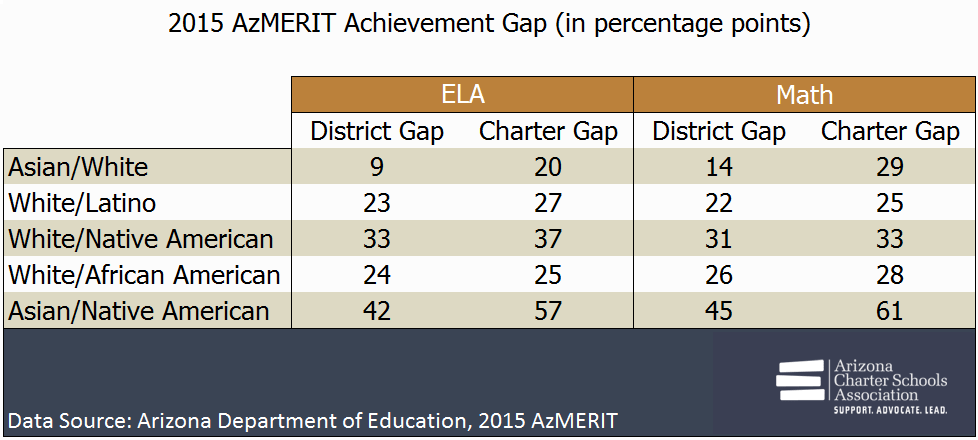
The initial results indicate there is an achievement gap between districts and charters – where overall charter students are outperforming their district peers.  The Association also wanted to investigate achievement gaps between subgroups of students within charters and districts.  The table below shows achievement gaps within charters and districts for each of the major subgroups of students, in both ELA and Math.

For example, the ELA Asian/White achievement gap (the difference between the passing rates for these two subgroups in ELA) in charter schools is 20 percentage points compared to 9 percentage points in district schools.  This means that the passing rate for Asian students in charter schools is 20 percentage points higher than their White charter peers, whereas Asian students in district schools outperform their White district peers by only nine percentage points.

FIGURE 4: ACHIEVEMENT GAP BY RACE/ETHNICITY AND SCHOOL TYPE

The most striking finding in this analysis is the relative size of the achievement gaps between subgroups, regardless of school type. With only two exceptions, all gaps are at least 20 percentage points.  Of all groups, Native American students have the lowest performance in both ELA and Math, and have the widest achievement gaps compared to their peers. The Asian/Native American gap shows the size of the extremes.

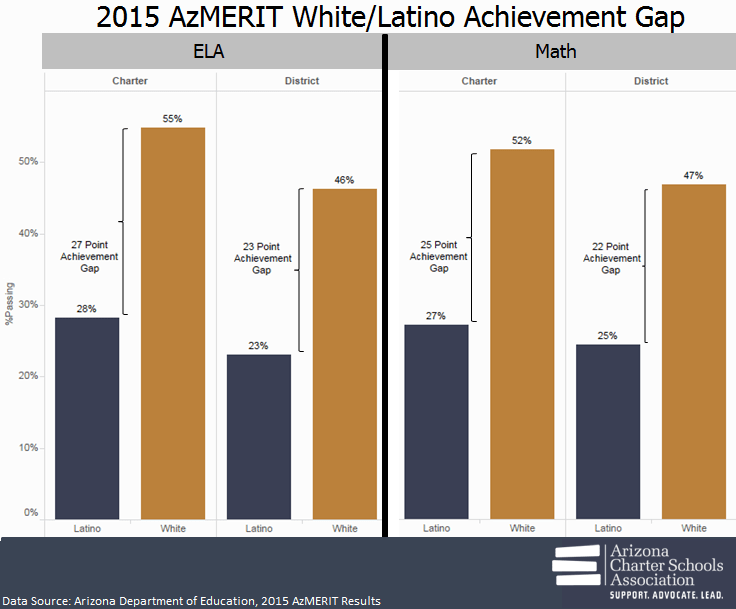
White and Latino students represent the two largest groups in the state and their achievement gap is illustrated in the figure below. Since the charter advantage for White students is greater than it is for Latino students (see Figure 3), the size of the achievement gap is greater in charter schools than in district schools.

FIGURE 5: WHITE/LATINO ACHIEVEMENT GAP BY SCHOOL TYPE


IMPLICATIONS

Policy makers are beginning to contemplate school accountability measures to evaluate the quality of Arizona’s public schools.  The new A-F formula will include a combination of proficiency and growth measures.  These data suggest that charter schools are likely to fare well in the overall evaluation when proficiency rates are compared to their district counterparts.  The new A-F system must also integrate federal requirements to evaluate subgroup performance on AzMERIT and other indicators of school quality. The evaluation of achievement gaps in subgroups is a critical component in the identification of schools for targeted and comprehensive support (federal intervention).  These data suggest that charter schools are likely to fare worse in the evaluation of achievement gaps, despite their overall higher performance.

In addition to accountability implications, these data raise questions about overall academic performance of student subgroups and ways that schools can close achievement gaps that exist among them.  Clearly, the answer is not to reduce the rate at which Asian and White students are performing in schools.  Rather, there needs to be a focus on replicating that same, or greater, performance for other student groups across all public schools.

FOOTNOTES/REFERENCES

[1] The Association used 2015 AzMERIT data for all public schools to evaluate their performance.  The AzMERIT data provided were unredacted, through a research agreement with the Arizona Department of Education; these data included details for small schools and student groups that are not available in the publicly released data file.  The demographic data included in these analyses were obtained from the October 1 Enrollment file for 2014-2015 (unredacted).

Categories
Education Blog

WILL THE PUBLIC HAVE A SAY IN ARIZONA SCHOOLS’ NEXT ACCOUNTABILITY SYSTEM?

Rating Arizona’s 2,015 public schools with a label of A-F helps the community identify the quality of the school.  Letter grades were assigned from 2012-2014 and suspended in 2015 and 2016 as Arizona students transitioned to a new statewide test.  Letter grades are based, in part, on how students perform on Arizona’s statewide test.

To grade schools in 2017, the Arizona Department of Education asked the community to participate in a Request For Information on the new A-F system’s components and methodology. However, in order to respond to 45 questions, the public must have extensive technical knowledge.  Thus while the Department of Education is attempting to solicit feedback from the public, the unintended consequence is likely to be greater exclusion of all stakeholders.

Further, anyone submitting a response to the 45 questions in the Request For Information is excluded from participating as a technical or policy advisor during A-F methodology discussions.

Public Engagement

In 2014, the State Board of Education developed the A-F School Accountability Principles of Agreement[1] in preparation for the development of the new A-F formula.  These Principles were created collaboratively with stakeholders and advocates to ensure the newly developed system aligned with the Board’s philosophical, technical and implementation expectations.  In part, the Principles state:

“A coalition of technical and policy stakeholders must be consulted to create, evaluate and refine the methodologies used in the achievement profile to ensure transparency, feedback from the field and community, and compliance with Agreements.”

Additionally, the Every Student Succeeds Act (ESSA)[2] requires meaningful stakeholder participation in the development of the state’s accountability system.  In the past, the Arizona Department of Education utilized technical advisors to support the development of accountability concepts, indicators and methodologies; they focused outreach efforts to school personnel through presentations and targeted communication strategies, and the general public had access to materials once they were available for presentations to the State Board of Education.  In response to these newly stated expectations for increased public engagement the Department released a Request For Information (RFI) for Arizona School Accountability Components and System[3] to solicit stakeholder opinions and feedback.  On the face of it, this new RFI process should yield more opportunities for broad stakeholder engagement in the development of the A-F accountability system.

Unintended Consequences

However, the purpose statement of the RFI strays from this goal.  It states “this RFI solicits feedback from interested parties with any relevant expertise, systems or methodology they have developed or conceptualized which meet the intent of any of the components described below” (page 2). This language, “relevant expertise”, is likely to alienate the general public and exclude them from the process altogether. If the purpose statement doesn’t scare the public from responding, the introduction might.  It makes it clear to the reader that responses should be framed within the new ESSA requirements, A.R.S. § 15-241, SB 1430, State Board’s Principles of Agreement, Superintendent Douglas’ plan as well as other historical documentation.  While the RFI states that respondents are invited to respond to one, any or all of the 45 questions contained – the sheer magnitude of the document is likely to limit responses.

So then, it would seem that the RFI is really designed to solicit responses from the State Board’s coalition of technical and policy advisors. The technical advisory group is made up of individuals who represent a variety of education stakeholders; large and small districts, charter schools, online schools, alternative schools, etc. The policy advisors include the business and philanthropic communities as well as advocacy organizations. These groups represent individuals who have relevant expertise, have likely developed or conceptualized systems or methodologies, and have knowledge of the pertinent statutes and requirements described. Many of the Board’s advisors have also historically provided technical assistance to the Department in the development of prior accountability systems.

The RFI makes it clear that any and all developed or conceptualized systems and methodologies or any suggestions previously submitted for consideration must be resubmitted through the RFI for consideration. This requirement applies to both the general public and to any technical or policy advisor of the Board or Department.  The RFI goes on to state, “respondents to this RFI will be excluded in evaluating and integrating responses which may or may not result in a high stakes accountability system and related competitions” (page 3).  This exclusionary language creates a catch-22 and puts all of the State Board’s technical and policy advisors in an untenable position.  That is to say, if any technical and/or policy advisor submits a response to suggest ways to create or refine the methodologies used in the achievement profiles they won’t be unable to participate in future accountability discussions and methodology decisions.

The Impact

Since 2014, Arizona schools and education advocates have been anxiously awaiting new letter grades.  Due to a two-year moratorium negotiated between education advocates and the legislature, schools have been left holding on to legacy letter grades. This is great news for the 67% of schools that earned an A or B but not ideal for the remaining schools. As the 2016-17 school year approaches, the first year of the new accountability system’s implementation, little is known about how schools will be evaluated.

The issuance of the Department’s RFI puts the development of the state’s new accountability system in jeopardy. First, the RFI will likely limit new and innovative methodologies and concepts created by Arizona’s most qualified technical and policy experts because they are unlikely to submit responses. The resulting accountability system may look very similar to prior system; despite the opportunities for innovation provided by the revised state and federal statutes. Second, it restricts the State Board’s technical and policy advisors from carrying their explicit role to “create, evaluate and refine the methodologies used in the achievement profile” as outlined in the Board’s Implementation Principle.  Each of these outcomes has the potential to undermine the newly developed system and introduce unnecessary distrust and skepticism.


References and Footnotes

[1] Arizona State Board of Education’s A-F Accountability Principles of Agreement, implementation agreements  https://azsbe.az.gov/resources/f-school-letter-grade-accountability

[2] Every Student Succeeds Act (ESSA) Dear Colleague Letter regarding collaboration http://www2.ed.gov/policy/elsec/guid/secletter/160622.html

[3] Arizona Department of Education’s Request for Information (RFI) for Arizona School Accountability Components and System http://www.azed.gov/accountability/rfi/

Categories
Education Blog

A FIRST LOOK AT AzMERIT: MORE TEST RESULTS THAN STUDENTS

Arizona’s new state test, AzMERIT, shifts high school testing from a tenth grade exam to end-of-course assessments in grades nine through eleven.  This shift presents new challenges and opportunities for policy makers to consider when building a state accountability system. These dynamics will likely play out in a variety of ways when calculating percent passing and percentage tested. It will be important for policy makers to understand the potential impacts prior to the development of any accountability system.

What’s the Big Deal?

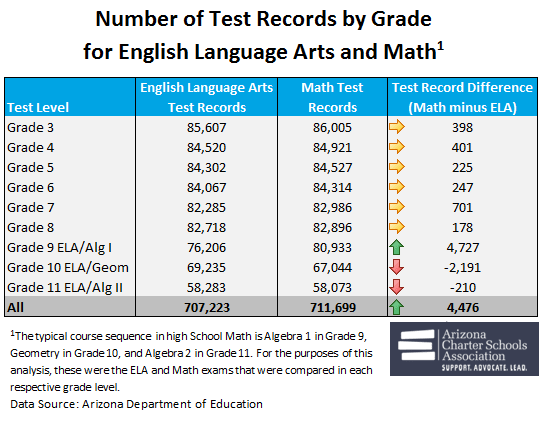
With the passage of SB1430 the State Board of Education will begin to develop its A-F methodology.  The cornerstone to any state accountability system is student level test scores that are used to calculate passing rates and growth scores.  In preparation for this work, the Association began analyzing the 2015 AzMERIT data and discovered significant differences in the number of test records between English Language Arts (ELA) and Math, especially at the high school level.  Given the importance of these data, we set out to investigate the causes and understand the impact. Table 1 shows the number of test records for ELA and Math for each grade level.  At nearly every grade level, the number of Math test records is greater than those for ELA.

The greatest difference is in Grade 9, where most students take an ELA test and, typically, Algebra I. In 2015, the nearly 5,000 more Algebra I test records than Grade 9 ELA test records suggest that students other than high school freshmen are taking Algebra I.
In order to understand the effect of these results, the Association evaluated them in context to the overall enrollment by grade. Table 2 presents grade-level enrollment and a calculation of the percent tested within each content area, as a point of reference.  These data are also reported out by district and charter schools in order to identify any potential differences by type of school.Table 2: 

The use of October enrollment, the only publicly available enrollment file, may impact the “percentage tested” calculations; it is unclear how enrollment changes closer to the testing window could affect these results.  These data show that for almost all elementary grades (grades 3-8), test records account for 99 to 100 percent of grade level enrollment.  Until Grade 8, no compelling difference exists between district and charter schools. However, in Grade 8, math test records account for only 96 percent of grade level enrollment for charter school students, while district schools test 99 percent.

The significant pattern changes that can be seen in the high school “percent tested” columns suggest that the guidance from the Assessment and Accountability divisions within the Department were either unclear or, at best, left room for interpretation.  It would appear that district and charter schools implemented the guidance from the Department regarding end-of-course exams very differently; with large differences in percent testing between the types of schools.  These data also suggest that districts and charters had differing interpretations of the guidance regarding which students must test for each of the end-of-course assessments.

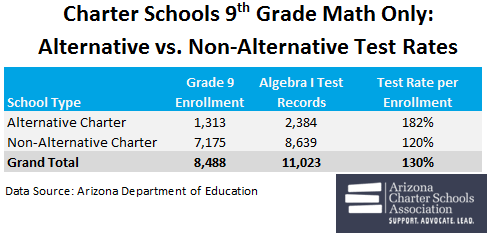
Several examples of this can be seen throughout high school testing.  For example, Grade 9 ELA test records account for 104 percent of Grade 9 enrollment in charter schools and 88 percent of Grade 9 enrollment in district schools. Algebra I test records in math account for 130 percent of Grade 9 enrollment in charter schools and 92 percent of Grade 9 enrollment in district schools.  This suggests that district schools have significantly fewer freshmen taking the Grade 9 ELA test than taking the Algebra I test, and that charter schools are likely testing grades other than freshmen in these courses, particularly Algebra I.  This could be the result of the significant number of alternative charter high schools that serve over-age, credit deficient student populations. The October enrollment file shows 118 alternative charter schools serving Grade 9 students.

In order to investigate this further, the Association evaluated the percentage of ninth grade students tested within charter schools by comparing alternative charter high schools to all other charter high schools.  The results shown in Table 3 suggest alternative charter school students are taking the Algebra I exam beyond Grade 9, and are likely taking multiple end-of-course exams in a given year. This finding is consistent with the student population enrolled in alternative schools and likely explains a significant portion of the overall difference between charter and district schools.

Table 3:

WHY IS THIS IMPORTANT?

These results suggest that guidance from multiple divisions within the Arizona Department of Education resulted in districts and charters making choices about which students should be tested and with which test they should be given.  Without clear policies regarding test taking and the use of test scores for school accountability, the technical validity and overall fairness of any accountability system may be jeopardized.

As state policy makers begin to consider the components and methodology that will be used to calculate A-F and federal accountability formulas, it will be important to understand the impact of end-of-course assessments on availability of data and its use. Unlike the previous state assessment, AzMERIT and the use of end-of-course assessments significantly increases the complexity of available testing data.  These new data need to be fully understood prior to their use for high stakes decisions.

Policy makers should focus on the following areas for consideration: understanding the requirements for end -of-course exam administration and how they impact testing; determine how multiple scores associated with individual students will be used in accountability decisions i.e., calculation of percentage passing; determine how a greater than 100% tested rate will impact accountability decisions.  With each of these areas, clear and timely guidance to the field will be necessary to ensure that schools are not adversely impacted by their testing decisions.  Without this, the foundation of our state’s accountability system (the test score) will be under scrutiny and the reliability and validity of the overall rating will be suspect.

Categories
Education Blog

FROM POVERTY TO POLICY: FREE AND REDUCED LUNCH POPULATIONS IN ARIZONA

The Association reviewed the poverty rates of Arizona students over the past six years, and we found that a greater percentage of students are enrolled in schools with higher concentrations of poverty.

In addition to a statewide analysis, the Association analyzed the results by school type (charter/district). The most striking difference between the two groups is the disparity in the percent of students who are enrolled in a school with no free or reduced lunch (FRL) data.

Introduction

There is near universal agreement that students from low income families are more likely to struggle to meet and exceed academic expectations in school. Challenges such as the lack of resources at home, home or food insecurity, lack of books and other learning tools, and stressed or unavailable parents, can all contribute to educational difficulties of impoverished students. The National School Lunch and Breakfast Program exists to mitigate the effect of hunger on learning[i]. For the 2015-2016 school year, a student whose family income falls below 130% of the federal poverty line qualifies for free meals. For a family a four, the threshold is $31,525[ii].  A family of four below 185%, or $44,863, qualifies for reduced-priced meals.

The Analysis

Although not a perfect measure of poverty, the percent of students in a school who qualify for the FRL program is the only proxy currently available to measure the level of poverty and corresponding instructional needs in a school. The Association used FRL data available through the Arizona Department of Education[iii] to analyze the distribution of students living in poverty among Arizona schools and changes in the distribution from 2010 to 2016.

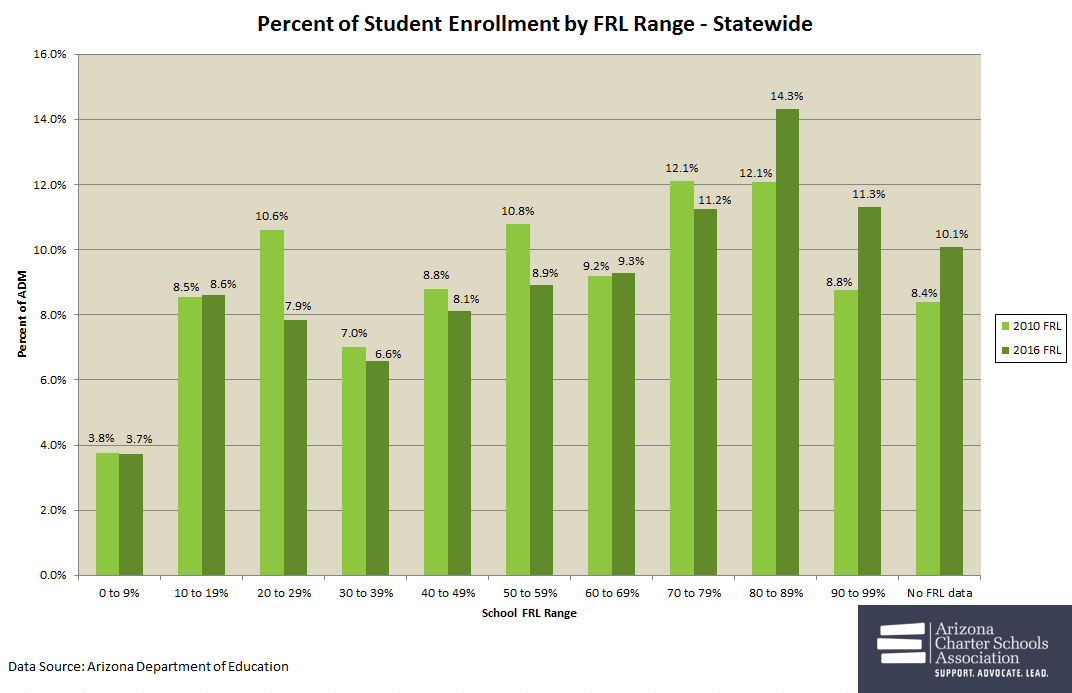
The figure below shows the distribution of Arizona’s students eligible for free or reduced-priced lunch in 2010 and 2016.  Each bar represents the percent of total student enrollment in the given FRL range. For example, in 2010, 3.8% of all Arizona students were enrolled in a school with 0 to 9% FRL; in 2016 that percent was about the same (3.7%).  The concentration of poverty in a school is demonstrated by the percentage of students eligible for FRL enrolled in the school.

The degree of poverty increases from left to right; therefore, the farthest range – 90 to 99% – represents the most concentrated poverty, where nearly all students are eligible for assistance. The exception is the rightmost bar, which indicates the percentage of students enrolled in a school that does not have FRL data. Schools that do not participate in the program do not generate any data. There are varied reasons why a school might not participate in the program and exploring those reasons is outside the scope of this blog; here we will focus our attention on the trends for those schools that do report.

Statewide, we can detect a shift of the distribution to the right, meaning that a larger percentage of students are enrolling in schools with higher concentrations of FRL students. Beginning with the low-poverty schools, both the 0 to 9% and 10 to 19% schools have a relatively unchanged percentage of students.  Schools saw declines in the percentage of students they enroll in the 20 to 29%, 30 to 39%, 40 to 49%, and 50 to 59% ranges. These students moved to the right of the distribution, into the 60% or more ranges. Combined, schools with 50 percent or more of their students eligible to receive FRL enrolled 53 percent of Arizona’s student population in 2010 and 55 percent in 2016.

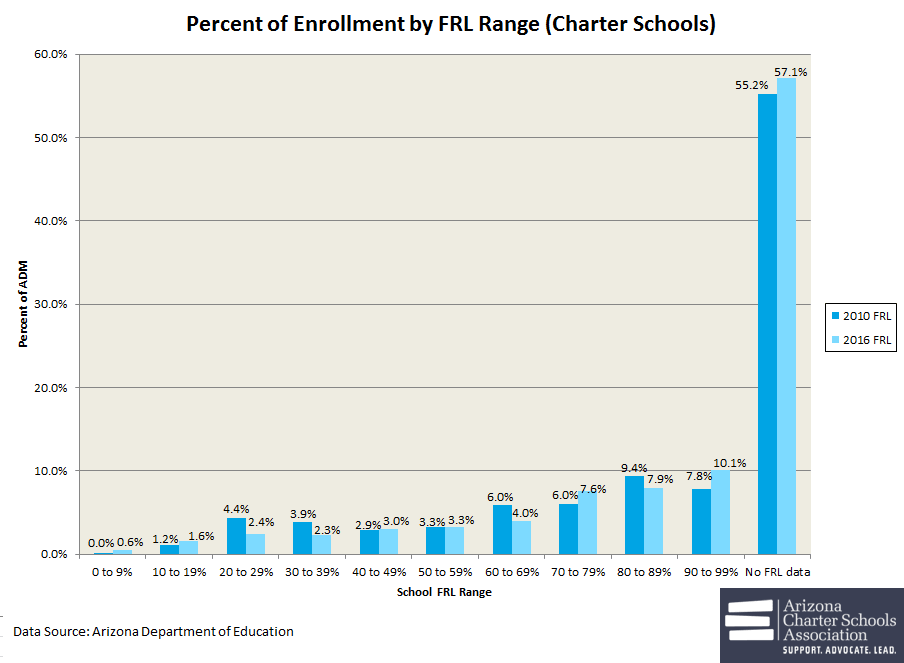
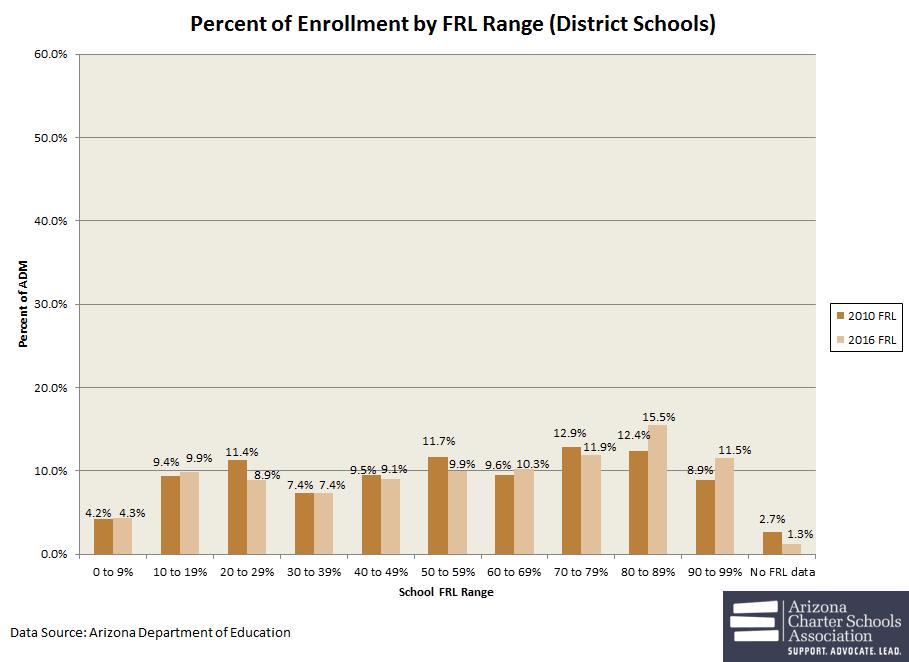
In addition to a statewide analysis, the Association analyzed the results by school type (charter/district). The most striking difference between the two groups is the disparity in the percent of students who are enrolled in a school with no FRL data. As shown below, a majority of charter students are enrolled in a school that did not report FRL data in 2010 or 2016, however, very few students in district schools are enrolled in a school with no FRL data.

Given that FRL information for over half of the students enrolled in charter schools is not available, charter results must be interpreted very cautiously. For those charter schools that do report FRL data, the distribution is moving slightly to the right. In 2010, 32 percent of charter students were enrolled with 50 percent or more FRL; in 2016, this grew to 33 percent.

The results for districts schools are consistent with the statewide trend. From 2010 to 2016, a greater percentage of students are enrolled in schools with higher concentrations of poverty, despite variability in the individual ranges. In 2010, over 55 percent of district students were enrolled in schools with 50 percent of more FRL; in 2016, this grew to 59 percent.

The Implications

Higher levels of poverty in our public schools translate to higher demands of our educators and on our limited resources. If the challenges to students and demands placed on schools increase as overall resources decrease, then the challenge for schools is multiplied. Recruiting and retaining high quality teachers, for example, becomes even more difficult at the same time that the need for them becomes even more critical to student success.

As the state looks to revamp its school accountability and funding systems, the relationship between poverty and measures of achievement must be properly addressed. School accountability labels that can be largely predicted based on the FRL rate do a disservice to the very schools with the biggest challenges[iv]. Our state funding and accountability policies should reflect the real challenges presented to schools serving students in poverty.

Additionally, any policy that takes poverty into consideration must examine how to deal with the significant lack of FRL data in the charter sector. This may include the need for additional data collection or information gathering before a policy can be effectively and appropriately implemented.

A Note on Data

Although determining why charter schools do not participate in the National School Lunch and Breakfast Program is outside of the scope of this blog, finding out the reasons may be important as the state moves forward with its K-12 funding revamp.

Footnotes/References

[i] http://www.azed.gov/health-nutrition/nslp/
[ii] https://www.gpo.gov/fdsys/pkg/FR-2015-03-31/pdf/2015-07358.pdf
[iii] http://www.azed.gov/health-nutrition/frpercentages/
[iv] See the Association’s paper, School Ratings: Improving the Data in Data Driven Decision Making, for a full explanation and recommendations.

Categories
Education Blog

Oh, the Places They’ll Go: Charters and County Choice

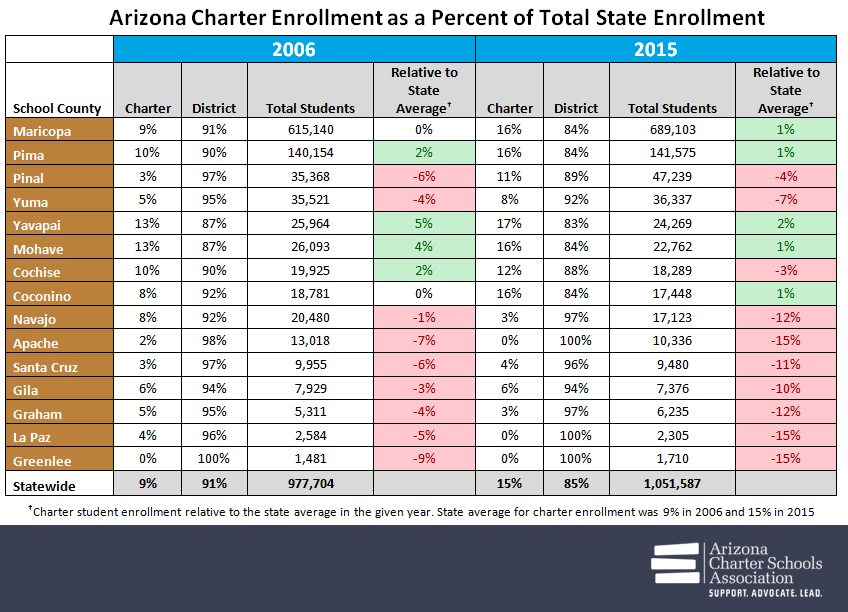
Arizona charter student enrollment has increased from nine percent of all Arizona students in 2006 to 15 percent of students in 2015, an increase of nearly 74,000 students.  Given the significant growth in the charter sector, most counties saw an increase in the total number of students enrolled in charter schools. However, not all counties grew their charter populations at the same rate.

The table below summarizes district[1] and charter school enrollment in each county, sorted by county enrollment size, from largest to smallest.

Since enrollment trends in charter schools parallel county enrollment trends to some extent (see our March blog), one might expect that county size would impact charter enrollment, i.e., counties with fewer students enrolled would have fewer charter schools and vice versa.  However, this doesn’t appear to be the case across Arizona.

Take for example Cochise and Coconino Counties, two mid-sized counties with total student enrollment just under 20,000. Despite similar total enrollment in both years, Coconino County saw significant growth in charter enrollment by doubling its charter student enrollment to 16 percent. At the same time, Cochise County saw charter enrollment increase slightly to 12 percent. Yuma County, however, the state’s fourth largest county, enrolls only eight percent of its students in charter schools, slightly half of the state average.

Most counties saw an increase in the total number of students enrolled in charter schools. However, not all counties grew their charter populations at the same rate. In order to gauge the rate of charter growth in each county, we calculated the difference in charter enrollment from the state average for each county in both years.

When considering relative charter enrollment, even counties like Cochise and Coconino that saw enrollment increases in the total number of students saw their relative proportion of the state’s charter enrollment impacted. Coconino County mirrors statewide charter enrollment, while Cochise County’s charter growth has been slower[2].

County Statistics:

  • Largest Percentage of Charter Students: Maricopa County – In 2015, charter students made up 16 percent of the student population of Maricopa County, slightly above the state average, similar to results in 2006. This suggests that charter growth in Maricopa County reflects statewide charter growth (given its size, this is not surprising).
  • Fastest Growth of Charter Students: Pinal County – Consistent with our March 2016 blog showing Pinal as the fastest growing county, it also has the fastest rate of growth in charters. In 2015, 11 percent of students are enrolled in charter schools, only four percentage points below the state average, compared to 2006, when only three percent of its students were enrolled in charter schools.
  • Fastest Decline of Charters: Navajo, Apache and La Paz Counties –
    • Navajo County enrolled eight percent of its students in charter school in 2006, just under the state average. By 2015, however, only three percent of students are enrolled in charter schools.
    • Apache County, charter enrollment declined from two percent in 2006 to nearly zero percent in 2015[3].
    • La Paz County now has no students enrolled in charter schools, compared to four percent of its enrollment in 2006.
  • No Charter Students: Greenlee County – Greenlee did not enroll any charter students in 2006 or 2015.

Our state school choice policies are built on the assumption that school choice and access to charter schools is desirable for all students no matter where they live in the state. These data show that such access and opportunity is not equally available to all students. This snapshot of two points in time suggests dynamics are at work within each county that either encourage or discourage enrollment in charter schools. Further work is needed to identify what those dynamics might be and whether or not these can be (or should be) addressed to provide access to choice across Arizona.

Footnotes:

[1] Joint Technological Education District enrollments are not included.
[2] Coconino’s 16 percent charter enrollment, which doubled from 8 percent in 2006, is just slightly above the state average. Cochise’s 12 percent charter enrollment, which is up from 10 percent in 2006, is still three percentage points lower than the state average charter population.
[3] The only charter school in Apache County in 2014-2015 closed for the 2015-2016 school year.

Categories
Education Blog

Oh, the Places They’ll Go: Enrollment Trends Since 2007

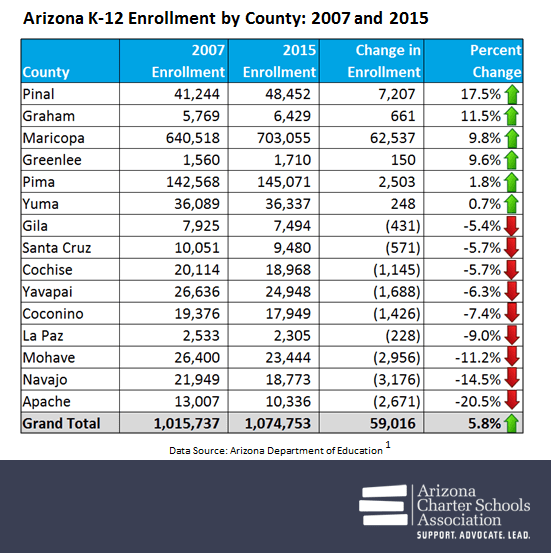
The Association’s first look at statewide enrollment trends over the last nine years shows that despite the overall growth in K-12 enrollment, nine of the fifteen counties in the state have seen an overall decline in student enrollment.

Perhaps not surprisingly, Maricopa County saw the greatest increase in the number of students, adding 62,537 students. In terms of percent change, Pinal County outpaced Maricopa County, increasing by 17.5%, or 7,207 students. Two of the state’s smallest counties, Graham County and Greenlee, also top the list of percent growth at 11.5% and 9.6% respectively.

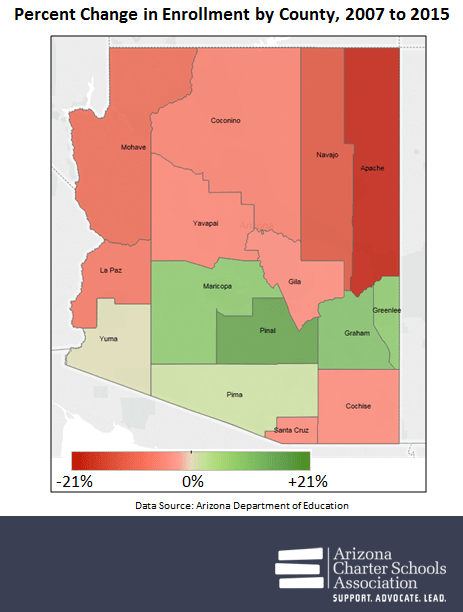
When we consider the “percent change” column of the above table with a geographical lens, we get a clearer picture of Arizona’s enrollment patterns. The map below shows that the largest enrollment declines are occurring in the northern part of the state, with Cochise and Santa Cruz counties being the exceptions to this trend:

The implications of such enrollment trends are not insignificant. Statewide comparisons, independent of county-specific analyses, paint a positive, growing K-12 environment. As the overall population of students in the state increases, so does our overall K-12 budget allocated from the state’s general fund. However, simply evaluating statewide trends provides an incomplete picture of student enrollment trends that may result in ineffective policy decisions. Evaluating these data by county is pivotal in understanding how enrollment has changed across our state. For example, the declining enrollments in rural counties result in declining school and district budgets, making it even more difficult to find qualified teachers in these counties. Also, as enrollment increases in Maricopa and Pinal Counties, the demand for school facilities will grow while at the same time buildings in Northern Arizona become underutilized.

It is clear from these data that student enrollment patterns vary significantly by county and this will likely complicate future discussions regarding budget, facilities and access to high quality schools. Arizona’s education policy discussions should not assume enrollment growth is occurring statewide. Instead, policymakers would benefit from reviewing differing enrollment patterns across different parts of the state and consider the impact on proposed policies.