Categories
Association Blog In the News

Arizona Parents Want School Choice and Support Charter Schools. Here’s Proof

By Jake Logan and Nina Rees

Arizona classes are back in session.

For parents of the more than 1.1 million Arizona students enrolled in a public school, it’s hard to imagine that less than a generation ago, the decision about where your child would attend school was made for you, not by you.

Indeed, many of us are old enough to remember a time when school assignment was dictated not by a student’s needs, but by the neighborhood in which his or her parents could afford to live.

In Arizona, that was the reality until 1994 when Arizona enacted charter school legislation. Together with the adoption of district open enrollment, the statutory changes affirmed a simple principle: Parents know best when it comes to picking the right school for their child.

Categories
Association Blog

Why Choosing Online School is the Best Fit for Our Family

By Tara Boedigheimer

In 2011, when our son Drew was just two years old, we experienced every parent’s worst nightmare.

We were given the shocking and completely unexpected news, by a pediatric cardiologist, that our precious boy was critically ill with a very rare form of cardiomyopathy–and in need of a heart transplant. It was the only thing that could save his life. Not only that, he needed it immediately and the transplant program at Phoenix Children’s Hospital was very new and not approved by our insurance to handle Drew’s situation.

Categories
Association Blog

New Charter Schools Answer the Call for More Educational Choice

By Jamar Younger

As we approach the 25th anniversary of public charter schools in Arizona, charter school enrollment continues to surge with almost 200,000 students now attending the state’s charter schools.

This growth, along with the increasing prevalence of open enrollment, signals that parents are demanding more and varied choices for their students.

The State Board for Charter Schools on Monday added even more choices for families by approving charters for 10 new schools that plan to open for the 2019-20 school year.

These new public charter schools will add 3,187 new seats for Arizona students and families who are seeking more diverse educational options. As part of our strategic efforts to increase access to quality charter schools, the Arizona Charter Schools Association contributed to the creation of more than 2,600 of these seats by providing support to these new schools through consulting, charter application reviews, mock interviews and other workshops.

These new charters will be spread throughout the Phoenix Valley, situated in areas such as Maricopa, Apache Junction, Phoenix’s Maryvale neighborhood and Goodyear.

Categories
Association Blog

Arizona Charter Students Boast Larger NAEP Gains than Any State

By Eric Berschback 

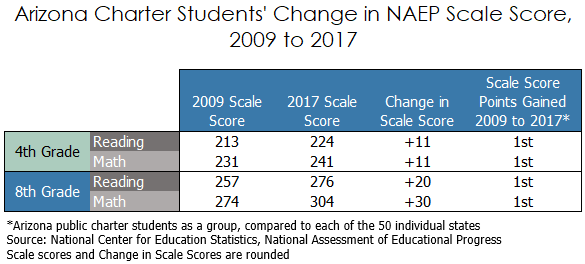
Recently released results from the National Assessment of Educational Progress (NAEP) show that Arizona’s public charter school students have posted greater scale score gains than any individual state, from 2009 to 2017. The data show that when measured as their own “state”, Arizona charter students outpaced the gains realized by their state level peers in all four major tested subjects: fourth grade reading and math, as well as eighth grade reading and math.

Categories
Association Blog

State Charter Board issues guidance for charters regarding special education students

By Jamar Younger

Public charter schools are required to admit all students, including special education pupils.

The State Board for Charter Schools has issued guidance for charters clarifying whether schools can cap or limit admission for special education students.

In short, charter schools are required to accept all special education students and offer the same services, and make the same accommodations for those students as school districts.

The Charter Board cites information from the U.S. Department of Education’s Office for Civil Rights, and Office of Special Education and Rehabilitative Services. The Arizona Department of Education, Exceptional Student Services can also provide resources for charters.

You can view the Charter Board’s guidance here.

The Association also created an enrollment and admissions fact sheet to address questions and misconceptions about charter school enrollment policies. Click here to view the fact sheet.


Categories
Education Blog

2017 AzMERIT INTERACTIVE DASHBOARD – HOW DID YOUR SCHOOL DO?

If you are one of the many Arizonans wondering what to make of last month’s release of the 2017 AzMERIT results, then the Association’s school-by-school dashboard will help to provide meaningful context. The dashboard ranks each school in Arizona based on overall pass rates in Mathematics and English Language Arts, and results can be filtered by city and free and reduced lunch rate. Click the image to see the full interactive dashboard.

HOW TO USE THE DASHBOARD
  • Each icon on the scatterplot represents a school. Hover over an icon to see more information about the school, such as its district/charter holder, its overall pass rate on the ELA or Math exam, or its state rank based on those pass rates.
  • Use the sliding filter for FRL to examine schools by their reported Free and Reduced Lunch rates. Use the clickable “Sector” and “Alternative” filters to toggle charter schools/district schools, or alternative/traditional schools. The scatterplot icons as well as the lists at the bottom of the dashboard will update to include only the schools that are within the parameters of the filters.
  • Use the “City” filter to see only the schools that are within a certain city. The scatterplot icons as well as the lists at the bottom of the dashboard will update to include only the schools that are within the given city.
METHODOLOGY
  • This dashboard assigns each school in the 2017 AzMERIT file to a city, based on that school’s physical address.
  • Ties in pass rate resulted in the same ranking being assigned to each tied school, and subsequent schools being ranked based on how many schools were tied in the group ahead of them. Example: If the top five schools in the state were tied for first with a 90% pass rate, those five schools would all be assigned a ranking of “1st”, while the school or schools with the next-best pass rate in the state would be assigned a ranking of “6th”.
  • The pass rates of schools with fewer than 11 students tested were redacted from the state file. Such schools were not included in the rankings, and are not shown in the scatterplot, as they do not have reported pass rates for ELA or Math.
  • Some schools have pass rates listed as as “>=98%” or “<2%” in the state-released file. Such schools were coded with pass rates of “99%” and “1%”, respectively, and included in the rankings. This small adjustment in the reported pass rates is the reason why the x- and y-axes are listed as “Math Pass Rate Proxy” and “ELA Pass Rate Proxy”.
  • Free and Reduced Lunch rates are sometimes reported to ADE as ranges, such as “40-49%”. Such reported FRL rates were recoded with an “FRL Proxy” that is a number, such as 45%. Additionally, several schools in the state do not report FRL rates. These schools were assigned an FRL Proxy of 0%.
Categories
Association Blog

Charter supporters set the record straight on school accountability

By Jamar Younger

After a self-published and flawed report on public charter schools, Arizona’s charter community and the Arizona Republic quickly responded that charter schools are held accountable and school leaders are motivated by student success, not financial gain.

The Arizona Charter Schools Association issued the first set of responses with a statement and letter to our schools emphasizing that charter schools are academically successful, which is what matters most.

Here is a roundup of the other responses:

Categories
Association Blog Charters Changing Lives

Charter leaders sacrifice to see dreams become reality

By Jamar Younger

When Nick Schuerman reflects on the fact that he’s responsible for the education of the 225 children who attend his school, he is nearly moved to tears.

Schuerman opened Victory Collegiate Academy, a K-6 public charter school, this month in Phoenix’s Maryvale neighborhood, fulfilling his dream of providing a quality education to underserved students.

“I’m seeing the fruits of my labor. It’s here now. I have to sit back and pinch myself,” he said.

Lori Weiss and Melissa McKinsey experienced a similar feeling when they welcomed almost 300 students to Synergy Public School, their brand new central Phoenix campus, which also opened this month.

These schools started as a kernel of an idea just three years ago, but have grown into the manifestation of their founders’ dreams.

Categories
Association Blog

Arizona’s new A-F accountability system will prove crucial to charter success

By Jamar Younger

Arizona’s A-F letter grade system has served as the outward-facing indicator of a school’s quality since it was introduced in 2010.

For charter schools, A-F letter grades influence high stakes decisions such as whether a school or network can renew its charter, increase its enrollment and open another campus.

Ultimately, if a charter school receives an ‘F,’ it may potentially lead to the school’s closure.

That’s why the next six weeks will provide a series of defining moments as the state looks to complete its revamp of the new, proposed A-F Framework crafted by the state’s A-F Ad Hoc Committee.

Categories
Education Blog

WILL THE PUBLIC HAVE A SAY IN ARIZONA SCHOOLS’ NEXT ACCOUNTABILITY SYSTEM?

Rating Arizona’s 2,015 public schools with a label of A-F helps the community identify the quality of the school.  Letter grades were assigned from 2012-2014 and suspended in 2015 and 2016 as Arizona students transitioned to a new statewide test.  Letter grades are based, in part, on how students perform on Arizona’s statewide test.

To grade schools in 2017, the Arizona Department of Education asked the community to participate in a Request For Information on the new A-F system’s components and methodology. However, in order to respond to 45 questions, the public must have extensive technical knowledge.  Thus while the Department of Education is attempting to solicit feedback from the public, the unintended consequence is likely to be greater exclusion of all stakeholders.

Further, anyone submitting a response to the 45 questions in the Request For Information is excluded from participating as a technical or policy advisor during A-F methodology discussions.

Public Engagement

In 2014, the State Board of Education developed the A-F School Accountability Principles of Agreement[1] in preparation for the development of the new A-F formula.  These Principles were created collaboratively with stakeholders and advocates to ensure the newly developed system aligned with the Board’s philosophical, technical and implementation expectations.  In part, the Principles state:

“A coalition of technical and policy stakeholders must be consulted to create, evaluate and refine the methodologies used in the achievement profile to ensure transparency, feedback from the field and community, and compliance with Agreements.”

Additionally, the Every Student Succeeds Act (ESSA)[2] requires meaningful stakeholder participation in the development of the state’s accountability system.  In the past, the Arizona Department of Education utilized technical advisors to support the development of accountability concepts, indicators and methodologies; they focused outreach efforts to school personnel through presentations and targeted communication strategies, and the general public had access to materials once they were available for presentations to the State Board of Education.  In response to these newly stated expectations for increased public engagement the Department released a Request For Information (RFI) for Arizona School Accountability Components and System[3] to solicit stakeholder opinions and feedback.  On the face of it, this new RFI process should yield more opportunities for broad stakeholder engagement in the development of the A-F accountability system.

Unintended Consequences

However, the purpose statement of the RFI strays from this goal.  It states “this RFI solicits feedback from interested parties with any relevant expertise, systems or methodology they have developed or conceptualized which meet the intent of any of the components described below” (page 2). This language, “relevant expertise”, is likely to alienate the general public and exclude them from the process altogether. If the purpose statement doesn’t scare the public from responding, the introduction might.  It makes it clear to the reader that responses should be framed within the new ESSA requirements, A.R.S. § 15-241, SB 1430, State Board’s Principles of Agreement, Superintendent Douglas’ plan as well as other historical documentation.  While the RFI states that respondents are invited to respond to one, any or all of the 45 questions contained – the sheer magnitude of the document is likely to limit responses.

So then, it would seem that the RFI is really designed to solicit responses from the State Board’s coalition of technical and policy advisors. The technical advisory group is made up of individuals who represent a variety of education stakeholders; large and small districts, charter schools, online schools, alternative schools, etc. The policy advisors include the business and philanthropic communities as well as advocacy organizations. These groups represent individuals who have relevant expertise, have likely developed or conceptualized systems or methodologies, and have knowledge of the pertinent statutes and requirements described. Many of the Board’s advisors have also historically provided technical assistance to the Department in the development of prior accountability systems.

The RFI makes it clear that any and all developed or conceptualized systems and methodologies or any suggestions previously submitted for consideration must be resubmitted through the RFI for consideration. This requirement applies to both the general public and to any technical or policy advisor of the Board or Department.  The RFI goes on to state, “respondents to this RFI will be excluded in evaluating and integrating responses which may or may not result in a high stakes accountability system and related competitions” (page 3).  This exclusionary language creates a catch-22 and puts all of the State Board’s technical and policy advisors in an untenable position.  That is to say, if any technical and/or policy advisor submits a response to suggest ways to create or refine the methodologies used in the achievement profiles they won’t be unable to participate in future accountability discussions and methodology decisions.

The Impact

Since 2014, Arizona schools and education advocates have been anxiously awaiting new letter grades.  Due to a two-year moratorium negotiated between education advocates and the legislature, schools have been left holding on to legacy letter grades. This is great news for the 67% of schools that earned an A or B but not ideal for the remaining schools. As the 2016-17 school year approaches, the first year of the new accountability system’s implementation, little is known about how schools will be evaluated.

The issuance of the Department’s RFI puts the development of the state’s new accountability system in jeopardy. First, the RFI will likely limit new and innovative methodologies and concepts created by Arizona’s most qualified technical and policy experts because they are unlikely to submit responses. The resulting accountability system may look very similar to prior system; despite the opportunities for innovation provided by the revised state and federal statutes. Second, it restricts the State Board’s technical and policy advisors from carrying their explicit role to “create, evaluate and refine the methodologies used in the achievement profile” as outlined in the Board’s Implementation Principle.  Each of these outcomes has the potential to undermine the newly developed system and introduce unnecessary distrust and skepticism.


References and Footnotes

[1] Arizona State Board of Education’s A-F Accountability Principles of Agreement, implementation agreements  https://azsbe.az.gov/resources/f-school-letter-grade-accountability

[2] Every Student Succeeds Act (ESSA) Dear Colleague Letter regarding collaboration http://www2.ed.gov/policy/elsec/guid/secletter/160622.html

[3] Arizona Department of Education’s Request for Information (RFI) for Arizona School Accountability Components and System http://www.azed.gov/accountability/rfi/