Categories
Association Blog

Impact Aid: Federal Money Available for Charter Schools

Arizona is the largest recipient of Impact Aid, which is federal money available for charter schools on or near federal or tribal lands, as well as schools that have parents employed by the federal government.

With a looming government shutdown, Impact Aid could be affected. Arizona has an Arizona State Impact Aid Association nonprofit to provide leadership, advocacy and a united voice. Based on information from the Arizona State Impact Aid Association, 79 district and charter schools receive the federal money, totaling $221,031,427 in 2012.

Categories
Press Releases

Arizona Awarded Grant to Expand Charter Schools

Recognizing the academic success of Arizona’s charter schools, the U.S. Department of Education today awarded $23.6 million to Arizona to provide additional high quality charter schools to Arizona’s students.

“As public schools serving public students, charter schools are focused on improving the number of quality seats for Arizona’s students,” said Eileen Sigmund, Arizona Charter Schools Association President. “It takes two years of planning to start a high quality charter, but schools don’t get funding until students start class. Without start-up funding, it’s very difficult to find a facility, purchase textbooks and desk, and hire teachers. This grant enables our charter schools to be intentional and start right from day one.”

More than 170,500 students attend 533 public charter schools for this current school year. In 2014, 73 percent of charter schools with two years of letter grades either improved their letter grade or earned an A (A-Alt) or B (B-Alt).

Since the program’s inception, the United States Department of Education has invested about $47.5 million in Arizona’s charter schools, with an aim of strengthening accountability and quality of our schools.

This year’s state grant program awarded $125 million in new grants to eight states. The funding will enable them to run state-level grant competitions to support approximately 400 new and expanded public charter schools, according to the U.S. Department of Education.

Categories
Education Blog

Move On When Reading? Keeping the Bar Low (Until 2017)

While it is an urban myth[i] that prison population projections are based on the number of third graders that cannot read — a connection exists between incarceration and failure to read. A student not reading by the end of third grade is four times less like to graduate, and high school dropouts were 63 times more likely to see the inside of prison walls than college graduates[ii].

In an effort to combat those statistics, the state’s Move on When Reading (MOWR) law[iii] requires schools to retain third-graders who fall far below reading standards.

With 44 percent of our third graders scoring “minimally proficient” on AzMERIT, it was surprising that in August the Arizona State Board of Education set the bar based on past exam levels, allowing only three percent of Arizona’s third-graders mandated access to “intervention and remedial strategies.” Despite test results demonstrating more of our students lack the skills to graduate high school, the State Board set a policy that keeps the bar low for the 2015 and 2016 administrations of AzMERIT.

So…Why Does it Matter?

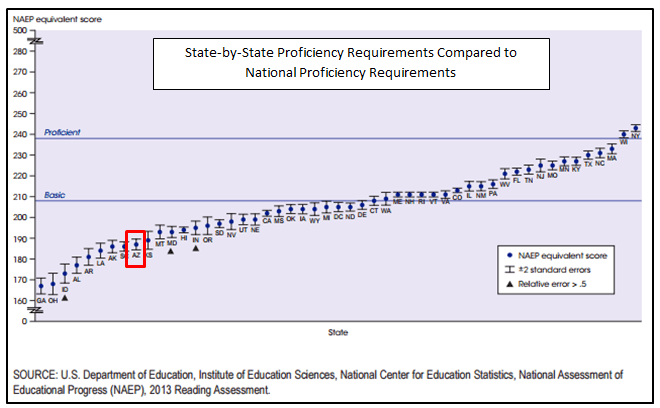
Arizona’s measures for determining the academic preparedness of our students have long differed from external measures, namely national assessments. In the 2013 AIMS results, 77% of fourth and 72% of eighth grade students were proficient in reading; however, the 2013 National Assessment of Educational Progress (NAEP) results show that 72% of Arizona fourth- and eighth-graders were NOT proficient in reading, compared to 66% of students nation-wide. As our students matriculate to high school, we see the ramifications of these results: 25% of Arizona students do not graduate from high school with their class, according to statistics from the Arizona Department of Education.

How is it possible to have such differing diagnoses from the state and national exams? The 2013 NAEP Mapping Study[iv] demonstrates the disparity. The following chart represents the alignment between NAEP expectations and state proficiency expectations in reading. It is clear that Arizona’s AIMS proficiency standard is significantly lower than both the NAEP Proficient and Basic cut scores. The chart also illustrates how it is possible for students identified as proficient on AIMS to simultaneously score well below the Basic level on NAEP.

In response to these facts, Governor Doug Ducey[v] communicated the following during his remarks to the State Board of Education in March:

“First, Arizona’s scores are too low – unacceptably low. Second, we’re giving false assurance to too many parents that their kids are well-prepared for life or college — when in fact they are not. So we need to commit ourselves to achieving excellence.  And when we see excellence, we should understand who and what creates it and export those best practices to other schools so that they can benefit from it.

This Board – along with my office and the Legislature – needs to design policies that get Arizona on a path to significant improvement in the quality of education.  It won’t happen overnight, and it’s a long-term proposition, but it can be done and we need to make that our primary focus.”

The State Board developed policies in response to this call to action. The Performance Level Descriptors adopted by the Board and used extensively by teachers during standards-setting established high expectations for proficiency that were critical to beginning to align our state’s outcomes to national measures, and furthermore, to prepare Arizona students for college or career. According to the Department’s materials, the AzMERIT performance standards are generally comparable to the performance standards on NAEP.

It was widely acknowledged throughout the standards-setting process that teachers understood that students taking the exam in 2015 were not prepared or ready to meet the higher standards, yet teachers recommended appropriate standards anyway. Dr. Joe O’Reilly, an external observer and school district employee, presented his observations regarding the standards-setting process and teachers’ commitment to educational excellence in his memo to the Board:

“Teachers took their training to heart. We heard them say things to each other like ‘I want to make sure we are setting it at college and career ready, not too low, not where a student is not really college and career ready.’ They also discussed why the results turned out as they did and said things like ‘we are setting this for what we want students to be able to do, not what they can do now,’ ‘that [item’s results] is a teacher issue and where the teacher is on the new standards,’ and ‘that should be an easy item if it was taught properly.’ ” (P. 3)[vi]

Our state’s past academic results along with the overwhelming acknowledgement by educational professionals, parents, policymakers, and the business community contributed to the Board’s decision to establish higher, more rigorous standards for AzMERIT on August 14, 2015.

So…How Did This Happen?

Why, despite the Board’s prior moves to rigorous expectations, did the Board take a step backwards towards old expectations and performance standards?  A.R.S. §15-701 required them to set the cut score using “reading scores.” Alternative recommendations to set it at the Minimally Proficient level, using the English Language Arts (ELA) scores, were dismissed due to this interpretation. Unfortunately, the Department didn’t provide an alternatively rigorous reading score, one that might have aligned more closely to the Minimally Proficient level, for the Board to consider.  Simply put, the Board was left with only the AIMS equivalent cut score as an option.

In an attempt to ameliorate their decision, to revert to lower standards and old expectations, the Board approved a measure that would avoid providing confusing information to parents of existing fourth graders. Students impacted by the Board’s decision are still eligible for remediation support, despite being promoted, so this information will be provided to schools only with the expectation that students receive interventions during the 2015-16 school year.

The Board also acknowledged that the approved cut scores don’t reflect the level of rigor and expectations for reading and are inconsistent with their previous decisions to set high expectations for passing on AzMERIT.  Their motion required the Department to reconvene a standard setting committee to provide a recommended “falls far below” level for subsequent years that is in alignment with the AzMERIT expectations. Lastly, the Board will seek additional legislation regarding Arizona’s Move on When Reading statute to align it with the current statewide assessment, specifically the use of an English Language Arts assessment.

So…What Does This Mean?

Although a majority of Arizona fourth- and eighth-grade students were deemed “proficient” in reading in the 2013 AIMS results, these same students fell far short of expectations for proficiency on the national exam (NAEP). Expectations vary state-by-state, and in many cases, individual states’ expectations fall short of the requirements of the national exam – Arizona is one of these states.

In March, Governor Ducey called for action to raise the state academic standards to more closely align with national standards, and to better prepare Arizona students for college and career. The State Board has responded, developing curricula requirements and implementing assessments that match the performance standards of the NAEP.

Despite these advances, third graders in 2016 will be passed on at the same rate as their predecessors who were subjected to lower standards and expectations. This slow transition to a more rigorous standard in 2017 will mean thousands of children will be duped into thinking they are on track for college and career when they are not.
Footnotes/References
[i] http://www.theatlantic.com/business/archive/2012/07/an-urban-myth-that-should-be-true/259329/
[ii] http://readingpartners.org/blog/do-prisons-use-third-grade-reading-scores-to-predict-the-number-of-prison-beds-theyll-need/
[iii] A.R.S. §15-701 http://www.azleg.gov/FormatDocument.asp?inDoc=/ars/15/00701.htm&Title=15&Doc
[iv] Bandeira de Mello, V., Bohrnstedt, G., Blankenship, C., and Sherman, D. (2015). Mapping State Proficiency Standards Onto NAEP Scales: Results From the 2013 NAEP Reading and Mathematics Assessments (NCES 2015-046). U.S. Department of Education, Washington, DC: National Center for Education Statistics. Retrieved 8/18/15 from http://nces.ed.gov/pubsearch.
[v] http://azgovernor.gov/governor/news/governor-duceys-remarks-arizona-state-board-education
[vi] August 14, 2015 agenda materials https://azsbe.az.gov/public-meetings 
Categories
Association Blog

Council Readying to Overhaul School Finance

In a few weeks, Governor Doug Ducey’s Classrooms First Initiative Council will take the first, small step towards creating an equitable, efficient state school finance system that benefits all of our students.

The Council will reveal its preliminary recommendations for overhauling Arizona’s K-12 finance system on Sept. 22 after spending this summer exploring various aspects of school finance and meeting with consultants and advisors, including the Arizona Charter Schools Association and Center for Student Achievement.

Categories
In the News

Tucson Students Choosing Charters

Tucson-area students are taking advantage of school choice by attending more charter schools, as well as other nontraditional schools and programs. “Families and students are looking for choice and finding it in charters,” said Association President and CEO Eileen Sigmund.

Categories
In the News

Arizona Charter Schools Ranked Among Best High Schools in the Country

Arizona Agribusiness & Equine Center and Paradise Honors High School were named some of the top 500 high schools in the country by Newsweek, including in a separate list of best high schools that serve a high percentage of students in poverty.

Categories
In the News

Association President Disputes False Claim About Charter Schools

Association President and CEO Eileen Sigmund wrote an op-ed to the Sahuarita Sun  to dispel myths regarding charter school achievement and whether or not charter schools accept all students.

Categories
Education Blog

The Disconnect Between Student Funding and School Letter Grades

School finance has been the topic of lively debate in Arizona, recently.  Parents, school leaders, and politicians from both political parties have openly expressed their concern over years of budget cuts, while newspapers continue to report school funding as a major concern of educators, expressed at the Superintendent’s “We Are Listening” tour.  Add to that a recent report by the U.S. Census Bureau that ranks Arizona at or near the bottom in per pupil spending, and it’s clear that school funding is an issue that needs to be addressed.

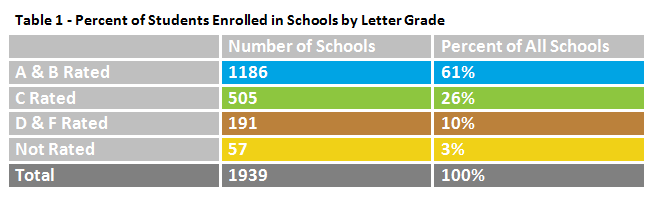
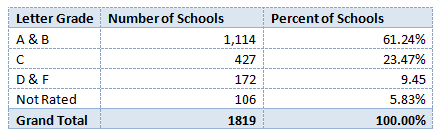
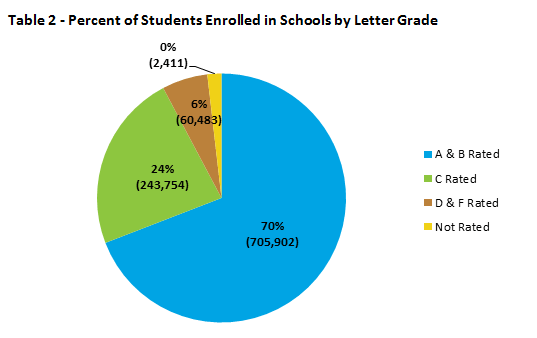
Although recent discussions about school funding would make it seem that urgent reform is needed, data reported from the Arizona Department of Education earlier this year paints a different picture.  Every year, the Department assigns letter grades to public schools based on a combination of their students’ performance on standardized tests and academic growth.  Although these grades are not perfect measures of school quality, they offer insight into how a school is serving its students.  When school letter grades were released to the public last August, education advocates were pleased to announce that schools were not only doing well, but that they had improved from the previous year.  Our analysis showed that that 61 percent of public schools received an A or B rating and that nearly 70 percent of public school students attended an A or B rated school.  Looking at these statistics, it seems that Arizona’s public schools are doing quite well.

Taken together, the fact that Arizona ranks at or near the bottom in per pupil spending at the same time it enrolls 70 percent of its students in A and B rated schools may be seen as an argument against increasing school funding.  In fact, these data could be interpreted to indicate that perhaps Arizona public schools are fine just the way they are.

We believe, however, that this is not the case. As we’ve written previously, Arizona’s school letter grades are not reflective of the true state of education in Arizona.  This is problematic for school funding and education reform advocates because, by our state’s own measures, Arizona schools appear to be doing well despite years of budget cuts.  However, consider the fact that in 2013, Arizona ranked 42nd in fourth-grade reading scores and 22nd in fourth-grade math scores on the National Assessment of Educational Progress.   Also, roughly 44 percent of high school graduates do not enroll in post-secondary institutions upon graduation and only 19 percent receive a diploma from a four-year institution six years after graduating from high school.  These data surely paint a very different picture of school performance.  It is plausible to assume that in order for Arizona to improve on these external measures of student performance, schools will need additional resources.  As the old adage states: the definition of insanity is doing the same thing over again and expecting a different result.

So then, if we believe that our schools are likely to require more resources then we must be clear about student outcomes.  This is not to diminish the work of teachers, principals, and students at A and B rated schools.  Earning these labels requires significant effort and should be commended.  However, we must also acknowledge that earning an A or B, in a system that essentially norms public school performance, does not mean that students are college and career ready.  If Arizona students are to receive the education that they deserve, then we must do more to provide them with access to rigorous curricula, excellent teachers, and resources that will prepare them to be happy and productive citizens in the 21st Century.  Doing this, however, costs money.

In the coming months, policy makers, educators and business leaders plan to address some of the state’s most pressing education issues. The Governor’s Classrooms First Initiative Council is faced with the daunting task of school finance reform.  At the same time, the Arizona State Board of Education and the Department of Education will begin redesigning A-F letter grades.

The Association will play an active role as technical advisors on both issues. As we advocate for increased funding for students, we will also be clear to decision makers that Arizona students deserve better schools.

Categories
Association Blog

Community Helps Oufit Underserved Charter Students

Empower College Prep students and families received a pleasant Back-to-School surprise last week when they returned to campus for orientation.

The students each received four free uniforms, a backpack, hygiene kit and free books to help them improve their reading, courtesy of Operation School Bell, a philanthropic partnership between Phoenix Rotary 100, the Assistance League of Phoenix and BHHS Legacy Foundation.

The program aims to outfit underserved students with new clothing, shoes and other essential items.

Categories
Association Blog

Nominate Excellence at Your School

Our 2015 Charter Awards will recognize the accomplishments of our exceptionally skilled and dedicated K-12 charter teachers, leaders and schools.

These educators and schools are responsible for overseeing substantial academic improvement at their schools, establishing sustainable business practices, designing highly ambitious goals for their schools, and showing valid achievement and growth data.

The awards are divided into four categories: School of the Year, Transformational Leader of the Year, Business Leader of the Year and Teacher of the Year.

We will honor award winners on Oct. 28 at our Charter Awards Celebration at the Hotel Palomar in downtown Phoenix.

[pexcirclecta pex_attr_small_title=”Celebrate Excellence” pex_attr_title=”2015 Arizona Charter Awards” pex_attr_button_text=”Nomination Forms” pex_attr_button_link=”http://azcharters.org/charter-awards/” pex_attr_button_link_open=”same” pex_attr_button_color=”00a4e4″][/pexcirclecta]