Categories
Association Blog

2014 Candidate Survey

A Look at Candidate Support of K-12 Public Education

In June of 2014, the Arizona Charter Schools Association asked all candidates running for elected office in 2014 to participate in a survey that sought their perspectives on education in Arizona. The survey posed seven questions to candidates covering six topics including:

  • Parent Choice – Do you support a parent’s right to choose the best public school, in their judgment, for their children?
  • Charter Schools – Do you support public charter schools in Arizona?
  • Charter Autonomy – Do you support continued autonomy for proven, high quality charter schools?
  • Equitable Funding – Do you support public charter school students receiving the same amount of public funding as students in other public schools?
  • Facilities – Do you support allowing public charter schools the ability to lease or purchase unused school district facilities at fair market value?
  • Improve K-12 Education – Where do you rank improving K-12 education in Arizona among your overall priorities?
  • Greatest Challenges – What is the greatest challenge facing public education in Arizona today?

Nearly one in three candidates responded to the public survey, with responses received from every public office on the 2014 primary ballot.

Categories
Education Blog

We Shouldn’t Take Growth for Granted

Population growth has been a crucial part of Arizona’s economic engine. This population growth is reflected in the increasing number of students enrolled in K-12 education and the increasing number of public schools, both district and charter. According to national statistics, our growth is expected to continue; the National Center for Education Statistics currently projects that Arizona’s K-12 population will grow by 20 percent between 2010 and 2021.

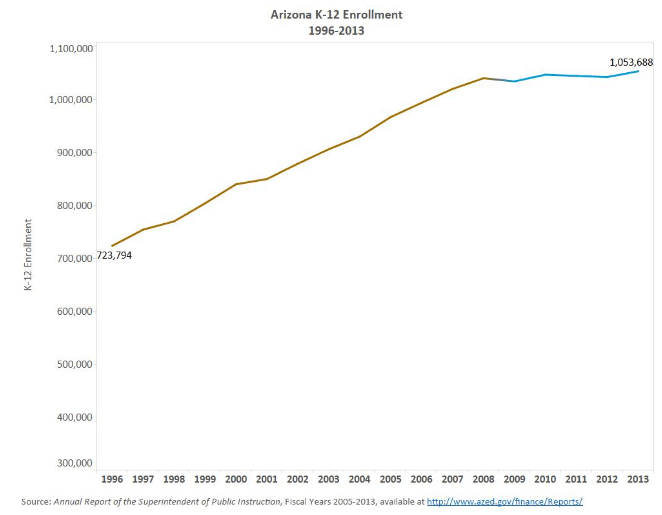
A recent look at enrollment trends for the last 17 years confirms the growth trajectory of public school enrollment in Arizona, but it also shows recent inconsistencies in that trajectory. The graphic below shows the total K-12 enrollment in Arizona from 1996 to 2013.  Over this period of time, enrollment swelled from 723,000 to 1.05 million students, an increase of 46 percent. For most of that time the growth was consistent— increasing by about 2 to 4 percent each year. However, starting in 2009, the state’s student enrollment begins to fluctuate. The decreases are small—6,000 fewer students in 2009, 2,300 fewer students in 2011, and another 2,000 in 2012—but potentially significant. The rate of growth did not just slow down in some years, but the number of students decreased for the first time in at least 13 years.

April14BlogPic

Given the year after year of growth prior to 2009, the first question that comes to mind is, “What happened?” The economic recession is a plausible explanation. So too may be the anti-immigrant policies which began in 2007. Without more detailed population and student demographic data, along with economic measures, such as Arizona’s gross domestic product, foreclosure or unemployment rates, we cannot answer this question.

The second question we asked ourselves is, “Why does it matter?” It matters to the state because our economy has relied heavily on growth. And it matters to schools, in particular, because school funding is based on student enrollment and it is provided to schools on a “per pupil” basis. Not only did public schools see a dramatic decline in resources due to the economic recession, they also saw a decline in resources due to the loss in enrollment.

No one expects Arizona to decrease in population or students in public schools over the long term, even when taking into account the fluctuations in recent years. At worst, we will not grow as much as we once believed. The National Center for Education Statistics’ 2011 report, projected that Arizona would grow by 26% from 2008 to 2020 (using actual enrollments through 2008) but adjusted the projection to 20% by 2021 when it incorporated actual enrollments through 2010.

However, short term fluctuations in enrollment—even relatively small ones—can still have a significant impact, particularly if they occur only in certain parts of the state or affect only certain school districts or groups of students. The Association will look at more detailed enrollment information, along with other demographic and economic indicators, to understand better “what happened?” and determine whether these fluctuations vary across the state or among groups of students.

Categories
Education Blog

Do You Know How Many Third Graders Will Fail?


If an eight-year-old child fails Arizona’s reading test on April 7, Arizona law requires that child to repeat third grade[i].  If 2014 AIMS results are consistent with 2013, then up to four percent of our third grade students will be retained, according to the Arizona Department of Education[ii].  That means about 3,359 children will be told before their ninth birthday that they cannot move on to fourth grade with their friends and peers.

So as a parent or governing board member, how many students in your school are affected?  Here are questions to ask:

Parents should be asking the school’s administration:

  1. Is my child on track to pass the AIMS test this year?
  2. If not, what interventions are you trying and how do you know they are working?
  3. What can I do at home to help?

Governing boards and concerned community members should be asking the administration:

  1. How many students are at risk for failure?
  2. How many are eligible for “good cause” exemptions?
  3. How do these data vary by school in our district?
  4. Which students are most at risk?
  5. What are we doing to prevent this? How do we know it is working?
  6. How are we working with parents to communicate this information and support their children?
  7. What can I do to help?


[i] http://www.azleg.gov/ars/15/00701.htm
[ii] http://www.azed.gov/research-evaluation/aims-assessment-results/
Categories
Association Blog

Charter School Participation in State Retirement Systems

The Issue

Allowing Arizona charter school employees to participate in the state retirement system was a decision made by the Arizona legislature in 1994. Now, the Internal Revenue Service wants to prohibit Arizona from allowing our 12,000 current and former charter school employees in the state retirement system.

The IRS, a bureau of the Department of Treasury, proposed regulation that would force charter employees enrolled in state retirement system to either leave their charter schools or lose their accrued pension wealth. We cannot allow these regulations, listed as “Determination of Government Plan Status,” to be adopted in their current form.

The regulations proposed by the IRS are part of the rule making process, which are not subject to a vote by Congress and are not legislation. Instead, they’re required to use their expertise and experience to come up with the best policies. The public can comment on the proposed rules, which is where we are now. The Treasury extended the deadline for public comments on the proposed rule from February 6 to June 18, 2012. They held a hearing on the rule on July 9, 2012.

Updates

July 11, 2012 — The IRS held a public hearing on Monday, July 9 to discuss the potential regulation change that could affect 95,000 public charter school employees nationwide. The National Alliance for Public Charter Schools and two other state charter associations testified in support of charter employees. Although the proposed regulation doesn’t specifically mention charter schools, it describes entities a lot like charter schools and excludes them from state retirement systems. We want the IRS to incorporate our suggestions to into the next round of their drafts, ensuring charter employees are still allowed to participate in state sponsored retirement systems. After the next draft is released, there will be another public hearing. The IRS is only in the preliminary stages of this process, and it could take years before the proposed regulations become official.

March 8, 2012 — Issues regarding the Internal Revenue Service’s proposed regulation affecting charter employees participating in state retirement systems continue to unfold. Thank you for engaging your congressional delegation on this issue – you and your charter school communities are being heard! Due to your grassroots action in sending messages to Congress and Administration officials, we have several significant victories, including:

  • On Thursday, March 1, 17 members of the U.S. House of Representatives sent a bipartisan letter to IRS Commissioner Doug Shulman, embracing our concerns and urging the IRS to adopt our position.
  •  Education Sector issued a report titled, “A Legal Guide to State Pension Reform.” Although the report is not specific to charter schools, it details how laws protecting state pension benefits vary dramatically from state to state. Please review this report to understand how Arizona’s laws may or may not protect charter employees’ retirement wealth, should modifications to existing plans happen (either because of the IRS draft Proposed Regulations or because of political pressure to reform state pension plans).
  • Through your efforts, over 1,200 people have sent nearly 6,600 emails. Across the nation over 43,000 emails were sent.
  • The Internal Revenue Service extend the public comment period until June 18, 2012 and said in a statement that public charter schools were not intended to be impacted by the draft proposal.

The Treasury Department and Internal Revenue Service have confirmed that our messages have had a direct effect on the extension of the public comment deadline. The tens of thousands of emails sent via the Association and other charter organizations allowed our concerns to be heard and produced a positive reaction for the charter community. At this point, the threat appears minimal to charter employees; however, this issue is far from resolved or decided, and we must remain diligent, informed and involved.