Categories
Association Blog

PPEP Tec: Arizona’s Oldest Charter School Serving At Risk Students

Year Founded: 1995
Students Served: 5,800 students at seven campuses and online education programs
Grades Served: 9-12
Location: Tucson, Douglas, Sierra Vista, Somerton, Casa Grande, San Luis
Website: www.ppeptechs.org

[pextestim pex_attr_set=”ppep-tec” pex_attr_autoplay=”false”][/pextestim]

Categories
Association Blog

Ask a Lawyer – 2016 Legal Week Podcast

[pexvimeo pex_attr_src=”https://vimeo.com/165099257″][/pexvimeo]

As part of the Arizona Charter Schools Association’s 2016 Legal Week, we are featuring a new podcast titled, “Ask a Lawyer,” where Osborn Maledon attorney Lynne Adams answers questions submitted by charter school leaders. Don’t miss this fun and informative feature moderated by Association trainer, Andrew Nelson.

Watch our podcast and find answers to the following five questions submitted by Arizona charter school leaders:

  1. Many charter schools received a records request email from American Transparency on April 17. Do they have to respond, and if so, what advice do you have about the response?
  2. What documents must be provided in response to a public records request? Are email and voicemail messages public records?  Does it matter who sent or received them (board members, teachers, or site leaders, for example)?
  3. What obligations does a school have to maintain records, including student records and diplomas?
  4. Are charter schools considered “political subdivisions” of the state, and if not, why not? Wouldn’t that be better for schools and allow them to get more funding and generally create a more equal playing field?
  5. When a student designs a robot or part of a robot for a class or a school club, does the school or the student have rights in the design?
Categories
Education Blog

FROM POVERTY TO POLICY: FREE AND REDUCED LUNCH POPULATIONS IN ARIZONA

The Association reviewed the poverty rates of Arizona students over the past six years, and we found that a greater percentage of students are enrolled in schools with higher concentrations of poverty.

In addition to a statewide analysis, the Association analyzed the results by school type (charter/district). The most striking difference between the two groups is the disparity in the percent of students who are enrolled in a school with no free or reduced lunch (FRL) data.

Introduction

There is near universal agreement that students from low income families are more likely to struggle to meet and exceed academic expectations in school. Challenges such as the lack of resources at home, home or food insecurity, lack of books and other learning tools, and stressed or unavailable parents, can all contribute to educational difficulties of impoverished students. The National School Lunch and Breakfast Program exists to mitigate the effect of hunger on learning[i]. For the 2015-2016 school year, a student whose family income falls below 130% of the federal poverty line qualifies for free meals. For a family a four, the threshold is $31,525[ii].  A family of four below 185%, or $44,863, qualifies for reduced-priced meals.

The Analysis

Although not a perfect measure of poverty, the percent of students in a school who qualify for the FRL program is the only proxy currently available to measure the level of poverty and corresponding instructional needs in a school. The Association used FRL data available through the Arizona Department of Education[iii] to analyze the distribution of students living in poverty among Arizona schools and changes in the distribution from 2010 to 2016.

The figure below shows the distribution of Arizona’s students eligible for free or reduced-priced lunch in 2010 and 2016.  Each bar represents the percent of total student enrollment in the given FRL range. For example, in 2010, 3.8% of all Arizona students were enrolled in a school with 0 to 9% FRL; in 2016 that percent was about the same (3.7%).  The concentration of poverty in a school is demonstrated by the percentage of students eligible for FRL enrolled in the school.
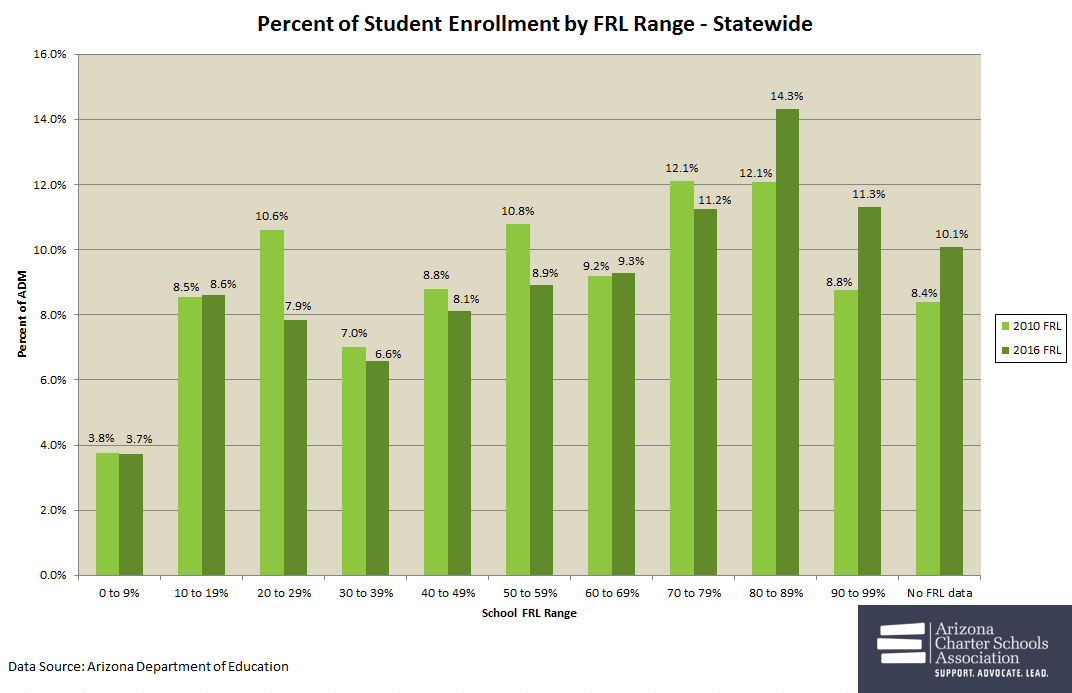
The degree of poverty increases from left to right; therefore, the farthest range – 90 to 99% – represents the most concentrated poverty, where nearly all students are eligible for assistance. The exception is the rightmost bar, which indicates the percentage of students enrolled in a school that does not have FRL data. Schools that do not participate in the program do not generate any data. There are varied reasons why a school might not participate in the program and exploring those reasons is outside the scope of this blog; here we will focus our attention on the trends for those schools that do report.

Statewide, we can detect a shift of the distribution to the right, meaning that a larger percentage of students are enrolling in schools with higher concentrations of FRL students. Beginning with the low-poverty schools, both the 0 to 9% and 10 to 19% schools have a relatively unchanged percentage of students.  Schools saw declines in the percentage of students they enroll in the 20 to 29%, 30 to 39%, 40 to 49%, and 50 to 59% ranges. These students moved to the right of the distribution, into the 60% or more ranges. Combined, schools with 50 percent or more of their students eligible to receive FRL enrolled 53 percent of Arizona’s student population in 2010 and 55 percent in 2016.

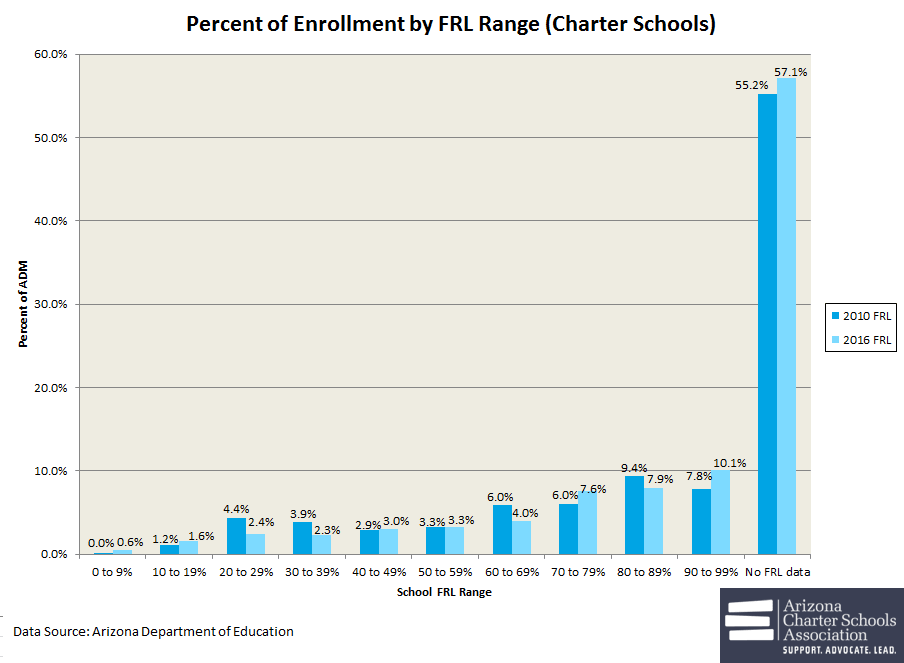
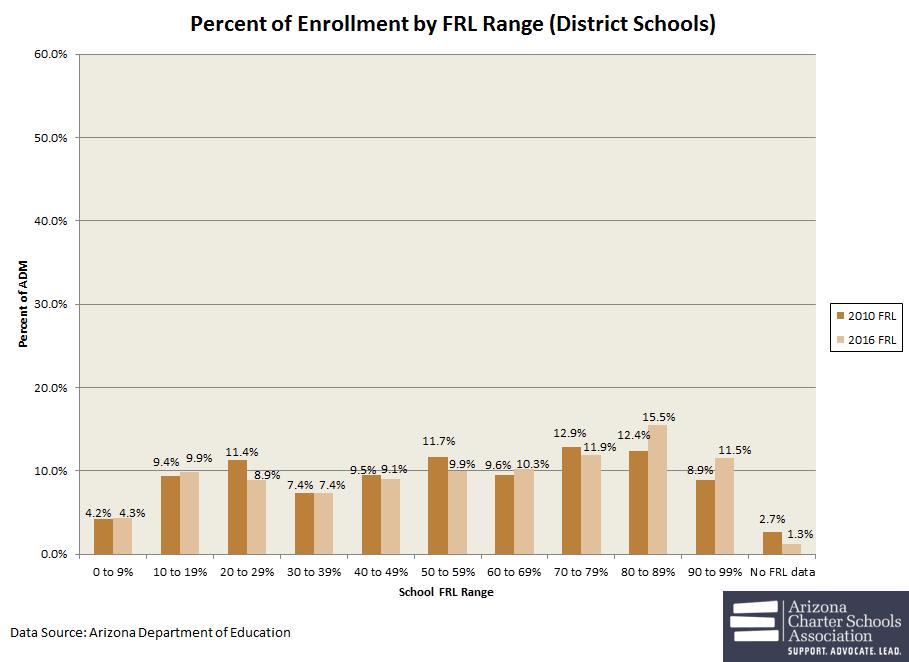
In addition to a statewide analysis, the Association analyzed the results by school type (charter/district). The most striking difference between the two groups is the disparity in the percent of students who are enrolled in a school with no FRL data. As shown below, a majority of charter students are enrolled in a school that did not report FRL data in 2010 or 2016, however, very few students in district schools are enrolled in a school with no FRL data.

Given that FRL information for over half of the students enrolled in charter schools is not available, charter results must be interpreted very cautiously. For those charter schools that do report FRL data, the distribution is moving slightly to the right. In 2010, 32 percent of charter students were enrolled with 50 percent or more FRL; in 2016, this grew to 33 percent.

The results for districts schools are consistent with the statewide trend. From 2010 to 2016, a greater percentage of students are enrolled in schools with higher concentrations of poverty, despite variability in the individual ranges. In 2010, over 55 percent of district students were enrolled in schools with 50 percent of more FRL; in 2016, this grew to 59 percent.

The Implications

Higher levels of poverty in our public schools translate to higher demands of our educators and on our limited resources. If the challenges to students and demands placed on schools increase as overall resources decrease, then the challenge for schools is multiplied. Recruiting and retaining high quality teachers, for example, becomes even more difficult at the same time that the need for them becomes even more critical to student success.

As the state looks to revamp its school accountability and funding systems, the relationship between poverty and measures of achievement must be properly addressed. School accountability labels that can be largely predicted based on the FRL rate do a disservice to the very schools with the biggest challenges[iv]. Our state funding and accountability policies should reflect the real challenges presented to schools serving students in poverty.

Additionally, any policy that takes poverty into consideration must examine how to deal with the significant lack of FRL data in the charter sector. This may include the need for additional data collection or information gathering before a policy can be effectively and appropriately implemented.

A Note on Data

Although determining why charter schools do not participate in the National School Lunch and Breakfast Program is outside of the scope of this blog, finding out the reasons may be important as the state moves forward with its K-12 funding revamp.

Footnotes/References

[i] http://www.azed.gov/health-nutrition/nslp/
[ii] https://www.gpo.gov/fdsys/pkg/FR-2015-03-31/pdf/2015-07358.pdf
[iii] http://www.azed.gov/health-nutrition/frpercentages/
[iv] See the Association’s paper, School Ratings: Improving the Data in Data Driven Decision Making, for a full explanation and recommendations.
Categories
Association Blog

Desert View Academy: Strong Academics, Growth For Families in Yuma

Year Founded: 2000
Students Served:
616
Grades Served:
K-5
Location:
Yuma, Ariz.
Website:
www.desertviewacademy.com

[pextestim pex_attr_set=”desert-view-yuma” pex_attr_autoplay=”false”][/pextestim]

Categories
Association Blog

Legal Week: DAPA and DACA

How Charter Schools Can (and Should) Engage, Empower and Serve Undocumented Families

Deferred Action for Childhood Arrivals, or DACA, provides relief to children brought to the United States illegally. DACA, announced on June 15, 2012, allows those who came to the U.S. as children to request consideration of deferred action for two years and allows eligibility for legally working in America.  Two years after DACA, President Barack Obama expanded the DACA program to parents through executive order, creating the Deferred Action for Parents of Americans or DAPA, which allows parents of U.S. citizens and permanent residents to remain in U.S..  Both DAPA and DACA will be decided in June by the United State Supreme Court.

[pextestim pex_attr_set=”obama-dapa” pex_attr_autoplay=”false”][/pextestim]

The Association created a handout to provide assistance to schools and information for families. Download the handout in English and Spanish below. In addition, the Association is working with experts to update schools and their families once the decision is made by the United States Supreme Court in June.

Download the English Version

Descargar la versión en Español

Categories
Association Blog In the News

Arizona’s Proposed Budget and What it Means for Charter Students

The FY2017 budget is now underway in Senate Appropriations while the House continues work on its budget. As introduced, the Senate budget bills show a cut to charter schools through the continuation of Small School Weight reductions for charter networks.

The Association is fervently working to freeze the Small School Weight reductions for FY17 and restore the Additional Assistance reductions taken from charter schools during the recession. Freezing the Small School Weight reductions and restoring Additional Assistance money is crucial to maintaining the strength of Arizona’s charter movement.

Here is an initial update on what is in the proposed Senate language.

Categories
Association Blog Charters Changing Lives

STAR School’s Story

The educational landscape for Native American students has changed dramatically within the last few decades, as tribes have sought to take ownership of an education system that previously disconnected them from their culture. Learn how a small Arizona charter school, which straddles the edge of the Navajo Nation, strives to interweave its academic focus with traditional Navajo values.

Here is their story.

Categories
Association Blog

Charters Support Prop 123

Public education in Arizona is at a precipice.

Arizona saw modest gains in student enrollment over the last decade with a 5.8 percent increase, but enrollment is projected to rise dramatically as our state’s K-12 population could grow by 57 percent over the next 14 years.

States with growing student populations face a variety of fiscal challenges in recruiting and retaining the necessary workforce, and in providing the physical space to house students, according to the Foundation for Excellence in Education.

So how do we begin addressing Arizona’s K-12 funding challenges?

Proposition 123.

Prop 123, which is on the ballot for Arizona’s May 17 special election, adds funding over the next 10 years to K-12 education and settles a funding lawsuit between the legislature and public schools. The settlement includes money from the general fund and increased distributions from the State Trust Land, which exists to support public education.

The Arizona Charter Schools Association strongly supports Prop 123. Our members overwhelmingly voted to donate $10,000 to support Prop 123 on behalf of Arizona’s charter schools and students. In addition, we have created a neutral fact sheet, vetted by an education attorney, to help our members get out the word about Prop 123.

Registering voters is permissible for schools, and the last day to register is April 18.  Please spread the message and visit www.arizona.vote to register.

Association President and CEO Eileen B. Sigmund wrote this letter, which was originally published in the Association’s monthly e-newsletter on Thursday, April 7, 2016. Read the full newsletter here.

Categories
Education Blog

Oh, the Places They’ll Go: Charters and County Choice

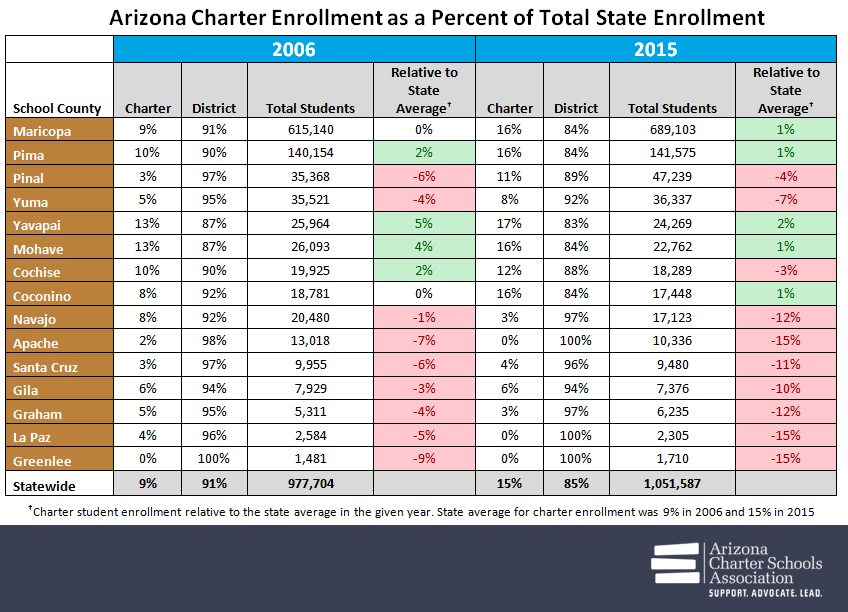
Arizona charter student enrollment has increased from nine percent of all Arizona students in 2006 to 15 percent of students in 2015, an increase of nearly 74,000 students.  Given the significant growth in the charter sector, most counties saw an increase in the total number of students enrolled in charter schools. However, not all counties grew their charter populations at the same rate.

The table below summarizes district[1] and charter school enrollment in each county, sorted by county enrollment size, from largest to smallest.

Since enrollment trends in charter schools parallel county enrollment trends to some extent (see our March blog), one might expect that county size would impact charter enrollment, i.e., counties with fewer students enrolled would have fewer charter schools and vice versa.  However, this doesn’t appear to be the case across Arizona.

Take for example Cochise and Coconino Counties, two mid-sized counties with total student enrollment just under 20,000. Despite similar total enrollment in both years, Coconino County saw significant growth in charter enrollment by doubling its charter student enrollment to 16 percent. At the same time, Cochise County saw charter enrollment increase slightly to 12 percent. Yuma County, however, the state’s fourth largest county, enrolls only eight percent of its students in charter schools, slightly half of the state average.

Most counties saw an increase in the total number of students enrolled in charter schools. However, not all counties grew their charter populations at the same rate. In order to gauge the rate of charter growth in each county, we calculated the difference in charter enrollment from the state average for each county in both years.

When considering relative charter enrollment, even counties like Cochise and Coconino that saw enrollment increases in the total number of students saw their relative proportion of the state’s charter enrollment impacted. Coconino County mirrors statewide charter enrollment, while Cochise County’s charter growth has been slower[2].

County Statistics:

  • Largest Percentage of Charter Students: Maricopa County – In 2015, charter students made up 16 percent of the student population of Maricopa County, slightly above the state average, similar to results in 2006. This suggests that charter growth in Maricopa County reflects statewide charter growth (given its size, this is not surprising).
  • Fastest Growth of Charter Students: Pinal County – Consistent with our March 2016 blog showing Pinal as the fastest growing county, it also has the fastest rate of growth in charters. In 2015, 11 percent of students are enrolled in charter schools, only four percentage points below the state average, compared to 2006, when only three percent of its students were enrolled in charter schools.
  • Fastest Decline of Charters: Navajo, Apache and La Paz Counties –
    • Navajo County enrolled eight percent of its students in charter school in 2006, just under the state average. By 2015, however, only three percent of students are enrolled in charter schools.
    • Apache County, charter enrollment declined from two percent in 2006 to nearly zero percent in 2015[3].
    • La Paz County now has no students enrolled in charter schools, compared to four percent of its enrollment in 2006.
  • No Charter Students: Greenlee County – Greenlee did not enroll any charter students in 2006 or 2015.

Our state school choice policies are built on the assumption that school choice and access to charter schools is desirable for all students no matter where they live in the state. These data show that such access and opportunity is not equally available to all students. This snapshot of two points in time suggests dynamics are at work within each county that either encourage or discourage enrollment in charter schools. Further work is needed to identify what those dynamics might be and whether or not these can be (or should be) addressed to provide access to choice across Arizona.

Footnotes:

[1] Joint Technological Education District enrollments are not included.
[2] Coconino’s 16 percent charter enrollment, which doubled from 8 percent in 2006, is just slightly above the state average. Cochise’s 12 percent charter enrollment, which is up from 10 percent in 2006, is still three percentage points lower than the state average charter population.
[3] The only charter school in Apache County in 2014-2015 closed for the 2015-2016 school year.

Categories
Association Blog

Parents Not Allowed to Opt Students Out of AzMERIT

AzMERIT testing has started and questions have arose regarding whether parents can opt their students out of the test, as some parents have already made that request. While it’s understandable there may be some confusion, parents cannot opt students out of AzMERIT, according to a memo issued by the Attorney General on Oct. 9, 2015.

[pextestim pex_attr_set=”parent-opt-out” pex_attr_autoplay=”false”][/pextestim]

Read the Full Opinion Here