Michael Galola faced uncertainty four years ago when both of his sons were diagnosed with autism. Find out how a Phoenix charter school was able to restore hope and ensure a bright future for the boys.
This is Michael’s story.
Michael Galola faced uncertainty four years ago when both of his sons were diagnosed with autism. Find out how a Phoenix charter school was able to restore hope and ensure a bright future for the boys.
This is Michael’s story.
Arizona’s achievement gap is among the smallest in the country and charter schools top many of the rankings.
“Education is not a one-size-fits-all endeavor. The Arizona Charter Schools Association commends lawmakers for their passage of legislation that will give public schools much-needed discretion in selecting the standardized assessment that best aligns with the school’s curriculum and the needs of its students.”
-Eileen B. Sigmund, President and CEO on the passage of HB2544
[pexnivoslider pex_attr_sliderid=”56″][/pexnivoslider]
Representing every legislative district across Arizona, school leaders turned out for ‘Charters at the Capitol’ Wednesday to discuss how charters are changing lives in their unique schools. Governor Doug Ducey met with our leaders and recognized their academic success, as Arizona charter students outperformed nearly every state on the 2015 Nation’s Report Card.
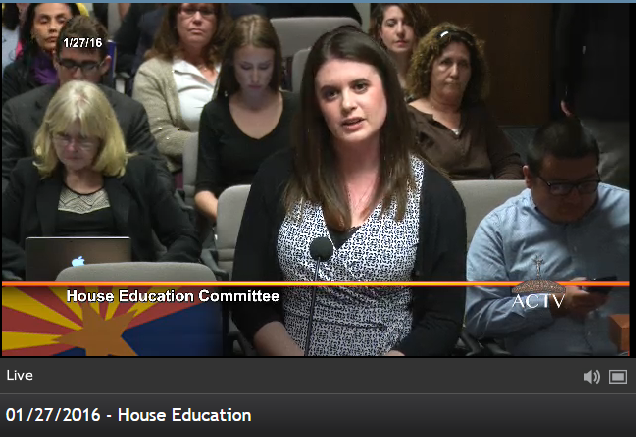
In our 130 meetings scheduled with 27 legislators and the Governor, along with my presentation to the House Education committee, we highlighted how charter students are exceeding the state average in every grade for reading and math. Charter leaders also discussed how the instability of Arizona’s K-12 funding impacted their plans to expand and serve thousands of families on wait lists.
The schools represented have diverse educational philosophies, such as STEM, Waldorf, Arts, and Socratic methods of learning. Our leaders drove from all corners of the state including Sierra Vista, Kingman, Tucson and Bisbee to participate.
With 170,755 students and 556 public charter schools, Arizona’s charter community is committed to student success and strengthening K-12 education, ensuring a vibrant Arizona.
I want to personally thank the Governor, legislators and everyone who made ‘Charters at the Capitol’ a great success.
Sincerely,
Eileen B. Sigmund
President and CEO
Arizona Charter Schools Association
The Association’s first look at statewide enrollment trends over the last nine years shows that despite the overall growth in K-12 enrollment, nine of the fifteen counties in the state have seen an overall decline in student enrollment.
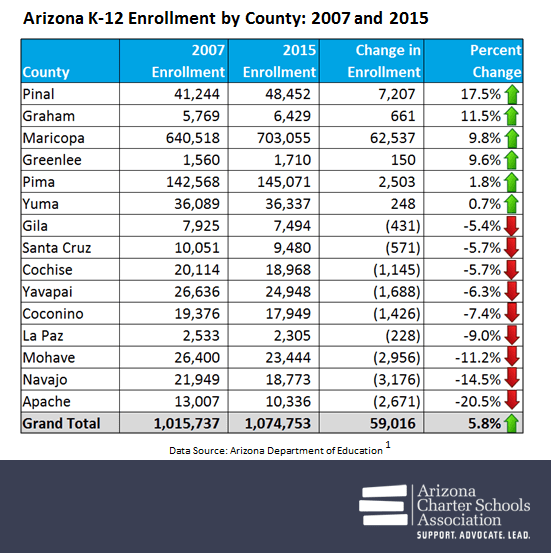
Perhaps not surprisingly, Maricopa County saw the greatest increase in the number of students, adding 62,537 students. In terms of percent change, Pinal County outpaced Maricopa County, increasing by 17.5%, or 7,207 students. Two of the state’s smallest counties, Graham County and Greenlee, also top the list of percent growth at 11.5% and 9.6% respectively.
When we consider the “percent change” column of the above table with a geographical lens, we get a clearer picture of Arizona’s enrollment patterns. The map below shows that the largest enrollment declines are occurring in the northern part of the state, with Cochise and Santa Cruz counties being the exceptions to this trend:
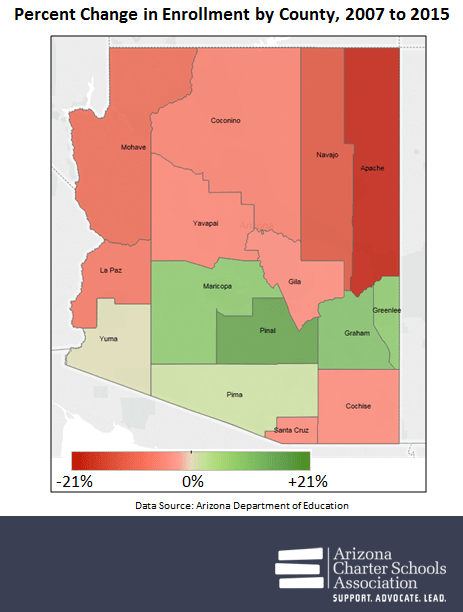
The implications of such enrollment trends are not insignificant. Statewide comparisons, independent of county-specific analyses, paint a positive, growing K-12 environment. As the overall population of students in the state increases, so does our overall K-12 budget allocated from the state’s general fund. However, simply evaluating statewide trends provides an incomplete picture of student enrollment trends that may result in ineffective policy decisions. Evaluating these data by county is pivotal in understanding how enrollment has changed across our state. For example, the declining enrollments in rural counties result in declining school and district budgets, making it even more difficult to find qualified teachers in these counties. Also, as enrollment increases in Maricopa and Pinal Counties, the demand for school facilities will grow while at the same time buildings in Northern Arizona become underutilized.
It is clear from these data that student enrollment patterns vary significantly by county and this will likely complicate future discussions regarding budget, facilities and access to high quality schools. Arizona’s education policy discussions should not assume enrollment growth is occurring statewide. Instead, policymakers would benefit from reviewing differing enrollment patterns across different parts of the state and consider the impact on proposed policies.
Educators have the ability to inspire students to think beyond their school walls, and Mission Montessori Academy has made that their mission.
The K-8 charter school in Scottsdale provides a global education, even sending students to New York City, Chile and China to attend conferences and discuss methods for conserving resources and protecting the environment.
Emboldened by their teachers, a group of seventh-graders have taken a local approach to solving problems and raising awareness of these issues, hoping to change the lives of their community for generations to come.
The students have created their own Non-Governmental Organizations (NGOs) dedicated to creating a more sustainable environment and helping to influence the lives of those in their communities.
Here are their stories.
Arizona has again demonstrated that we are a state invested in increasing quality choice for students.
On Monday, the Arizona State Board of Education unanimously approved Charter School Program grant funding for the creation and expansion of 11 charter schools serving disadvantaged students. The majority of the applicants were supported by New Schools For Phoenix, a non-profit whose mission is to support the development and expansion of high quality schools serving low-income students in the Phoenix urban core.
Arizona was one of only eight states to receive the highly competitive $23.6 million federal grant to increase the number of high quality schools available to disadvantaged students. This year’s $7.5 million grant allocations will help these charter schools grow to serve over 5,000 students.
The Association was an integral part to ensure Arizona would be eligible for the federal grant. During the 2015 legislative session, the Association worked with lawmakers to consider progress towards academic performance expectations as one of the most important factors in determining charter renewal. This accountability measures was a deciding factor for the U.S. Department of Education’s grant award to Arizona.
This year’s awardees include:
“Charter students are beating state averages at every grade level. Beyond the data, charters are changing lives and giving students and families a world of new academic options.”
-Eileen Sigmund, Association President and CEO
Phoenix Business Journal 2-16-16
Education remains a priority for politicians and voters, with lawmakers sending Prop 123 to the ballot, polls showing education as a top issue and the usual spate of education bills circulating through the State Legislature this session.
With education at the forefront of policy discussions, the House and Senate Education Committees have made it a priority to highlight some of the positive happenings in Arizona’s schools.
For the last few weeks, Education Committee Chairs Rep. Paul Boyer and Sen. Sylvia Allen have invited teachers to share their experiences in Arizona’s public education system with committee members.
And charter teachers have led the way.
During the Great Recession, Arizona shifted from a K-12 funding system primarily supported by the state, to one where local taxpayers provided a larger share of those revenues. The fact that the amounts from all of these local sources vary by school district, sometimes quite significantly, and that charter schools do not have access to many of these sources, makes bonds and overrides problematic for many education stakeholders. This blog post will address bonds and overrides and provide context on the inequities for students as reliance on local funding has increased.
Bonds and overrides are only two of the multiple sources of revenue that fall under the “local” category of school revenue sources. Others include: the local portion of the state equalization formula, small isolated district funding, desegregation funding, adjacent ways, public school tax credits, and any other money raised locally by the district through donations or fees. Bonds and overrides make up the biggest share of these, second only to the local portion of the equalization formula.
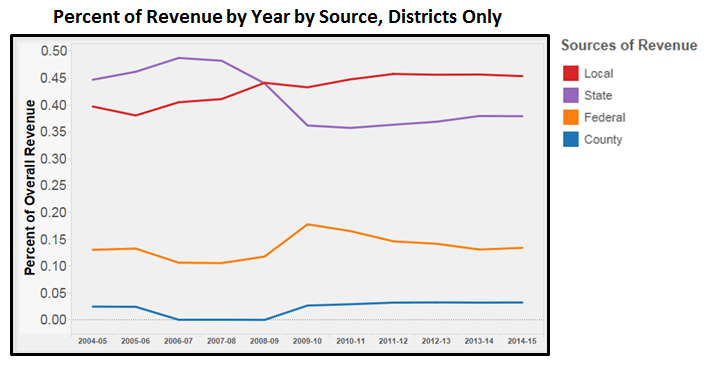
The Arizona Department of Education released in January the Annual Report of the Arizona Superintendent of Public Instruction, Fiscal Year 2015[1]. Page six of Volume I offers a ten-year breakout of the sources of revenue for education; below is a graphical representation of that same information (“county” and “intermediate” source categories have been combined for presentation).
The fact that the amounts from all of these local sources vary by school district, sometimes quite significantly, and that charter schools do not have access to many of these sources, makes bonds and overrides problematic for many education stakeholders. The state has come to rely more heavily on the local school districts to fund a portion of our public education system which poses a challenge to “fixing” the inequalities local funding sources create between communities.
The above graph shows clearly that the 2008-2009 fiscal year represented a shift from a funding system where the state provided the largest share of revenues for districts to one where local taxpayers provided the larger share of those revenues. This was likely precipitated by the Great Recession and the state’s budget shortfalls to follow, but while both the federal and county shares have returned to pre-recession levels, the state/local shift has remained in place.
Starting in 1980 and prior to the Students FIRST Act of 1998, schools relied on “Class A” bonds to fund large capital projects such as the construction of new buildings, or the purchasing of school buses or furniture. Class A bonds required voter approval, because they were accompanied by an increase in property taxes. School districts could ask voters within their district for permission to sell bonds up to a maximum of 15% of the district’s secondary assessed value , and unified school districts could ask for a maximum of 30% of the secondary assessed value[2].
When the Arizona Supreme Court deemed this practice unconstitutional in the 1994 ruling Roosevelt v. Bishop, on the basis that it allowed “property rich” districts to tax at higher rates to produce more financing dollars than their “property poor” counterparts, change was afoot. Lawmakers proposed two possible systems, which were both rejected by the Court, before the Legislature successfully enacted the Court-approved Students FIRST Act of 1998.
Among other things, Students FIRST changed the way that school bonds worked in Arizona. As of December 31, 1998, all future voter-approved bonds were to be known as “Class B” bonds, and carried with them the following restrictions:
The legislation also established the School Facilities Board (SFB), which was charged with setting facilities standards for all schools, and overseeing the funds that were distributed to schools to meet these standards. The SFB was (and is) funded by the state General Fund, and the influx of state dollars into district schools’ capital outlay finance equation was the justification for the newly-lowered local debt limits.
The debt limits remained at 5% for elementary and high school districts and 10% for unified districts until 2013, when the limits were raised to 10% and 20%, respectively[4]. Today, school districts are still subject to the 10%/20% debt maximums when considering whether or not to ask voters for bond approval. Bonds may be issued any time within 10 years of voter approval[5].
A second form of voter-approved funding comes in what are called overrides. Much like bonds, overrides are financed by a raise in local property taxes, and are also used to fund special purchases and programs that schools would like to implement, but that are not covered by the state-provided budget. Most overrides expire after seven years, with the first five years consisting of full budget override funding, and the final two years acting as “phase out” years. Many school districts return to the voters in year 5 of an override to ask for a renewal, thereby eliminating the phase-out years, to keep funding at full budget levels.
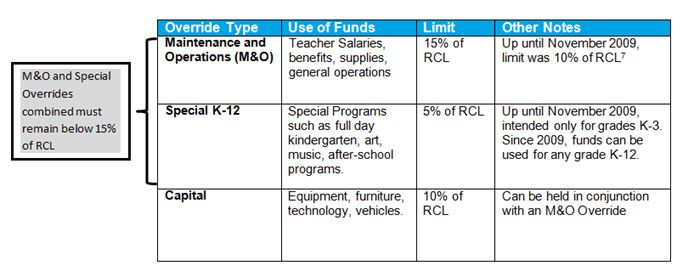
There are three types of overrides: Maintenance and Operations (M&O), Special, and Capital.
All three types of overrides come with their own sets of restrictions – the limit, which is calculated as a percentage of a school’s revenue control limit (RCL), what the money can be spent on, etc. A district may have all three overrides at one time, though many districts choose to lump the Special Override in with the M&O override, since they cannot exceed 15% combined.
The following table summarizes these attributes:
[1] http://www.azed.gov/finance/reports/#SafrTop
[2] Arizona Revised Statute, §15-1021(A)(C)
[3] Laws 2009, 3rd S.S., Ch. 12, §38
[4] Laws 2013, 1st S.S., Ch. 3, §35.
[5] Arizona Revised Statute, §15-1021(E)
[6] Laws 2009, 3rd S.S., Ch. 12, §§ 11-12
[7] Laws 2009, 3rd S.S., Ch. 12, §§ 11-12
