Categories
Association Blog Press Releases

And the Survey Says…Education a Top Priority for Legislative Candidates

Nearly 9 in 10 candidates running for the Arizona Legislature – 87 percent – say they rank K-12 education as their first or second priority. That’s according to legislative candidates who responded to a new survey distributed by the Arizona Charter Schools Association.

The Association, a non-profit advocacy organization for public charter schools, asked all Arizona legislative candidates to participate in a survey that sought their perspectives on public education.

The survey posed a dozen questions to candidates on a variety of topics related to public schools, both charter and district. You can find a complete list of questions and survey results here.

Categories
Education Blog

THE CONUNDRUM OF MEASURING SCHOOL QUALITY: RAISE ACHIEVEMENT OR CLOSE THE GAP?

Results of the 2015 AzMERIT testing data show that students in charter schools consistently outperform students in district schools, across all racial and ethnic groups. But does the higher student achievement lead to a closing of the achievement gap between different groups of students? The Association’s analysis shows that the differences in achievement of student subgroups within charter schools actually serves to widen the already large achievement gap.

CHARTER AND DISTRICT DEMOGRAPHICS[1]

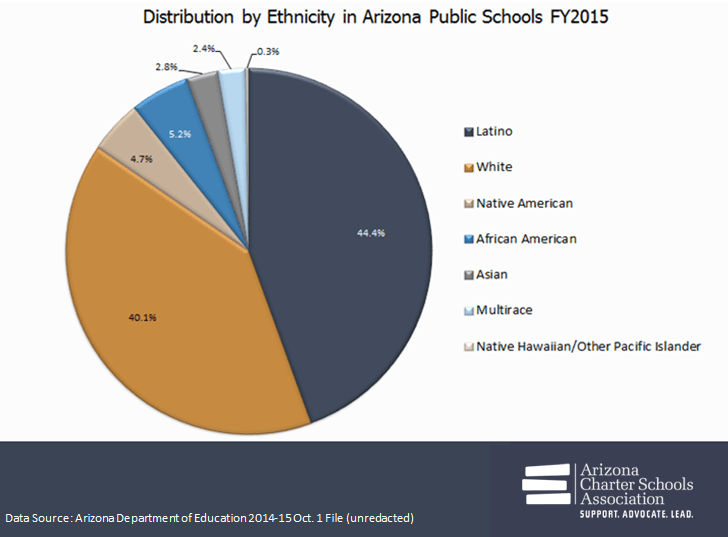
Figure 1 shows the racial and ethnic composition of all Arizona public schools during the 2014-2015 school year.  Latino students comprise the largest group (44 percent) in the state, followed by White students (40 percent). The next largest group, African American students, is only slightly above five percent of the state, followed by Native American enrollment at slightly below five percent, with all other groups reporting fewer than five percent each.

FIGURE 1: DISTRIBUTION BY ETHNICITY IN ARIZONA PUBLIC SCHOOLS FY2015

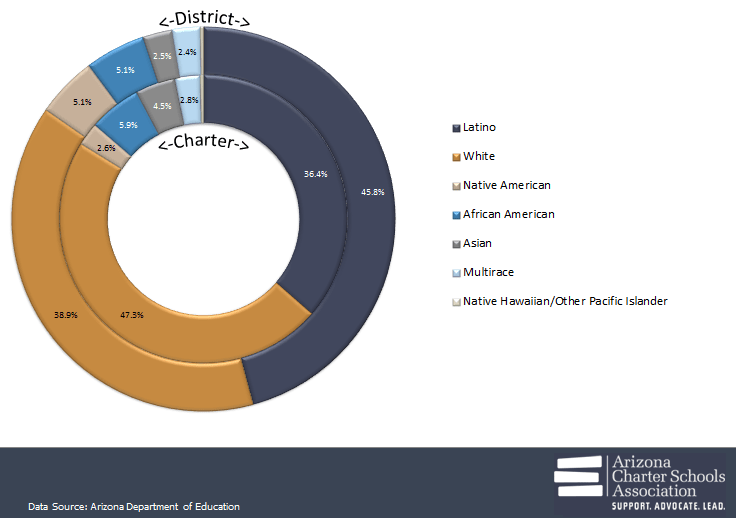
Figure 2 illustrates notable differences in the composition of district and charter school students. Charter schools serve a larger share of White students, 47 percent compared to 39 percent in district schools. Charters also serve a larger share of Asian and African American students than district schools. Conversely, charters serve a smaller share of Latino students, 36 percent compared to 46 percent in district schools, and a significantly smaller share of Native American students.

FIGURE 2: DISTRIBUTION BY ETHNICITY IN DISTRICT AND CHARTER SCHOOLS

These data suggest that White, Asian, and to a smaller extent, African American families are more likely to choose charter schools than other students and families.  When evaluating these students’ overall academic performance, this decision appears to pay off.

AzMERIT RESULTS – THE CHARTER ADVANTAGE

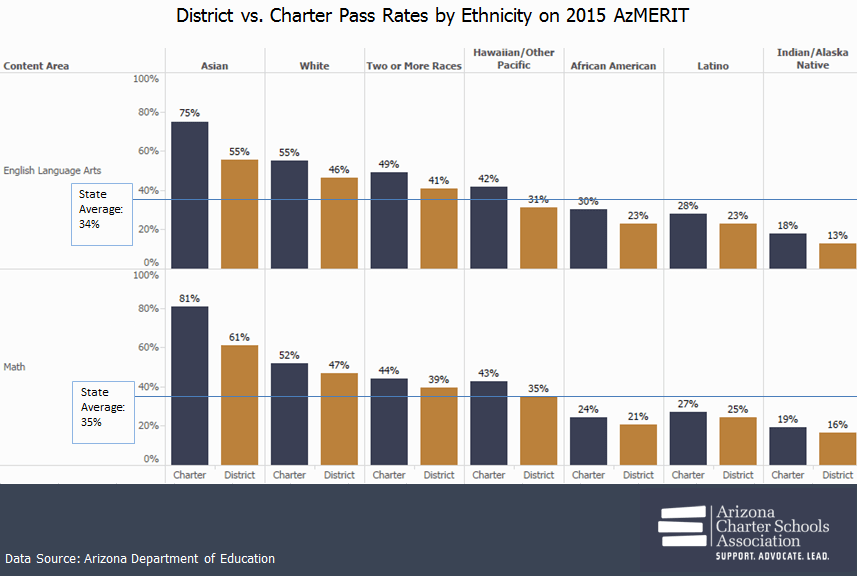
The figure below (Figure 3) shows the percent of students passing the AzMERIT exam in 2015, broken out by school type (district or charter) and student subgroup. These data combine the passing rates across grade levels in English Language Arts (ELA) and Math.  In both content areas, charter students in all subgroups have higher passing rates than their district counterparts.  These data demonstrate that charter schools are providing increased academic outcomes for the students enrolled – at least for the 2014-15 school year. For Arizona charter schools this is good news, given that a charter, by definition, is a contract to improve student achievement.

FIGURE 3: DISTRICT VS. CHARTER PASS RATES BY ETHNICITY ON 2015 AzMERIT

The charter advantage—the difference between charter and district performance—is particularly large for Asian students, a relatively small group of students in both sectors.  Charter schools enroll a significantly higher percentage of Asian students than district schools and provide a 20 point pass rate advantage over district schools in both ELA and Math. The charter advantage for White students is also significant, nine points in ELA and five points in Math.  We see a similar charter advantage for students from two or more races and Native Hawaiian/Pacific Island students.  These four groups of students account for over 55 percent of charter enrollment; they are all scoring above the state average in ELA and Math and their results help explain charter schools’ overall performance.

Latino, African American, and Native American students also see a charter advantage, but a somewhat smaller one. Despite the gains experienced in charter schools, none of these groups perform at or above the state averages in ELA or Math.

AzMERIT RESULTS – THE ACHIEVEMENT GAP

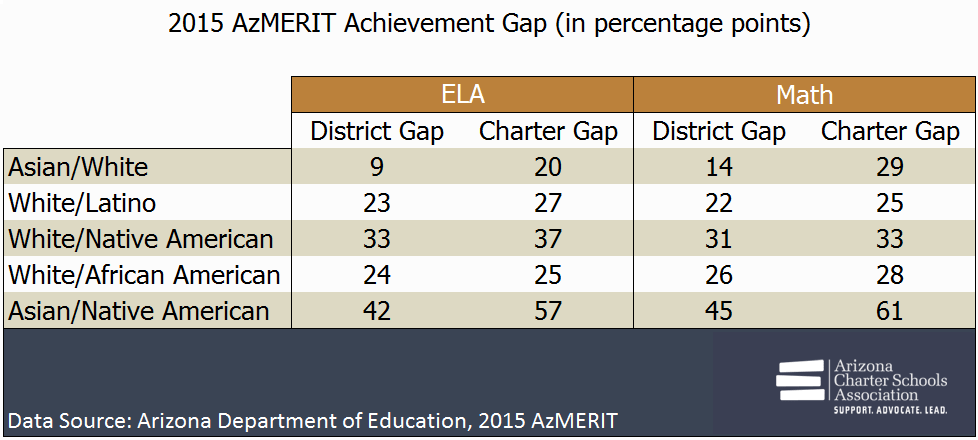
The initial results indicate there is an achievement gap between districts and charters – where overall charter students are outperforming their district peers.  The Association also wanted to investigate achievement gaps between subgroups of students within charters and districts.  The table below shows achievement gaps within charters and districts for each of the major subgroups of students, in both ELA and Math.

For example, the ELA Asian/White achievement gap (the difference between the passing rates for these two subgroups in ELA) in charter schools is 20 percentage points compared to 9 percentage points in district schools.  This means that the passing rate for Asian students in charter schools is 20 percentage points higher than their White charter peers, whereas Asian students in district schools outperform their White district peers by only nine percentage points.

FIGURE 4: ACHIEVEMENT GAP BY RACE/ETHNICITY AND SCHOOL TYPE

The most striking finding in this analysis is the relative size of the achievement gaps between subgroups, regardless of school type. With only two exceptions, all gaps are at least 20 percentage points.  Of all groups, Native American students have the lowest performance in both ELA and Math, and have the widest achievement gaps compared to their peers. The Asian/Native American gap shows the size of the extremes.

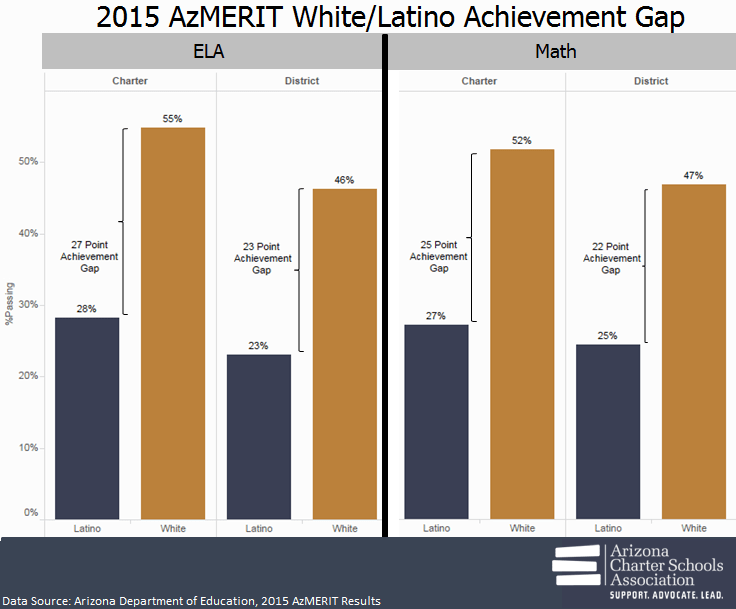
White and Latino students represent the two largest groups in the state and their achievement gap is illustrated in the figure below. Since the charter advantage for White students is greater than it is for Latino students (see Figure 3), the size of the achievement gap is greater in charter schools than in district schools.

FIGURE 5: WHITE/LATINO ACHIEVEMENT GAP BY SCHOOL TYPE


IMPLICATIONS

Policy makers are beginning to contemplate school accountability measures to evaluate the quality of Arizona’s public schools.  The new A-F formula will include a combination of proficiency and growth measures.  These data suggest that charter schools are likely to fare well in the overall evaluation when proficiency rates are compared to their district counterparts.  The new A-F system must also integrate federal requirements to evaluate subgroup performance on AzMERIT and other indicators of school quality. The evaluation of achievement gaps in subgroups is a critical component in the identification of schools for targeted and comprehensive support (federal intervention).  These data suggest that charter schools are likely to fare worse in the evaluation of achievement gaps, despite their overall higher performance.

In addition to accountability implications, these data raise questions about overall academic performance of student subgroups and ways that schools can close achievement gaps that exist among them.  Clearly, the answer is not to reduce the rate at which Asian and White students are performing in schools.  Rather, there needs to be a focus on replicating that same, or greater, performance for other student groups across all public schools.

FOOTNOTES/REFERENCES

[1] The Association used 2015 AzMERIT data for all public schools to evaluate their performance.  The AzMERIT data provided were unredacted, through a research agreement with the Arizona Department of Education; these data included details for small schools and student groups that are not available in the publicly released data file.  The demographic data included in these analyses were obtained from the October 1 Enrollment file for 2014-2015 (unredacted).
Categories
Education Blog

WILL THE PUBLIC HAVE A SAY IN ARIZONA SCHOOLS’ NEXT ACCOUNTABILITY SYSTEM?

Rating Arizona’s 2,015 public schools with a label of A-F helps the community identify the quality of the school.  Letter grades were assigned from 2012-2014 and suspended in 2015 and 2016 as Arizona students transitioned to a new statewide test.  Letter grades are based, in part, on how students perform on Arizona’s statewide test.

To grade schools in 2017, the Arizona Department of Education asked the community to participate in a Request For Information on the new A-F system’s components and methodology. However, in order to respond to 45 questions, the public must have extensive technical knowledge.  Thus while the Department of Education is attempting to solicit feedback from the public, the unintended consequence is likely to be greater exclusion of all stakeholders.

Further, anyone submitting a response to the 45 questions in the Request For Information is excluded from participating as a technical or policy advisor during A-F methodology discussions.

Public Engagement

In 2014, the State Board of Education developed the A-F School Accountability Principles of Agreement[1] in preparation for the development of the new A-F formula.  These Principles were created collaboratively with stakeholders and advocates to ensure the newly developed system aligned with the Board’s philosophical, technical and implementation expectations.  In part, the Principles state:

“A coalition of technical and policy stakeholders must be consulted to create, evaluate and refine the methodologies used in the achievement profile to ensure transparency, feedback from the field and community, and compliance with Agreements.”

Additionally, the Every Student Succeeds Act (ESSA)[2] requires meaningful stakeholder participation in the development of the state’s accountability system.  In the past, the Arizona Department of Education utilized technical advisors to support the development of accountability concepts, indicators and methodologies; they focused outreach efforts to school personnel through presentations and targeted communication strategies, and the general public had access to materials once they were available for presentations to the State Board of Education.  In response to these newly stated expectations for increased public engagement the Department released a Request For Information (RFI) for Arizona School Accountability Components and System[3] to solicit stakeholder opinions and feedback.  On the face of it, this new RFI process should yield more opportunities for broad stakeholder engagement in the development of the A-F accountability system.

Unintended Consequences

However, the purpose statement of the RFI strays from this goal.  It states “this RFI solicits feedback from interested parties with any relevant expertise, systems or methodology they have developed or conceptualized which meet the intent of any of the components described below” (page 2). This language, “relevant expertise”, is likely to alienate the general public and exclude them from the process altogether. If the purpose statement doesn’t scare the public from responding, the introduction might.  It makes it clear to the reader that responses should be framed within the new ESSA requirements, A.R.S. § 15-241, SB 1430, State Board’s Principles of Agreement, Superintendent Douglas’ plan as well as other historical documentation.  While the RFI states that respondents are invited to respond to one, any or all of the 45 questions contained – the sheer magnitude of the document is likely to limit responses.

So then, it would seem that the RFI is really designed to solicit responses from the State Board’s coalition of technical and policy advisors. The technical advisory group is made up of individuals who represent a variety of education stakeholders; large and small districts, charter schools, online schools, alternative schools, etc. The policy advisors include the business and philanthropic communities as well as advocacy organizations. These groups represent individuals who have relevant expertise, have likely developed or conceptualized systems or methodologies, and have knowledge of the pertinent statutes and requirements described. Many of the Board’s advisors have also historically provided technical assistance to the Department in the development of prior accountability systems.

The RFI makes it clear that any and all developed or conceptualized systems and methodologies or any suggestions previously submitted for consideration must be resubmitted through the RFI for consideration. This requirement applies to both the general public and to any technical or policy advisor of the Board or Department.  The RFI goes on to state, “respondents to this RFI will be excluded in evaluating and integrating responses which may or may not result in a high stakes accountability system and related competitions” (page 3).  This exclusionary language creates a catch-22 and puts all of the State Board’s technical and policy advisors in an untenable position.  That is to say, if any technical and/or policy advisor submits a response to suggest ways to create or refine the methodologies used in the achievement profiles they won’t be unable to participate in future accountability discussions and methodology decisions.

The Impact

Since 2014, Arizona schools and education advocates have been anxiously awaiting new letter grades.  Due to a two-year moratorium negotiated between education advocates and the legislature, schools have been left holding on to legacy letter grades. This is great news for the 67% of schools that earned an A or B but not ideal for the remaining schools. As the 2016-17 school year approaches, the first year of the new accountability system’s implementation, little is known about how schools will be evaluated.

The issuance of the Department’s RFI puts the development of the state’s new accountability system in jeopardy. First, the RFI will likely limit new and innovative methodologies and concepts created by Arizona’s most qualified technical and policy experts because they are unlikely to submit responses. The resulting accountability system may look very similar to prior system; despite the opportunities for innovation provided by the revised state and federal statutes. Second, it restricts the State Board’s technical and policy advisors from carrying their explicit role to “create, evaluate and refine the methodologies used in the achievement profile” as outlined in the Board’s Implementation Principle.  Each of these outcomes has the potential to undermine the newly developed system and introduce unnecessary distrust and skepticism.


References and Footnotes

[1] Arizona State Board of Education’s A-F Accountability Principles of Agreement, implementation agreements  https://azsbe.az.gov/resources/f-school-letter-grade-accountability

[2] Every Student Succeeds Act (ESSA) Dear Colleague Letter regarding collaboration http://www2.ed.gov/policy/elsec/guid/secletter/160622.html

[3] Arizona Department of Education’s Request for Information (RFI) for Arizona School Accountability Components and System http://www.azed.gov/accountability/rfi/

Categories
Charters Changing Lives

Bringing Light to a Community

Roberto Castillo understands the dangers that can lurk behind dark corners, alleys and other hidden spots in his neighborhood.

About three years ago, Castillo, who lives in Maryvale, and his cousin were robbed as they were walking home after playing soccer.

“As we were walking home, these two guys were behind us. We didn’t notice because it was kind of dark,” he said. “In no time at all, they just dropped us to the ground and grabbed anything they could.”

That experience motivated him to search for ways to improve safety in his neighborhood and eventually collaborate with two like-minded students in his social entrepreneurship class at Western School of Science and Technology: A Challenge Foundation Academy, a public charter school in Maryvale. Western opened in 2014 as one of the inaugural schools in the New Schools for Phoenix program, which aims to increase the number of high quality schools in Phoenix’s urban core. The school serves grades 7-10 and will grow to serve seniors by 2018.

Categories
Education Blog

A FIRST LOOK AT AzMERIT: MORE TEST RESULTS THAN STUDENTS

Arizona’s new state test, AzMERIT, shifts high school testing from a tenth grade exam to end-of-course assessments in grades nine through eleven.  This shift presents new challenges and opportunities for policy makers to consider when building a state accountability system. These dynamics will likely play out in a variety of ways when calculating percent passing and percentage tested. It will be important for policy makers to understand the potential impacts prior to the development of any accountability system.

What’s the Big Deal?

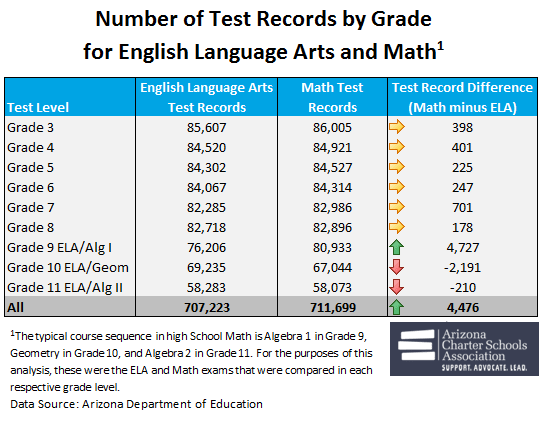
With the passage of SB1430 the State Board of Education will begin to develop its A-F methodology.  The cornerstone to any state accountability system is student level test scores that are used to calculate passing rates and growth scores.  In preparation for this work, the Association began analyzing the 2015 AzMERIT data and discovered significant differences in the number of test records between English Language Arts (ELA) and Math, especially at the high school level.  Given the importance of these data, we set out to investigate the causes and understand the impact. Table 1 shows the number of test records for ELA and Math for each grade level.  At nearly every grade level, the number of Math test records is greater than those for ELA.

The greatest difference is in Grade 9, where most students take an ELA test and, typically, Algebra I. In 2015, the nearly 5,000 more Algebra I test records than Grade 9 ELA test records suggest that students other than high school freshmen are taking Algebra I.
In order to understand the effect of these results, the Association evaluated them in context to the overall enrollment by grade. Table 2 presents grade-level enrollment and a calculation of the percent tested within each content area, as a point of reference.  These data are also reported out by district and charter schools in order to identify any potential differences by type of school.Table 2: 

The use of October enrollment, the only publicly available enrollment file, may impact the “percentage tested” calculations; it is unclear how enrollment changes closer to the testing window could affect these results.  These data show that for almost all elementary grades (grades 3-8), test records account for 99 to 100 percent of grade level enrollment.  Until Grade 8, no compelling difference exists between district and charter schools. However, in Grade 8, math test records account for only 96 percent of grade level enrollment for charter school students, while district schools test 99 percent.

The significant pattern changes that can be seen in the high school “percent tested” columns suggest that the guidance from the Assessment and Accountability divisions within the Department were either unclear or, at best, left room for interpretation.  It would appear that district and charter schools implemented the guidance from the Department regarding end-of-course exams very differently; with large differences in percent testing between the types of schools.  These data also suggest that districts and charters had differing interpretations of the guidance regarding which students must test for each of the end-of-course assessments.

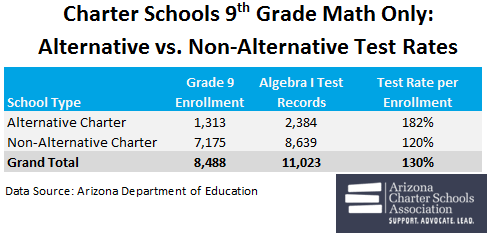
Several examples of this can be seen throughout high school testing.  For example, Grade 9 ELA test records account for 104 percent of Grade 9 enrollment in charter schools and 88 percent of Grade 9 enrollment in district schools. Algebra I test records in math account for 130 percent of Grade 9 enrollment in charter schools and 92 percent of Grade 9 enrollment in district schools.  This suggests that district schools have significantly fewer freshmen taking the Grade 9 ELA test than taking the Algebra I test, and that charter schools are likely testing grades other than freshmen in these courses, particularly Algebra I.  This could be the result of the significant number of alternative charter high schools that serve over-age, credit deficient student populations. The October enrollment file shows 118 alternative charter schools serving Grade 9 students.

In order to investigate this further, the Association evaluated the percentage of ninth grade students tested within charter schools by comparing alternative charter high schools to all other charter high schools.  The results shown in Table 3 suggest alternative charter school students are taking the Algebra I exam beyond Grade 9, and are likely taking multiple end-of-course exams in a given year. This finding is consistent with the student population enrolled in alternative schools and likely explains a significant portion of the overall difference between charter and district schools.

Table 3:

WHY IS THIS IMPORTANT?

These results suggest that guidance from multiple divisions within the Arizona Department of Education resulted in districts and charters making choices about which students should be tested and with which test they should be given.  Without clear policies regarding test taking and the use of test scores for school accountability, the technical validity and overall fairness of any accountability system may be jeopardized.

As state policy makers begin to consider the components and methodology that will be used to calculate A-F and federal accountability formulas, it will be important to understand the impact of end-of-course assessments on availability of data and its use. Unlike the previous state assessment, AzMERIT and the use of end-of-course assessments significantly increases the complexity of available testing data.  These new data need to be fully understood prior to their use for high stakes decisions.

Policy makers should focus on the following areas for consideration: understanding the requirements for end -of-course exam administration and how they impact testing; determine how multiple scores associated with individual students will be used in accountability decisions i.e., calculation of percentage passing; determine how a greater than 100% tested rate will impact accountability decisions.  With each of these areas, clear and timely guidance to the field will be necessary to ensure that schools are not adversely impacted by their testing decisions.  Without this, the foundation of our state’s accountability system (the test score) will be under scrutiny and the reliability and validity of the overall rating will be suspect.

Categories
Association Blog

Register for the Association’s 2016 Educator Summit!

EI-Banner

Are you ready to attend what is often called “the best academic conference in the state of Arizona?” We are ready to have you! The Arizona Charter Schools Association is excited to host the fourth annual “From Day One” Educator Summit, brought to you in partnership with the Center for Student Achievement! This is no ordinary conference. The 2016 “From Day One” Educator Summit is a conference planned BY educators, FOR educators.

Categories
Charters Changing Lives

Alexandrea’s Story

Only a few months into her freshman year, Alexandrea Barajas was a high school dropout. Barajas was a promising student, but her life was in flux as she endured a childhood marked by a turbulent relationship with her parents, frequent moves to different homes and an unending concern for her younger brother and sister’s well-being. Then her charter school principal intervened, issuing a simple challenge: break the cycle. Find out how a south Phoenix charter school helped Alexandrea overcome life’s obstacles to forge her own legacy.

Here is her story.

Categories
Association Blog

Prop 123 Will Help Sustain Academic Excellence for Public Charter Schools

Arizona’s public charter schools scored a number of budget victories during the recent legislative session, including freezing the Small School Weight and increasing additional assistance funding.

However, these victories will be rendered moot if voters don’t approve Proposition 123 on May 17.

Prop 123 would infuse $3.5 billion in additional education funding for all public schools within 10 years, including a boost to base level funding this fiscal year. For charter schools, the proposition would provide about $68 million within the next two fiscal years, raising the base level to more than $3,600 per student.

If Prop 123 fails, funding will be cut $4.8 million for charter schools.

Arizona’s charters have built tremendous positive momentum within the last year, with many publications ranking our schools among the best in the country, and charter students outperforming their peers on local and national assessments.

Arizona charter students outperformed every other state on the 2015 National Assessment of Educational Progress. On eighth grade mathematics, for instance, Arizona charter students scored in a statistical dead heat with Massachusetts, the highest scoring of the 50 states.

Charter students also outperformed the state average of students passing the AzMERIT English Language Arts and Math by 5-12 percentage points at every grade level. Furthermore, 49 out of the top 50 Local Education Agencies (LEAs) with the highest percentage of students passing those exams are charters.

Arizona’s charters have graced the top of school rankings published by U.S. News and World Report, the Phoenix Business Journal and other publications.

Prop 123 is essential to continuing this momentum and ensuring the success of our charter students.

Make sure to vote yes on May 17.

Categories
Association Blog

Charter Award Applications Now Open

Charter Schools Week is an opportunity to celebrate the accomplishments of the local and national charter movement, but honoring the excellent work of charter educators is a year-round endeavor.

To that end, the Arizona Charter Schools Association has launched the nomination process for our 2016 Charter Awards. The Charter Awards annually recognize the accomplishments of four exceptionally skilled and dedicated K-12 charter educators, administrators, business leaders and schools.

There are four categories for nominees: School of the Year, Transformational Leader of the Year, Business Leader of the Year and Teacher of the Year. We will announce the winners in October and honor them with an awards luncheon later that month.

As Charter Schools Week winds down, the Charter Awards provide a perfect opportunity to continue the celebration and highlight some of the best of what Arizona’s charter movement has to offer.

[pexcirclecta pex_attr_small_title=”Applications are Now Open” pex_attr_title=”2016 Charter Awards” pex_attr_button_text=”Apply Today” pex_attr_button_link=”https://azcharters.org/charter-applications” pex_attr_button_link_open=”same”][/pexcirclecta]

Find out more about our past award winners.

Categories
Association Blog

Celebrating #CharterSchoolsWeek

A Note From Eileen

Arizona charter schools are the foundation of school choice in our state. With over 556 charter schools serving over 170,000 students, our growing movement is supporting Arizona families and providing students with a quality education.

But don’t take my word for it.

Arizona charter students outperformed nearly every other state on the 2015 National Assessment of Educational Progress. On eighth grade mathematics, for instance, Arizona charter students scored in a statistical dead heat with Massachusetts, the highest scoring of the 50 states.

In the rolling hills of northern Arizona, STAR School, which straddles the edge of the Navajo reservation, is beating the odds. The K-8 charter school strives to interweave its academic focus with traditional Navajo values. And it’s working. About 80 percent of former STAR students graduate from high school in four years, while 70 percent of the students attend college within a year of graduating.