Categories
Association Blog Charters Changing Lives

2015 Charter Transformational Leader of the Year – Arlahee Ruiz

Arlahee Ruiz has a connection to NFL YET College Prep Academy that’s rare for a school administrator.

Ruiz was once a student at the south Phoenix school, who was new to the United States and still trying to learn English when she moved here from Ciudad Obregon, Sonora, Mexico in her sophomore year of high school.

She overcame those obstacles to graduate from NFL YET in 2003, earned her bachelor’s degree and began teaching leadership classes before moving into a variety of administrative roles at the school.

Today, she is the school leader for grades 7-12 and is primarily responsible for NFL YET’s rise from underperforming to a highly rated ‘A’ school.

Because of her dedication and tenacity to provide a better future for students in south Phoenix, and her outstanding leadership in transforming NFL YET, Ruiz is our 2015 Charter Transformational Leader of the Year.

Categories
Association Blog Charters Changing Lives

2015 Lifetime Achievement Award – Greg and Pam Miller

Greg and Pam Miller have always been fueled by a passion for education and, especially, children.

The Millers were in the midst of demanding careers, with Greg working in the civil engineering industry and Pam in banking, but that didn’t stop them from volunteering up to 30 hours a week at their children’s schools.

Their volunteerism didn’t stop with their children. Pam served on the Paradise Valley Unified School District governing board and as President of the United Parent Council, while Greg currently serves as President and charter school representative of the State Board of Education.

The Millers were pioneers of school choice, opening Challenge Charter School in 1996, just two years after the Legislature approved historic legislation bringing charter school education to Arizona. Their Glendale elementary school has been recognized as a National Blue Ribbon School, National Charter School of the Year by the Center for Education Reform and is consistently ranked among the state’s top public schools.

Because of their servitude and contribution to Arizona’s charter movement, the Arizona Charter Schools Association is honoring the Millers with its 2015 Lifetime Achievement Award.

Categories
Association Blog Charters Changing Lives

2015 Charter School of the Year – Mission Montessori Academy

Mission Montessori Academy strives to help their students grow into peacemakers, compassionate stewards of the planet and global citizens.

The school’s Global Education Program is central to this mission, with an emphasis on teaching students to understand global issues and find ways to help solve the world’s challenges.

However, Mission Montessori students don’t just learn these lessons in the classroom, they live it.

The students have traveled to China, Switzerland and Rome to practice these lessons and accomplish the program’s goals while gaining a deeper understanding of different cultures, religions and backgrounds. They’re scheduled to head to Chile later this school year.

This focus, along with the school’s high academic standing, is one of the main reasons Mission Montessori our 2015 Charter School of the Year.

Categories
Association Blog Charters Changing Lives

Behind the Scenes with our Charter Award Winners

Today, the Arizona Charter Schools Association announced the winners of our 2015 Charter Awards, which annually recognizes the top charter teacher, leader, business manager, school and Lifetime Achievement Award winner in Arizona’s charter movement.

Last week, we had a video shoot on the campus of each award winner. We were inspired by their success stories and their dedication to students.

Get a behind the scenes look at our 2015 Charter Award winners.

Categories
Press Releases

Charter Award Winners Announced

Largest Arizona Charter Support Organization Recognizes Top Charter Teachers, Leaders and Schools

Arizona has emerged as a national leader in the charter movement, with numerous teachers, administrators, and schools who drive the success of our charter schools. The Arizona Charter Schools Association is pleased to honor these exemplary educators with our 2015 Charter Awards, which annually recognizes the top charter teacher, leader, business manager and school in Arizona. The award winners highlight some of the best of what Arizona’s charter movement has to offer.

This year, the Association is also honoring Greg and Pam Miller, founders of Challenge Charter School in Glendale and pioneers of Arizona’s charter movement, with a Lifetime Achievement Award. The Millers were an integral part of the political discussions leading up to the original successful Arizona charter school legislation.

Categories
Education Blog

Charter Student Enrollment Increases

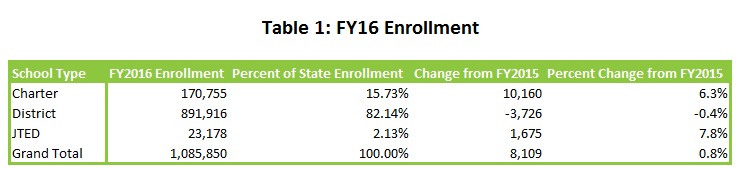
Despite a tumultuous legislative session that had significant impacts on charter schools, charter student enrollment continues to rise. Initial estimates indicate that an additional 10,000 students attend a charter school this year, which is a 6.3 percent increase.

During the 2015 session, the Arizona Legislature passed two significant policies directly impacting charter schools – policies that may have impacted student enrollment. The state now funds charter schools based on the total number of students in a “network,” or groups of affiliated schools. These charter school networks are now treated, for the purpose of funding, similarly to traditional school districts. Additionally, the Legislature made significant changes to district sponsored charter schools in FY2015, requiring most to revert back to traditional district status.

The number of unique charter organizations dropped from 267 in FY15 to 250 in FY16, due in large part to the State Board of Charter Schools closure of 27 campuses as well as the 59 districtsponsored charter schools the Legislature forced to revert back to traditional district status.

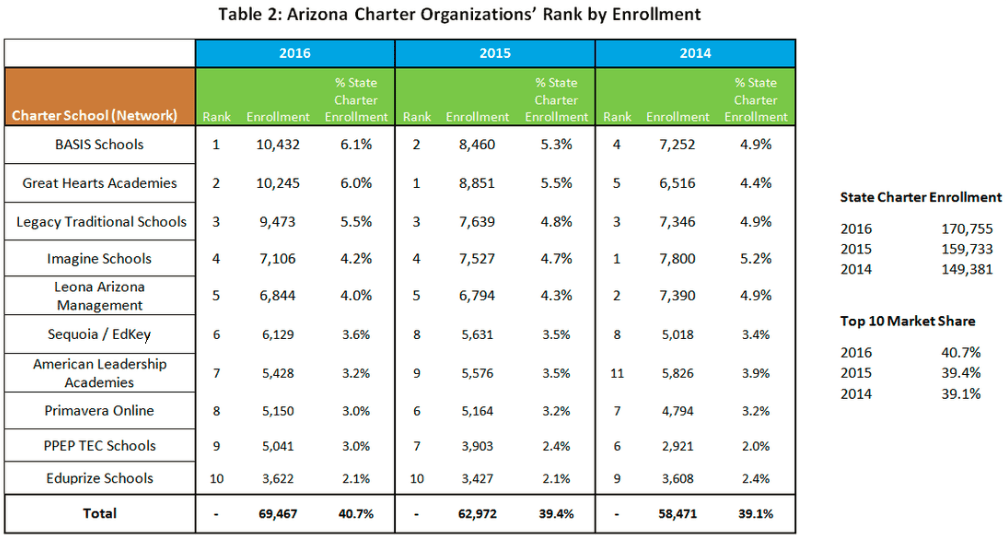
In our June 2015 blog, we introduced you to Arizona’s largest charter organizations. Table 2 shows these charters with their updated FY2016 data.  While the organizations in the top 10 remained stable from 2015 to 2016, the composition of the list changed significantly. The top two charter networks, Great Hearts Academies and Basis Schools, both experienced substantial enrollment increases, with Basis Schools taking the top spot.

The ten largest charter organizations enroll nearly 41 percent of all charter students. Charter market share for the two largest networks increased to 12 percent in FY16. The table also shows the relative ranking of charter organizations based on their share of charter student enrollment.  The majority of the rankings were impacted by these initial FY16 estimates: 6 out of 10 school networks shifted their relative positioning within the ranking.  These results continue to indicate that enrollment patterns within the state’s largest charter networks vary.

For charter school supporters, these data are heartening given the impacts of the 2015 Legislative session on charter schools. For supporters of increased access to quality school options, these data also provide evidence that Arizona’s highest performing charter networks are continuing to increase their impact and represent a significant population of Arizona’s charter student enrollment.
Categories
Association Blog

Impact Aid: Federal Money Available for Charter Schools

Arizona is the largest recipient of Impact Aid, which is federal money available for charter schools on or near federal or tribal lands, as well as schools that have parents employed by the federal government.

With a looming government shutdown, Impact Aid could be affected. Arizona has an Arizona State Impact Aid Association nonprofit to provide leadership, advocacy and a united voice. Based on information from the Arizona State Impact Aid Association, 79 district and charter schools receive the federal money, totaling $221,031,427 in 2012.

Categories
Press Releases

Arizona Awarded Grant to Expand Charter Schools

Recognizing the academic success of Arizona’s charter schools, the U.S. Department of Education today awarded $23.6 million to Arizona to provide additional high quality charter schools to Arizona’s students.

“As public schools serving public students, charter schools are focused on improving the number of quality seats for Arizona’s students,” said Eileen Sigmund, Arizona Charter Schools Association President. “It takes two years of planning to start a high quality charter, but schools don’t get funding until students start class. Without start-up funding, it’s very difficult to find a facility, purchase textbooks and desk, and hire teachers. This grant enables our charter schools to be intentional and start right from day one.”

More than 170,500 students attend 533 public charter schools for this current school year. In 2014, 73 percent of charter schools with two years of letter grades either improved their letter grade or earned an A (A-Alt) or B (B-Alt).

Since the program’s inception, the United States Department of Education has invested about $47.5 million in Arizona’s charter schools, with an aim of strengthening accountability and quality of our schools.

This year’s state grant program awarded $125 million in new grants to eight states. The funding will enable them to run state-level grant competitions to support approximately 400 new and expanded public charter schools, according to the U.S. Department of Education.

Categories
Education Blog

Move On When Reading? Keeping the Bar Low (Until 2017)

While it is an urban myth[i] that prison population projections are based on the number of third graders that cannot read — a connection exists between incarceration and failure to read. A student not reading by the end of third grade is four times less like to graduate, and high school dropouts were 63 times more likely to see the inside of prison walls than college graduates[ii].

In an effort to combat those statistics, the state’s Move on When Reading (MOWR) law[iii] requires schools to retain third-graders who fall far below reading standards.

With 44 percent of our third graders scoring “minimally proficient” on AzMERIT, it was surprising that in August the Arizona State Board of Education set the bar based on past exam levels, allowing only three percent of Arizona’s third-graders mandated access to “intervention and remedial strategies.” Despite test results demonstrating more of our students lack the skills to graduate high school, the State Board set a policy that keeps the bar low for the 2015 and 2016 administrations of AzMERIT.

So…Why Does it Matter?

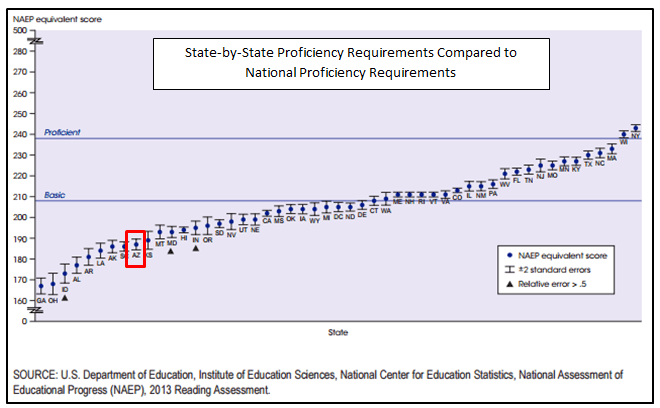
Arizona’s measures for determining the academic preparedness of our students have long differed from external measures, namely national assessments. In the 2013 AIMS results, 77% of fourth and 72% of eighth grade students were proficient in reading; however, the 2013 National Assessment of Educational Progress (NAEP) results show that 72% of Arizona fourth- and eighth-graders were NOT proficient in reading, compared to 66% of students nation-wide. As our students matriculate to high school, we see the ramifications of these results: 25% of Arizona students do not graduate from high school with their class, according to statistics from the Arizona Department of Education.

How is it possible to have such differing diagnoses from the state and national exams? The 2013 NAEP Mapping Study[iv] demonstrates the disparity. The following chart represents the alignment between NAEP expectations and state proficiency expectations in reading. It is clear that Arizona’s AIMS proficiency standard is significantly lower than both the NAEP Proficient and Basic cut scores. The chart also illustrates how it is possible for students identified as proficient on AIMS to simultaneously score well below the Basic level on NAEP.

In response to these facts, Governor Doug Ducey[v] communicated the following during his remarks to the State Board of Education in March:

“First, Arizona’s scores are too low – unacceptably low. Second, we’re giving false assurance to too many parents that their kids are well-prepared for life or college — when in fact they are not. So we need to commit ourselves to achieving excellence.  And when we see excellence, we should understand who and what creates it and export those best practices to other schools so that they can benefit from it.

This Board – along with my office and the Legislature – needs to design policies that get Arizona on a path to significant improvement in the quality of education.  It won’t happen overnight, and it’s a long-term proposition, but it can be done and we need to make that our primary focus.”

The State Board developed policies in response to this call to action. The Performance Level Descriptors adopted by the Board and used extensively by teachers during standards-setting established high expectations for proficiency that were critical to beginning to align our state’s outcomes to national measures, and furthermore, to prepare Arizona students for college or career. According to the Department’s materials, the AzMERIT performance standards are generally comparable to the performance standards on NAEP.

It was widely acknowledged throughout the standards-setting process that teachers understood that students taking the exam in 2015 were not prepared or ready to meet the higher standards, yet teachers recommended appropriate standards anyway. Dr. Joe O’Reilly, an external observer and school district employee, presented his observations regarding the standards-setting process and teachers’ commitment to educational excellence in his memo to the Board:

“Teachers took their training to heart. We heard them say things to each other like ‘I want to make sure we are setting it at college and career ready, not too low, not where a student is not really college and career ready.’ They also discussed why the results turned out as they did and said things like ‘we are setting this for what we want students to be able to do, not what they can do now,’ ‘that [item’s results] is a teacher issue and where the teacher is on the new standards,’ and ‘that should be an easy item if it was taught properly.’ ” (P. 3)[vi]

Our state’s past academic results along with the overwhelming acknowledgement by educational professionals, parents, policymakers, and the business community contributed to the Board’s decision to establish higher, more rigorous standards for AzMERIT on August 14, 2015.

So…How Did This Happen?

Why, despite the Board’s prior moves to rigorous expectations, did the Board take a step backwards towards old expectations and performance standards?  A.R.S. §15-701 required them to set the cut score using “reading scores.” Alternative recommendations to set it at the Minimally Proficient level, using the English Language Arts (ELA) scores, were dismissed due to this interpretation. Unfortunately, the Department didn’t provide an alternatively rigorous reading score, one that might have aligned more closely to the Minimally Proficient level, for the Board to consider.  Simply put, the Board was left with only the AIMS equivalent cut score as an option.

In an attempt to ameliorate their decision, to revert to lower standards and old expectations, the Board approved a measure that would avoid providing confusing information to parents of existing fourth graders. Students impacted by the Board’s decision are still eligible for remediation support, despite being promoted, so this information will be provided to schools only with the expectation that students receive interventions during the 2015-16 school year.

The Board also acknowledged that the approved cut scores don’t reflect the level of rigor and expectations for reading and are inconsistent with their previous decisions to set high expectations for passing on AzMERIT.  Their motion required the Department to reconvene a standard setting committee to provide a recommended “falls far below” level for subsequent years that is in alignment with the AzMERIT expectations. Lastly, the Board will seek additional legislation regarding Arizona’s Move on When Reading statute to align it with the current statewide assessment, specifically the use of an English Language Arts assessment.

So…What Does This Mean?

Although a majority of Arizona fourth- and eighth-grade students were deemed “proficient” in reading in the 2013 AIMS results, these same students fell far short of expectations for proficiency on the national exam (NAEP). Expectations vary state-by-state, and in many cases, individual states’ expectations fall short of the requirements of the national exam – Arizona is one of these states.

In March, Governor Ducey called for action to raise the state academic standards to more closely align with national standards, and to better prepare Arizona students for college and career. The State Board has responded, developing curricula requirements and implementing assessments that match the performance standards of the NAEP.

Despite these advances, third graders in 2016 will be passed on at the same rate as their predecessors who were subjected to lower standards and expectations. This slow transition to a more rigorous standard in 2017 will mean thousands of children will be duped into thinking they are on track for college and career when they are not.
Footnotes/References
[i] http://www.theatlantic.com/business/archive/2012/07/an-urban-myth-that-should-be-true/259329/
[ii] http://readingpartners.org/blog/do-prisons-use-third-grade-reading-scores-to-predict-the-number-of-prison-beds-theyll-need/
[iii] A.R.S. §15-701 http://www.azleg.gov/FormatDocument.asp?inDoc=/ars/15/00701.htm&Title=15&Doc
[iv] Bandeira de Mello, V., Bohrnstedt, G., Blankenship, C., and Sherman, D. (2015). Mapping State Proficiency Standards Onto NAEP Scales: Results From the 2013 NAEP Reading and Mathematics Assessments (NCES 2015-046). U.S. Department of Education, Washington, DC: National Center for Education Statistics. Retrieved 8/18/15 from http://nces.ed.gov/pubsearch.
[v] http://azgovernor.gov/governor/news/governor-duceys-remarks-arizona-state-board-education
[vi] August 14, 2015 agenda materials https://azsbe.az.gov/public-meetings 
Categories
Association Blog

Council Readying to Overhaul School Finance

In a few weeks, Governor Doug Ducey’s Classrooms First Initiative Council will take the first, small step towards creating an equitable, efficient state school finance system that benefits all of our students.

The Council will reveal its preliminary recommendations for overhauling Arizona’s K-12 finance system on Sept. 22 after spending this summer exploring various aspects of school finance and meeting with consultants and advisors, including the Arizona Charter Schools Association and Center for Student Achievement.