Categories
Education Blog

A FIRST LOOK AT AzMERIT: MORE TEST RESULTS THAN STUDENTS

Arizona’s new state test, AzMERIT, shifts high school testing from a tenth grade exam to end-of-course assessments in grades nine through eleven.  This shift presents new challenges and opportunities for policy makers to consider when building a state accountability system. These dynamics will likely play out in a variety of ways when calculating percent passing and percentage tested. It will be important for policy makers to understand the potential impacts prior to the development of any accountability system.

What’s the Big Deal?

With the passage of SB1430 the State Board of Education will begin to develop its A-F methodology.  The cornerstone to any state accountability system is student level test scores that are used to calculate passing rates and growth scores.  In preparation for this work, the Association began analyzing the 2015 AzMERIT data and discovered significant differences in the number of test records between English Language Arts (ELA) and Math, especially at the high school level.  Given the importance of these data, we set out to investigate the causes and understand the impact. Table 1 shows the number of test records for ELA and Math for each grade level.  At nearly every grade level, the number of Math test records is greater than those for ELA.
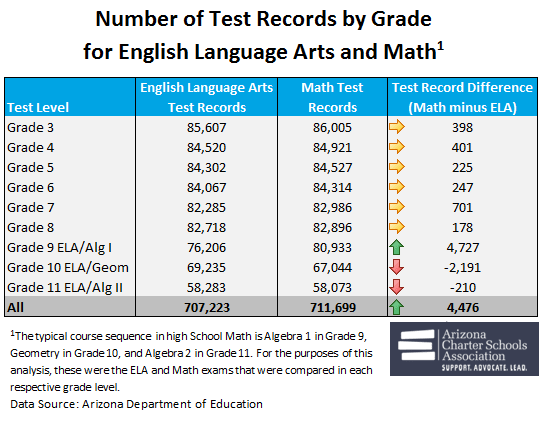
The greatest difference is in Grade 9, where most students take an ELA test and, typically, Algebra I. In 2015, the nearly 5,000 more Algebra I test records than Grade 9 ELA test records suggest that students other than high school freshmen are taking Algebra I.
In order to understand the effect of these results, the Association evaluated them in context to the overall enrollment by grade. Table 2 presents grade-level enrollment and a calculation of the percent tested within each content area, as a point of reference.  These data are also reported out by district and charter schools in order to identify any potential differences by type of school.Table 2: 

The use of October enrollment, the only publicly available enrollment file, may impact the “percentage tested” calculations; it is unclear how enrollment changes closer to the testing window could affect these results.  These data show that for almost all elementary grades (grades 3-8), test records account for 99 to 100 percent of grade level enrollment.  Until Grade 8, no compelling difference exists between district and charter schools. However, in Grade 8, math test records account for only 96 percent of grade level enrollment for charter school students, while district schools test 99 percent.

The significant pattern changes that can be seen in the high school “percent tested” columns suggest that the guidance from the Assessment and Accountability divisions within the Department were either unclear or, at best, left room for interpretation.  It would appear that district and charter schools implemented the guidance from the Department regarding end-of-course exams very differently; with large differences in percent testing between the types of schools.  These data also suggest that districts and charters had differing interpretations of the guidance regarding which students must test for each of the end-of-course assessments.

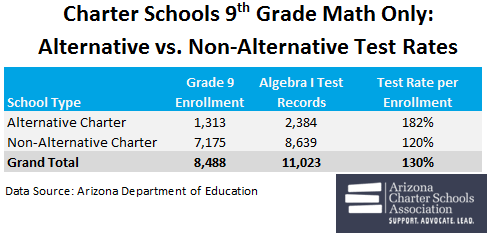
Several examples of this can be seen throughout high school testing.  For example, Grade 9 ELA test records account for 104 percent of Grade 9 enrollment in charter schools and 88 percent of Grade 9 enrollment in district schools. Algebra I test records in math account for 130 percent of Grade 9 enrollment in charter schools and 92 percent of Grade 9 enrollment in district schools.  This suggests that district schools have significantly fewer freshmen taking the Grade 9 ELA test than taking the Algebra I test, and that charter schools are likely testing grades other than freshmen in these courses, particularly Algebra I.  This could be the result of the significant number of alternative charter high schools that serve over-age, credit deficient student populations. The October enrollment file shows 118 alternative charter schools serving Grade 9 students.

In order to investigate this further, the Association evaluated the percentage of ninth grade students tested within charter schools by comparing alternative charter high schools to all other charter high schools.  The results shown in Table 3 suggest alternative charter school students are taking the Algebra I exam beyond Grade 9, and are likely taking multiple end-of-course exams in a given year. This finding is consistent with the student population enrolled in alternative schools and likely explains a significant portion of the overall difference between charter and district schools.

Table 3:
WHY IS THIS IMPORTANT?

These results suggest that guidance from multiple divisions within the Arizona Department of Education resulted in districts and charters making choices about which students should be tested and with which test they should be given.  Without clear policies regarding test taking and the use of test scores for school accountability, the technical validity and overall fairness of any accountability system may be jeopardized.

As state policy makers begin to consider the components and methodology that will be used to calculate A-F and federal accountability formulas, it will be important to understand the impact of end-of-course assessments on availability of data and its use. Unlike the previous state assessment, AzMERIT and the use of end-of-course assessments significantly increases the complexity of available testing data.  These new data need to be fully understood prior to their use for high stakes decisions.

Policy makers should focus on the following areas for consideration: understanding the requirements for end -of-course exam administration and how they impact testing; determine how multiple scores associated with individual students will be used in accountability decisions i.e., calculation of percentage passing; determine how a greater than 100% tested rate will impact accountability decisions.  With each of these areas, clear and timely guidance to the field will be necessary to ensure that schools are not adversely impacted by their testing decisions.  Without this, the foundation of our state’s accountability system (the test score) will be under scrutiny and the reliability and validity of the overall rating will be suspect.

Categories
Association Blog

Register for the Association’s 2016 Educator Summit!

EI-Banner

Are you ready to attend what is often called “the best academic conference in the state of Arizona?” We are ready to have you! The Arizona Charter Schools Association is excited to host the fourth annual “From Day One” Educator Summit, brought to you in partnership with the Center for Student Achievement! This is no ordinary conference. The 2016 “From Day One” Educator Summit is a conference planned BY educators, FOR educators.

Categories
Charters Changing Lives

Alexandrea’s Story

Only a few months into her freshman year, Alexandrea Barajas was a high school dropout. Barajas was a promising student, but her life was in flux as she endured a childhood marked by a turbulent relationship with her parents, frequent moves to different homes and an unending concern for her younger brother and sister’s well-being. Then her charter school principal intervened, issuing a simple challenge: break the cycle. Find out how a south Phoenix charter school helped Alexandrea overcome life’s obstacles to forge her own legacy.

Here is her story.

Categories
Association Blog

Prop 123 Will Help Sustain Academic Excellence for Public Charter Schools

Arizona’s public charter schools scored a number of budget victories during the recent legislative session, including freezing the Small School Weight and increasing additional assistance funding.

However, these victories will be rendered moot if voters don’t approve Proposition 123 on May 17.

Prop 123 would infuse $3.5 billion in additional education funding for all public schools within 10 years, including a boost to base level funding this fiscal year. For charter schools, the proposition would provide about $68 million within the next two fiscal years, raising the base level to more than $3,600 per student.

If Prop 123 fails, funding will be cut $4.8 million for charter schools.

Arizona’s charters have built tremendous positive momentum within the last year, with many publications ranking our schools among the best in the country, and charter students outperforming their peers on local and national assessments.

Arizona charter students outperformed every other state on the 2015 National Assessment of Educational Progress. On eighth grade mathematics, for instance, Arizona charter students scored in a statistical dead heat with Massachusetts, the highest scoring of the 50 states.

Charter students also outperformed the state average of students passing the AzMERIT English Language Arts and Math by 5-12 percentage points at every grade level. Furthermore, 49 out of the top 50 Local Education Agencies (LEAs) with the highest percentage of students passing those exams are charters.

Arizona’s charters have graced the top of school rankings published by U.S. News and World Report, the Phoenix Business Journal and other publications.

Prop 123 is essential to continuing this momentum and ensuring the success of our charter students.

Make sure to vote yes on May 17.

Categories
Association Blog

Charter Award Applications Now Open

Charter Schools Week is an opportunity to celebrate the accomplishments of the local and national charter movement, but honoring the excellent work of charter educators is a year-round endeavor.

To that end, the Arizona Charter Schools Association has launched the nomination process for our 2016 Charter Awards. The Charter Awards annually recognize the accomplishments of four exceptionally skilled and dedicated K-12 charter educators, administrators, business leaders and schools.

There are four categories for nominees: School of the Year, Transformational Leader of the Year, Business Leader of the Year and Teacher of the Year. We will announce the winners in October and honor them with an awards luncheon later that month.

As Charter Schools Week winds down, the Charter Awards provide a perfect opportunity to continue the celebration and highlight some of the best of what Arizona’s charter movement has to offer.

[pexcirclecta pex_attr_small_title=”Applications are Now Open” pex_attr_title=”2016 Charter Awards” pex_attr_button_text=”Apply Today” pex_attr_button_link=”https://azcharters.org/charter-applications” pex_attr_button_link_open=”same”][/pexcirclecta]

Find out more about our past award winners.

Categories
Association Blog

Celebrating #CharterSchoolsWeek

A Note From Eileen

Arizona charter schools are the foundation of school choice in our state. With over 556 charter schools serving over 170,000 students, our growing movement is supporting Arizona families and providing students with a quality education.

But don’t take my word for it.

Arizona charter students outperformed nearly every other state on the 2015 National Assessment of Educational Progress. On eighth grade mathematics, for instance, Arizona charter students scored in a statistical dead heat with Massachusetts, the highest scoring of the 50 states.

In the rolling hills of northern Arizona, STAR School, which straddles the edge of the Navajo reservation, is beating the odds. The K-8 charter school strives to interweave its academic focus with traditional Navajo values. And it’s working. About 80 percent of former STAR students graduate from high school in four years, while 70 percent of the students attend college within a year of graduating.

Categories
Association Blog

PPEP Tec: Arizona’s Oldest Charter School Serving At Risk Students

Year Founded: 1995
Students Served: 5,800 students at seven campuses and online education programs
Grades Served: 9-12
Location: Tucson, Douglas, Sierra Vista, Somerton, Casa Grande, San Luis
Website: www.ppeptechs.org

[pextestim pex_attr_set=”ppep-tec” pex_attr_autoplay=”false”][/pextestim]

Categories
Association Blog

Ask a Lawyer – 2016 Legal Week Podcast

[pexvimeo pex_attr_src=”https://vimeo.com/165099257″][/pexvimeo]

As part of the Arizona Charter Schools Association’s 2016 Legal Week, we are featuring a new podcast titled, “Ask a Lawyer,” where Osborn Maledon attorney Lynne Adams answers questions submitted by charter school leaders. Don’t miss this fun and informative feature moderated by Association trainer, Andrew Nelson.

Watch our podcast and find answers to the following five questions submitted by Arizona charter school leaders:

  1. Many charter schools received a records request email from American Transparency on April 17. Do they have to respond, and if so, what advice do you have about the response?
  2. What documents must be provided in response to a public records request? Are email and voicemail messages public records?  Does it matter who sent or received them (board members, teachers, or site leaders, for example)?
  3. What obligations does a school have to maintain records, including student records and diplomas?
  4. Are charter schools considered “political subdivisions” of the state, and if not, why not? Wouldn’t that be better for schools and allow them to get more funding and generally create a more equal playing field?
  5. When a student designs a robot or part of a robot for a class or a school club, does the school or the student have rights in the design?
Categories
Education Blog

FROM POVERTY TO POLICY: FREE AND REDUCED LUNCH POPULATIONS IN ARIZONA

The Association reviewed the poverty rates of Arizona students over the past six years, and we found that a greater percentage of students are enrolled in schools with higher concentrations of poverty.

In addition to a statewide analysis, the Association analyzed the results by school type (charter/district). The most striking difference between the two groups is the disparity in the percent of students who are enrolled in a school with no free or reduced lunch (FRL) data.

Introduction

There is near universal agreement that students from low income families are more likely to struggle to meet and exceed academic expectations in school. Challenges such as the lack of resources at home, home or food insecurity, lack of books and other learning tools, and stressed or unavailable parents, can all contribute to educational difficulties of impoverished students. The National School Lunch and Breakfast Program exists to mitigate the effect of hunger on learning[i]. For the 2015-2016 school year, a student whose family income falls below 130% of the federal poverty line qualifies for free meals. For a family a four, the threshold is $31,525[ii].  A family of four below 185%, or $44,863, qualifies for reduced-priced meals.

The Analysis

Although not a perfect measure of poverty, the percent of students in a school who qualify for the FRL program is the only proxy currently available to measure the level of poverty and corresponding instructional needs in a school. The Association used FRL data available through the Arizona Department of Education[iii] to analyze the distribution of students living in poverty among Arizona schools and changes in the distribution from 2010 to 2016.

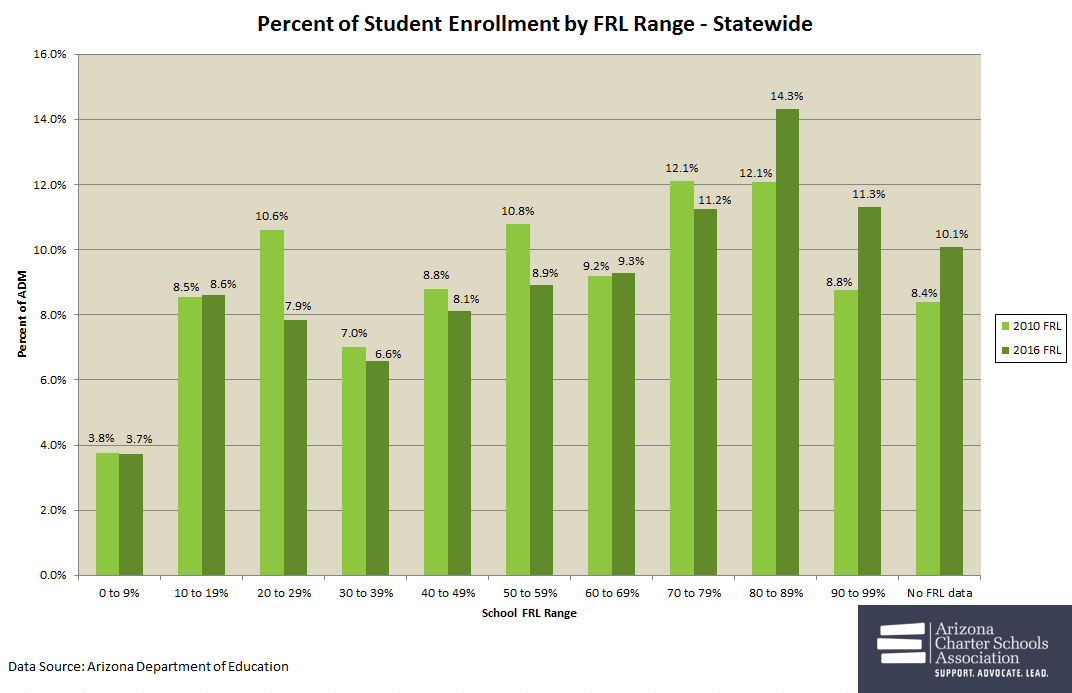
The figure below shows the distribution of Arizona’s students eligible for free or reduced-priced lunch in 2010 and 2016.  Each bar represents the percent of total student enrollment in the given FRL range. For example, in 2010, 3.8% of all Arizona students were enrolled in a school with 0 to 9% FRL; in 2016 that percent was about the same (3.7%).  The concentration of poverty in a school is demonstrated by the percentage of students eligible for FRL enrolled in the school.

The degree of poverty increases from left to right; therefore, the farthest range – 90 to 99% – represents the most concentrated poverty, where nearly all students are eligible for assistance. The exception is the rightmost bar, which indicates the percentage of students enrolled in a school that does not have FRL data. Schools that do not participate in the program do not generate any data. There are varied reasons why a school might not participate in the program and exploring those reasons is outside the scope of this blog; here we will focus our attention on the trends for those schools that do report.

Statewide, we can detect a shift of the distribution to the right, meaning that a larger percentage of students are enrolling in schools with higher concentrations of FRL students. Beginning with the low-poverty schools, both the 0 to 9% and 10 to 19% schools have a relatively unchanged percentage of students.  Schools saw declines in the percentage of students they enroll in the 20 to 29%, 30 to 39%, 40 to 49%, and 50 to 59% ranges. These students moved to the right of the distribution, into the 60% or more ranges. Combined, schools with 50 percent or more of their students eligible to receive FRL enrolled 53 percent of Arizona’s student population in 2010 and 55 percent in 2016.

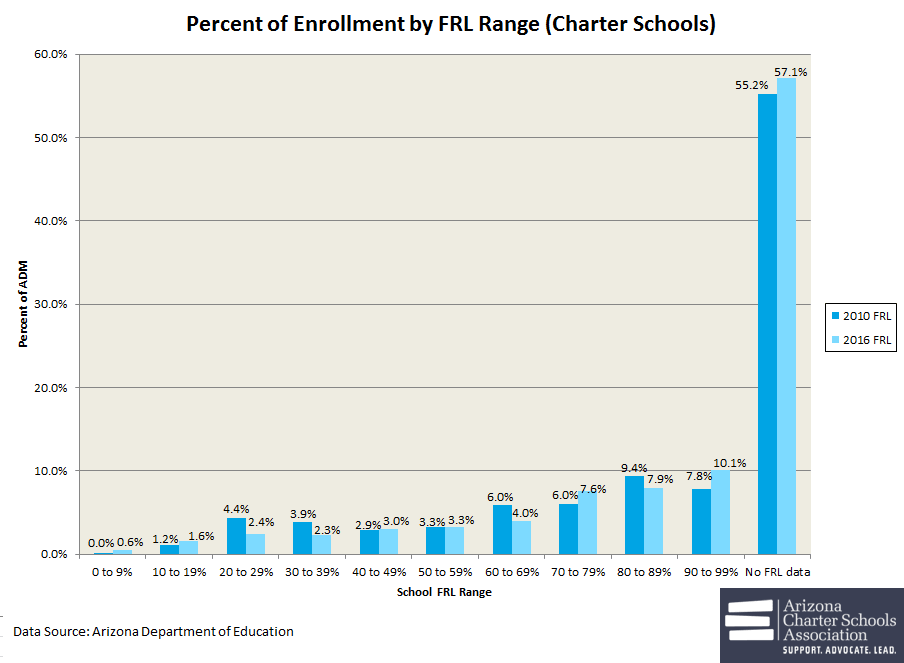
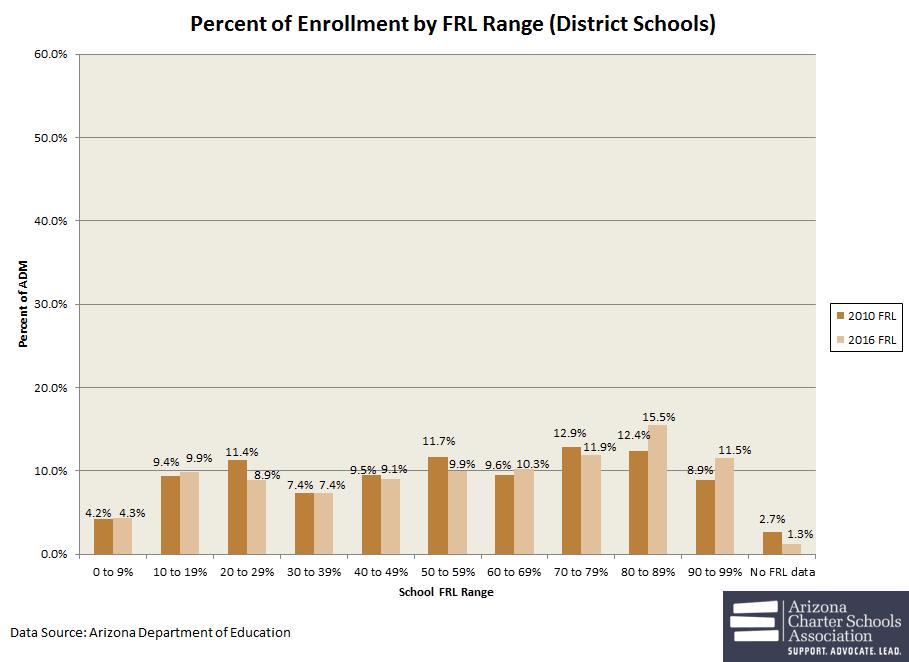
In addition to a statewide analysis, the Association analyzed the results by school type (charter/district). The most striking difference between the two groups is the disparity in the percent of students who are enrolled in a school with no FRL data. As shown below, a majority of charter students are enrolled in a school that did not report FRL data in 2010 or 2016, however, very few students in district schools are enrolled in a school with no FRL data.

Given that FRL information for over half of the students enrolled in charter schools is not available, charter results must be interpreted very cautiously. For those charter schools that do report FRL data, the distribution is moving slightly to the right. In 2010, 32 percent of charter students were enrolled with 50 percent or more FRL; in 2016, this grew to 33 percent.

The results for districts schools are consistent with the statewide trend. From 2010 to 2016, a greater percentage of students are enrolled in schools with higher concentrations of poverty, despite variability in the individual ranges. In 2010, over 55 percent of district students were enrolled in schools with 50 percent of more FRL; in 2016, this grew to 59 percent.

The Implications

Higher levels of poverty in our public schools translate to higher demands of our educators and on our limited resources. If the challenges to students and demands placed on schools increase as overall resources decrease, then the challenge for schools is multiplied. Recruiting and retaining high quality teachers, for example, becomes even more difficult at the same time that the need for them becomes even more critical to student success.

As the state looks to revamp its school accountability and funding systems, the relationship between poverty and measures of achievement must be properly addressed. School accountability labels that can be largely predicted based on the FRL rate do a disservice to the very schools with the biggest challenges[iv]. Our state funding and accountability policies should reflect the real challenges presented to schools serving students in poverty.

Additionally, any policy that takes poverty into consideration must examine how to deal with the significant lack of FRL data in the charter sector. This may include the need for additional data collection or information gathering before a policy can be effectively and appropriately implemented.

A Note on Data

Although determining why charter schools do not participate in the National School Lunch and Breakfast Program is outside of the scope of this blog, finding out the reasons may be important as the state moves forward with its K-12 funding revamp.

Footnotes/References

[i] http://www.azed.gov/health-nutrition/nslp/
[ii] https://www.gpo.gov/fdsys/pkg/FR-2015-03-31/pdf/2015-07358.pdf
[iii] http://www.azed.gov/health-nutrition/frpercentages/
[iv] See the Association’s paper, School Ratings: Improving the Data in Data Driven Decision Making, for a full explanation and recommendations.

Categories
Association Blog

Desert View Academy: Strong Academics, Growth For Families in Yuma

Year Founded: 2000
Students Served:
616
Grades Served:
K-5
Location:
Yuma, Ariz.
Website:
www.desertviewacademy.com

[pextestim pex_attr_set=”desert-view-yuma” pex_attr_autoplay=”false”][/pextestim]