Categories
Education Blog

ARIZONA RANKS 49TH IN EDUCATION FUNDING – HOW DID WE GET HERE?

While acknowledging Arizona K-12 funding is low compared to the national average, Governor Ducey in his state of the state provided policymakers 15 points to make Arizona more competitive for our educators and students.

But how low is our per-pupil funding compared to other states? And how long have we ranked near the bottom of the nation?  In this month’s blog, the Association compiled historical school funding metrics to evaluate how Arizona stacks up against other states in terms of funding per pupil, pupil-teacher ratios, and school size. In terms of school funding – we won’t mention hair styles – the ‘80s were great. Arizona funded its schools at levels slightly above the national average. Unfortunately, Arizona now is skimming the bottom of the funding barrel. Arizona boasts some of the largest teacher-student ratios while its school sizes near the national average.

Funding Per Pupil

The National Center for Education Statistics reports that in the late 1980s, Arizona funded its public schools at the national state average in terms of per-pupil revenues. But in the 1990s through the 2000s and up until the most recent data available (2013), Arizona slipped to “bad” and then to “worse”, becoming one of the lowest funded public education systems in the country, on a per-pupil basis.
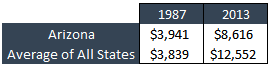
The last complete revamping of Arizona’s school finance system occurred in 1980. At that time, policymakers sought to limit local tax liabilities while “equalizing” funds between school districts to ensure a degree of equity. Besides annual skirmishes regarding school funding at the Legislature, Arizona has litigated the funding formula over inflation, capital improvements and maintenance, and funding our English language learners.

In 1994, Arizona lawmakers established a system of charter schools, separate from school districts and with a completely different school funding system. The narrated video below provides a national look at how states fund students, on a per pupil basis. On the left, a bar graph illustrates the state-by-state differences in funding in absolute dollars. On the right, the same information is displayed, but in map form. Click play to see how funding changes for each state over time, from 1987 to 2013.

For an interactive dashboard of the state-by-state funding per pupil video, click here. The dashboard allows for a more detailed look at each state or each year of the video.

In the final year of the above video (2013), the inter-mountain West (Arizona, Utah and Idaho) settled in as the lowest public school funding in terms of per-pupil dollars. Though Arizonans passed a number of funding initiatives (Proposition 301 in 2000, Proposition 123 in 2016 and scores of local district bonds and budget overrides), the per pupil downward slide continued.

Pupil-Teacher Ratios

Teachers and teaching staff are the largest expenditure in Arizona’s school system.  Not surprisingly, Arizona and other states in the bottom quarter of per-pupil revenue distribution tend to have larger class sizes.

In the narrated animation below, state per-pupil funding is plotted against student-teacher ratios for all states, and tracked over time. From these data, it is unclear how the rumored impending teacher shortage crisis plays out as a cause or a symptom of relatively large class sizes and low revenues. As of 2013, the western states of Utah, Arizona, Nevada, California, Washington, and Oregon had established themselves as a cohort of states having the highest pupil-to-teacher ratios, and some of the lowest per-pupil funding.


Average School Size

Arizona has been above average in the number of students per school site over the years.  Though the national average school size has shrunk, Arizona is still above the national average. Given the state’s funding mechanism, historical interests for smaller learning communities and Arizona’s robust school choice movement, it is not surprising that extremely large schools, with relatively low per-pupil administrative costs, have not manifested. In fact, Arizona’s school sizes were larger before Arizona allowed charter schools in 1994. As charters grew in number, Arizona average school sizes have shrunk incrementally, nearing the national average.

Despite this trend, in 2015, Arizona lawmakers voted to eliminate “small school weights” for charter schools that are part of a network , even if the schools are located far apart. Arizona is scheduled to completely eliminate small school weight funding for charter schools during this legislative session.

For an interactive dashboard of the average school size video, click here. The dashboard allows for a more detailed look at each state or each year of the video.

Conclusion

Arizona wasn’t always competing for last place in terms of school funding.  As recently as the 1980s, Arizona spent at the national average per pupil.  In less than thirty years, Arizona’s relative ranking has dropped by double-digits, despite more than doubling the state’s per pupil allocation to schools. Failure to keep up with the national trends in school funding has serious consequences for Arizona’s education system. First, Arizona has some of the highest student-teacher ratios compared to other neighboring states. Second, Arizona’s school sizes are shrinking closer to the national average. This meeting in the middle means that, on average, Arizona’s schools are cramming more students into classrooms to maximize the resources that the schools receive.  It is unclear how long Arizona’s education system can keep this up.
Categories
Charters Changing Lives

Mary Ellen’s Story

How A Charter School Education Expanded Opportunities for an Arizona Student-turned-Teacher

Mary Ellen Lee knows firsthand about the flexibility and innovation that have become a hallmark of charter schools.

Lee is the daughter of a charter school principal, a product of choice as a charter school student, and now is an innovative charter teacher who provides her students with the same high quality education she had as a child.

“I think the exciting thing about growing up in a charter school is that I experienced so much diversity. Instead of going to a school that was bound by location, I went to a school that was bound by interest,” she said.

Categories
Press Releases

What is a Charter School?

Charter schools are public schools that are innovative while still being held accountable for improved student achievement. Charter schools are funded by the state and free to all Arizona students. They vary in mission and model, serving a wide range of students. In the 2016-17 school year, a record 180,000 students attend 547 Arizona charter schools, an increase of nearly 10,000 students – or 5.8 percent – over the 2015-16 school year. That’s about 16 percent of students and 30 percent of public schools. By comparison, year-over-year enrollment in Arizona district schools grew by just 4,000 students – an uptick of less than half a percentage point.

Charter schools were authorized by the Arizona Legislature in 1994, and the first charters opened in 1995. Charter schools were established to give parents academic choices for their children and provide a learning environment to improve student achievement. Read our 20th Anniversary Report here.

The Arizona Republic produced a video explaining the differences between public charter schools and district schools. To view, click here or on the video below.


Categories
Association Blog In the News

Why 2017 is a Critical Year for School Choice

Association President and CEO Eileen Sigmund Highlights Successes, Upcoming Challenges Facing Charter Schools in Arizona Capitol Times Op-ed

This was originally published in the Arizona Capitol Times:

The coming year will be a critical time for the school choice movement in Arizona and nationally.

Rapid enrollment growth over the past 20 years has demonstrated the popularity of public charter schools when parents are given an option in their children’s education. In Arizona, 180,000 students now attend one of 547 charter schools across the state. Since 2007-08, charter enrollment nationally has more than doubled and now stands at nearly 3 million.

Even more impressive: Consider that another 1 million students are on waiting lists nationwide to attend a public charter school. Clearly, these schools are meeting a critical demand of American families.

Categories
Association Blog Press Releases

Charter Association Commends Governor for his Support of K-12 Education 

Governor’s Executive Budget Prioritizes Teachers, High Performing Schools  

“In Monday’s State of the State address, Governor Ducey introduced an ambitious, comprehensive education agenda built upon a simple but vital premise: ‘focus on what really works.’ Today, the Governor affirmed his message with an Executive Budget that puts K-12 public schools, students and teachers first.

eileen“In tight budget times, State dollars must be directed where they are needed most – rewarding our best teachers, supporting our best schools, especially those serving low-income students, and expanding educational options and opportunities for all Arizona students and families. We commend the Governor for a spending plan that provides real, meaningful resources to our high-performing schools, prioritizes teacher recruitment and retention, and ensures our quality charter school movement continues to thrive.

“This proposal is a positive and powerful step in the right direction, but our work is far from over. As budget discussions move forward, we’re hopeful the legislature will follow the Governor’s lead to fund what works, give teachers a much needed pay raise and support schools that get results.”

-Eileen B. Sigmund, President and CEO of Arizona Charter Schools Association

Categories
Education Blog

EVER SINCE FLORES: A REGIONAL PERSPECTIVE ON ENGLISH LANGUAGE LEARNERS

Arizona’s students identified as English Language Learners are declining on crucial achievement measures since 2000, and are faring worse than their counterparts in neighboring border states of California, New Mexico and Texas.

This blog is Part Two of our series that explored significant events and trends in the education of Arizona’s English Language Learners since the Flores Consent Decree of 20001. In Part One, we diagrammed recent Arizona-specific achievement measures, as well as a timeline of important English Language Learner events.

Categories
Association Blog

Arizona Charter Schools Association Endorses DeVos Nomination

Arizona Charter Schools Association, as unanimously resolved by its Board of Directors, submitted a letter of support for President-elect Donald J. Trump’s nomination for United States Secretary of Education, Betsy DeVos.

Dear Sen. Alexander,

As you and your committee colleagues undertake the many important tasks before you in Congress, we write on behalf of the Arizona Charter Schools Association, as unanimously resolved by its Board of Directors, to enthusiastically endorse President-elect Donald J. Trump’s nomination for United States Secretary of Education, Betsy DeVos.

Betsy DeVos has dedicated her considerable intellect, determined energies and material resources for long years in the effort to renew and advance American education. We believe that Betsy DeVos is well-chosen by President-elect Trump as America’s next Secretary of Education. She has a demonstrated a commitment to school choice and public charter schools. She brings passion, energy and a skill set to the process which gives those working so hard to raise the level of education for all students across America the hope that our schools will once again lead the world, and our children will grow to be lifelong learners, with a sustaining sense of both their heritage and their future.

Categories
Association Blog

Arizona Charter Schools Association Celebrates a Decade of Service

As Arizona Charter Schools Association nears its tenth anniversary of having a full-time team supporting Arizona’s growing, quality charter movement, we reflect back.

Charters have been “the hottest new concept in the world of education reform,” since the Arizona Republic first wrote about the fledgling charter movement in 1995. Rapid enrollment growth over the past 20 years has demonstrated the popularity of public charter schools when parents are given a choice in their children’s education.  In Arizona, 180,000 students now attend one of 547 charter schools across the state.

The Association, which had existed since the opening of the first charter schools, reached a turning point when it hired Eileen Sigmund as president and CEO. The former journalist, litigator and lobbyist began to position the Association to expand its advocacy efforts and eventually provide a comprehensive array of services.

Categories
In the News Press Releases

Charter Association Applauds Governor on Education Proposals

Focus on Teacher Pay, High-Performing Schools Highlights of Governor’s State of the State

The Arizona Charter Schools Association released a statement today expressing support for the proposals outlined in Gov. Doug Ducey’s State of the State address.

eileen“The Arizona Charter Schools Association applauds Governor Ducey for his strong focus on K-12 education during today’s State of the State. While we look forward to further policy and fiscal details, the Governor made it clear today K-12 education is a top priority,” said Eileen B. Sigmund, President and CEO of the Arizona Charter Schools Association. “Specifically, we are encouraged by Governor Ducey’s emphasis on the beating heart of every school: its teachers. Legislators should support the Governor’s call to boost teacher pay, attract teachers to low-income schools, and incentivize good teachers to study, work and stay in Arizona. Governor Ducey also signaled his commitment to assist high-performing public schools, including those doing good work in challenged communities.”

Categories
Association Blog In the News

“Fund What Works”

Association President Eileen Sigmund outlines goals for upcoming legislative session, says state needs to fund high performing, rapidly improving schools

Arizona needs to prioritize state money to support its most successful schools and clear the path for students who want to simultaneously attend high school and community college.

That’s the message from Association President and CEO Eileen Sigmund, who recently outlined those goals in a story published by the Arizona Republic on Jan. 4.