Categories
Education Blog

Where Do Public School Tax Credits Go? A Look at Arizona’s Public Schools’ Tax Credits, Part IV

Over the last few months, we’ve brought you an analysis of Arizona’s public school tax credits, how they’ve changed from 2005-2013, and which schools benefit from them. Find our first blog here and our second blog here and our third blog here.  For our final blog post on this topic, we will describe the types of programs that public school tax credits currently support. Our analysis uses 2013’s data which is the most recent year available from the Arizona Department of Revenue.

The law allows public school tax credits for extracurricular activities defined as “school sponsored activities that require enrolled students to pay a fee in order to participate including fees for band uniforms, equipment or uniforms for varsity athletic activities, and scientific laboratory materials [1].” In 1997, lawmakers expanded eligible programs to include “character education.” Character education programs must emphasize positive character traits like truthfulness, responsibility, compassion, diligence, and sincerity [2].

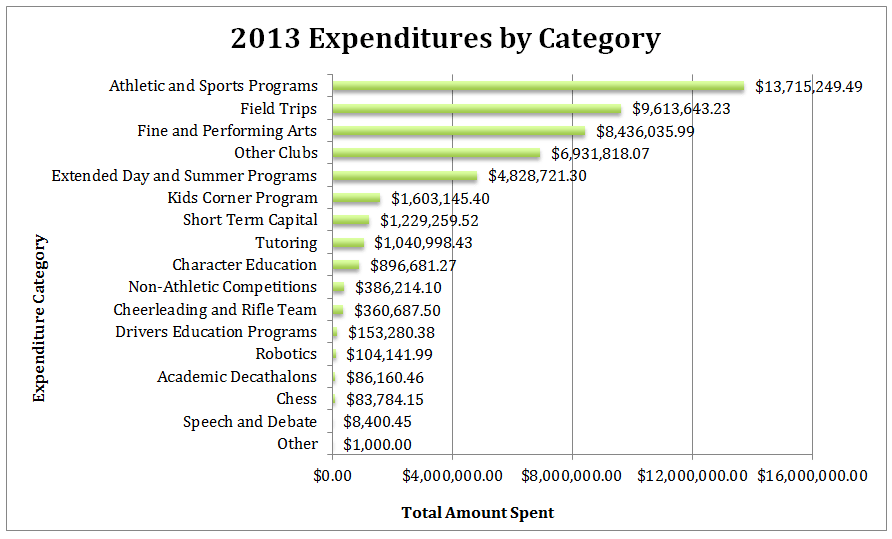
In 2013, Arizona public schools spent just under $50,000,000 of their tax credit donations, the largest portion of which was spent on sports and athletic programs ($13,715,249).  The next largest expenditure categories were field trips ($9,613,643) and fine and performing arts ($8,436,035).  Combined, these three categories comprised over 50% of tax credit expenditures in 2013 or just under $32,000,000.
Starting in 2011, as a temporary measure, public schools were allowed to use up to fifty percent of unencumbered contributions received on or before December 31, 2010 on short-term capital items such as textbooks, equipment, technology, library resources, instructional aids, and transportation vehicles. This provision expired on June 30, 2013.


Summary

Our previous analyses have shown that public school tax credit contributions continue to increase annually and that these contributions are increasingly benefiting more affluent students while donations at high-poverty schools have remained relatively low and stagnate over the last nine years.  These expenditure data suggest that a significant amount of tax credit contributions are funding fee-based activities and a relatively small amount is funding character education or scientific laboratory materials, as the law suggests.

DATA AND METHODOLOGY

The primary data for this blog series consists of school-level tax credit amounts reported by schools for years 2005 through 2013. These files were obtained from the Arizona Department of Revenue [3] and include the total number of donations a school received, the total dollar amount received, and the total amount spent for each year.  Additionally, for years 2011-2013, these files contain information about tax credit expenditures by category.  To enhance our understanding of school-level characteristics, we linked the tax credit data to enrollment [4] and poverty data [5] obtained from the Arizona Department of Education.

The Department of Revenue collects data from each public school in the state and in most cases the data are reported for each school. In some cases, the data are reported as aggregated district amounts. For our analyses, we utilized all data reported, whether by district or by school, for all state summary tables and graphs. Where our analysis required school-level information, the district-level cases were omitted.

While the tax credit may be taken for either a general contribution or for fees, the Department of Revenue data does not draw a distinction. As a result, there is no way to know whether the amounts schools receive are donations that can be used at the discretion of the school, or whether they are in the form of fees that are, in practical terms, earmarked for a particular student.

For our expenditure analysis, we took each expenditure category listed in the tax credit file and summed them across schools to determine a statewide total expenditure by category.  Because several categories listed in the tax credit file overlap (i.e. “sports” and “athletics”), we chose to combine them.  These categories are athletic and sports programs, fine and performing arts, extended day and summer programs, cheerleading and rifle team, and driver’s education programs.

Footnotes/References

[1] Arizona State Legislature Private School Tuition; Tax Credit (E) A.R.S. § 43-1088 (1997) (December 1, 2014).
[2] Arizona State Legislature Character Education Program Instruction; fund A.R.S. § 15-719 (December 1, 2014)

[3] Public School Tax Credit Reports, available at http://www.azdor.gov/ReportsResearch/SchoolTaxCredit.aspx
[4] Average Daily Membership Reports available at http://www.azed.gov/finance/reports/#SafrTop
[5] Percent of students who qualify for the National School Lunch Program, available http://www.azed.gov/health-nutrition/frpercentages/ 
Categories
Education Blog

Benefits to Public Schools: A Look at Arizona’s Public Schools’ Tax Credits, Part III

Our initial analysis of public school tax credits showed an increase in overall contributions during the nine years analyzed. Find our first blog here and our second blog here. The next question the Association sought to answer was which public schools have benefited from tax credits and to what extent.

In order to determine which public schools benefit from public school tax credit contributions, we looked at the variability in per pupil contributions across all schools.  Figure 1 shows the relative size differences in per pupil tax credit contributions for schools in 2013, the most recent year these data were available.

FIGURE 1: Variation in Per Pupil Tax Credit Contributions to Schools, 2013 

Each bubble in Figure 1 represents a school. The size of the bubble represents the relative size of public tax credit contributions per pupil.

It is clear from this simple visual that the amount of tax credit contributions schools receive varies significantly. Some schools may receive little or no funding per pupil, while other schools receive hundreds of dollar per pupil in tax credit contributions.

What might account for these differences?
Public school tax credits are voluntary contributions made to schools by individual taxpayers. Schools rely largely on parents to make tax credit contributions, particularly if these are collected as fees for extra-curricular activities rather than general contributions to the school. They also rely on their communities and often promote on their websites, district newsletters or advertise in local media to get the word out about tax credit contributions. It is not unusual to see a solicitation on a community bulletin board or a movie theater screen prior to the feature. The success of these efforts will likely be dependent on the income level of parents and the local community.

In order to determine whether there is a relationship between a school’s level of poverty and the amount of contributions that a school receives, we linked the public school tax credit data to school-level percentage of students eligible for free or reduced-priced lunch (FRL) as part of the National School Lunch Program.


Although it is not without some limitations, percent FRL is the best available proxy for the level of poverty in an Arizona school.  For this analysis, we divided schools into five categories:

  1. Fewer than 25% FRL
  2. 25%-49% FRL
  3. 50%-74% FRL
  4. 75% or more FRL
  5. No FRL data

 FRL Data

It is important to note that the lack of FRL data does not mean that the school does not enroll students from low income families; it only means that the degree of poverty is unknown. Schools that do not participate in the National School Lunch Program do not have FRL data and there are a number of reasons why schools may not participate in the program.
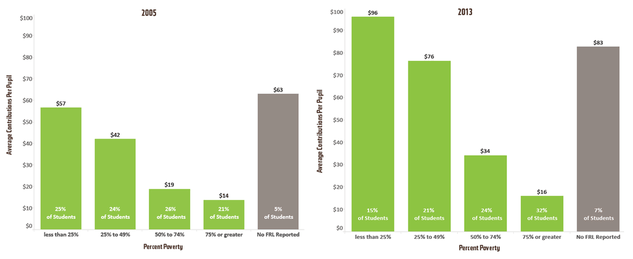
Table 2 shows the distribution of tax credit contributions for 2005 and 2013, broken out by level of poverty. For example, the bar at the far left represents the group of schools with fewer than 25% of students who qualify for free or reduced-priced lunches. This group of schools received, on average, $57 per pupil in 2005 and $96 per pupil in 2013. This same group of schools enrolled 25% of all students in the state in 2005 and 15% in 2013.
TABLE 2: Variation in Per Pupil Tax Credit Contributions to Schools, 2005 and 2013

Summary

The higher the concentration of poverty in the school, the less money it receives in public tax credit contributions. There is a clear pattern of decreasing contributions per pupil as the school’s poverty increases. In each year of the analysis, schools with less than 25% FRL received more contributions per pupil than all other groups of schools with FRL data. Schools with 25-49% FRL received the next largest amount of contributions, followed by the group of schools with 50-74% FRL, leaving the least amount of contributions to the group of schools with 75% or more FRL.The disparity in tax credit contributions between high-poverty and low-poverty schools is significant and growing. While all groups of schools saw an increase from 2005 to 2013 in the per pupil contributions they received, not all groups saw contributions grow at the same rate. The schools with the highest rates of poverty (75% or more) saw the smallest increase of all groups at only 14%, or $2 per pupil. The schools with the lowest rates of poverty (less than 25%) saw an increase of 68%, or $39 per pupil. Schools in the 25%-49% FRL range saw an increase of 80%, or $34 and schools in the 50%-74% FRL range saw an increase of 79%, or $15. Measured in total dollars or percent increase, the schools with the highest concentrations of poverty saw the smallest increase in contributions during the nine years we examined. In 2005, schools with the lowest rates of poverty received contributions per pupil that were approximately four times as much as schools with the highest rates of poverty ($56 vs. $14). In 2013, this gap has grown to six times the amount ($96 vs. $16). The relative difference between schools that have less than 50% FRL and more than 50% FRL is also significant; the average contribution per pupil amount is nearly half ($76 vs. $34 in 2013 ) once the school reaches 50% FRL.
This is Part I of the Association’s four-part series on Tax Credits. Find Part I here, Part II here, and Part IV here.

DATA AND METHODOLOGY

The primary data for this blog series consists of school-level tax credit amounts reported by schools for years 2005 through 2013. These files were obtained from the Arizona Department of Revenue [1] and include the total number of donations a school received, the total dollar amount received, and the total amount spent for each year.  Additionally, for years 2011-2013, these files contain information about tax credit expenditures by category.  To enhance our understanding of school-level characteristics, we linked the tax credit data to enrollment [2] and poverty data [3] obtained from the Arizona Department of Education.

The Department of Revenue collects data from each public school in the state and in most cases the data are reported for each school. In some cases, the data are reported as aggregated district amounts. For our analyses, we utilized all data reported, whether by district or by school, for all state summary tables and graphs. Where our analysis required school-level information, the district-level cases were omitted.

While the tax credit may be taken for either a general contribution or for fees, the Department of Revenue data does not draw a distinction. As a result, there is no way to know whether the amounts schools receive are donations that can be used at the discretion of the school, or whether they are in the form of fees that are, in practical terms, earmarked for a particular student.

For our expenditure analysis, we took each expenditure category listed in the tax credit file and summed them across schools to determine a statewide total expenditure by category.  Because several categories listed in the tax credit file overlap (i.e. “sports” and “athletics”), we chose to combine them.  These categories are athletic and sports programs, fine and performing arts, extended day and summer programs, cheerleading and rifle team, and driver’s education programs.

Footnotes/References

[1] Public School Tax Credit Reports, available at http://www.azdor.gov/ReportsResearch/SchoolTaxCredit.aspx
[2] Average Daily Membership Reports available at http://www.azed.gov/finance/reports/#SafrTop
[3] Percent of students who qualify for the National School Lunch Program, available http://www.azed.gov/health-nutrition/frpercentages/

Categories
Education Blog

A Look at Arizona’s Public Schools’ Tax Credits, Part II

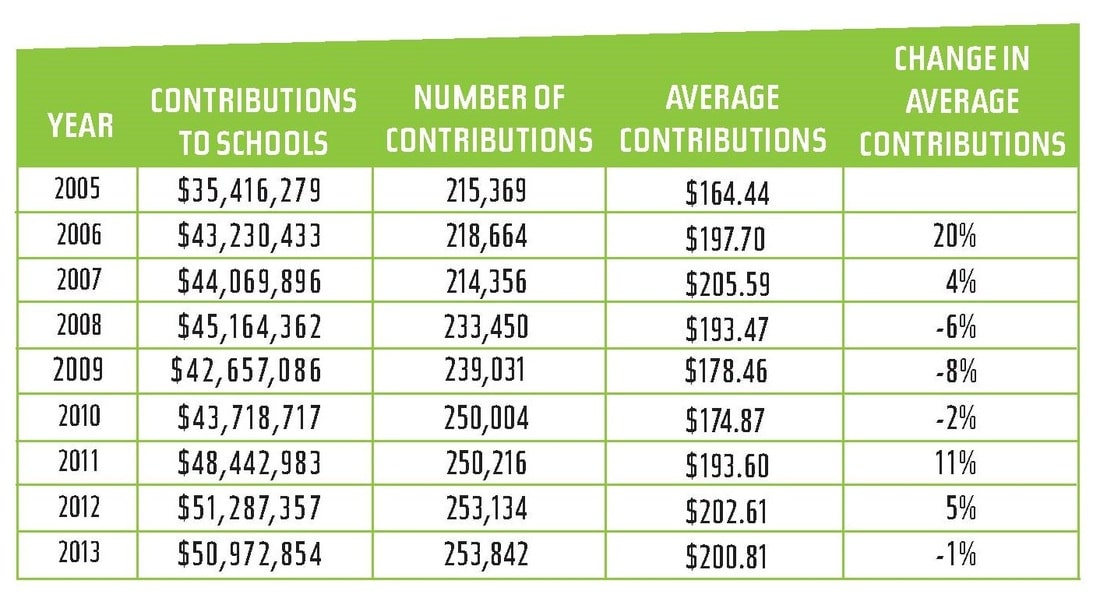
Continuing our look at Arizona’s public school tax credits, Table 2 shows the statewide trend in the number of contributions and the average contribution amount. A contribution may be a single person or a couple, so the number of contributions does not precisely reflect the number of taxpayers who are using the tax credit, but it does provide a useful indicator of the change in the level of taxpayer participation. To put this number in perspective, in 2012, Arizona residents filed over 2.7 million state income tax returns [1], suggesting fewer than ten percent of filers are using public school tax credits.

Table 2: Number and Average Contributions, 2005-2013

The number of contributions increased a total of 18% from 2005 to 2013. This rate is less than half of the 44% increase in the total contributions received by public schools in these years. This can be explained by the fact that the average contribution amount increased 22% during the same period of time, although it did fluctuate somewhat during these years. In other words, more people are contributing larger amounts of money.

It should be noted that the taxpayer may take the tax credit for a donation to a public school or for the payment of fees associated with a student’s extra-curricular activities. For example, a parent may make a $200 contribution to support a school’s athletic programs and take a $200 tax credit, or she can pay $200 in fees associated with her child’s participation in the school’s basketball team and take the same $200 tax credit (or a combination, within the allowable limits).  Available data do not allow an analysis of what proportion of contributions are made as donations or fees.

Summary

Trends show that more taxpayers are using public school tax credits and schools are the recipients of an increasing amount of dollars, both in total and on a per pupil basis. Their popularity is likely due to key features of the program that are attractive to the taxpayer — a dollar for dollar credit on state income tax and the ability to target dollars for the benefit of a particular school or, in some cases, a particular child.

Tax credit contributions are appealing to public schools that have experienced significant budget cuts as a result of the state’s poor economy and legislative action.  Anecdotal evidence suggests that these increases may also be due to a greater public awareness of the tax credit brought about by a higher level of effort on the part of schools to raise that awareness and solicit funds.

Given that there is no cap placed on the amount of total dollars that a school may receive and the low rate of taxpayer participation to date, it is reasonable to expect that these trends will continue on their upward trajectory.  While the benefits and appeal to the taxpayer are undeniable—a dollar for dollar credit on the state income tax plus the ability to target the contribution—the broader effects of this policy are worth considering.

This is Part II of the Association’s four-part series on Tax Credits. Find Part I here, Part III here, and Part IV here.

Footnotes

[1] Internal Revenue Service, Individual Income and Tax Data, by State  (December 3, 2014).
Categories
Education Blog

Working for Public Students? A Look at Arizona’s Public Schools’ Tax Credits, Part I


Public school tax credits have steadily grown from $4 million to $400 million.  What may have been envisioned originally as a few extra dollars for extracurricular activities is now at nearly $50 per student.  The average tax credit revenue per student for an elementary school of 500 students is $25,000.  For a high school with 2,500, $125,000 is the average tax credit. In the context of recent cuts to education funding, this can be the difference between having extracurricular options for students or not.

The public school tax credit began in 1997 with the passage of HB2047 which was an innovative option for Arizona taxpayers to donate a portion of their income to public schools in return for a credit towards their state income tax.  Individual donations are capped at $200 (or $400 for those filing jointly) and can be used by public schools only for extracurricular activities, such as the purchase of band instruments or sports equipment, and character building programs, such as Character Counts. Tax credit donations may not be used to pay for core instructional or operational needs, such as instructional materials, teacher salaries, or building maintenance.

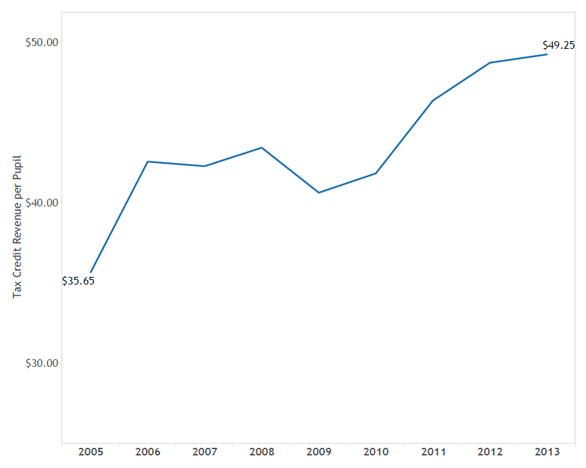
Figure 1: Tax Credit Revenues per Pupil, 2005 to 2013


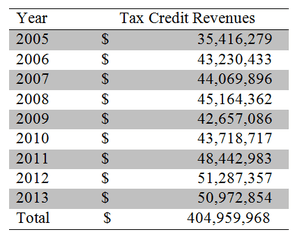
Originally estimated to cost the state “$3.9 million beginning in FY 1998-1999,”[1] tax credits have become a significant source of revenue for Arizona schools, totaling over $400 million in the last nine years. Table 1 shows tax credit revenue to public schools in each year from 2005 and 2013.  Despite slight decreases during the Great Recession, the total amount has increased from $35.4 million in 2005 to nearly $51 million in 2013.

o account for changes in the student population, Figure 1 shows revenues per pupil over the last nine years.  This too shows the per pupil amount increasing overall during this time period, despite small setbacks during the Great Recession.

An upcoming report by the Association will take a closer look at the distribution of public school tax credit dollars. How many taxpayers are taking advantage of the tax credit and how much are they donating? Are all schools benefitting equally from this policy? Which schools benefit the most or the least? How are tax credit revenues used by schools?  By taking an unprecedented longitudinal look at tax credit revenues, the Association intends to shed some light on how this particular tax and education policy is playing out in our public schools.

This is Part I of the Association’s four-part series on Tax Credits. Find Part II here, Part III here, and Part IV here.

DATA AND METHODOLOGY

The primary data for this blog series consists of school-level tax credit amounts reported by schools for years 2005 through 2013. These files were obtained from the Arizona Department of Revenue [2] and include the total number of donations a school received, the total dollar amount received, and the total amount spent for each year.  Additionally, for years 2011-2013, these files contain information about tax credit expenditures by category.  To enhance our understanding of school-level characteristics, we linked the tax credit data to enrollment [3] and poverty data [4] obtained from the Arizona Department of Education.

The Department of Revenue collects data from each public school in the state and in most cases the data are reported for each school. In some cases, the data are reported as aggregated district amounts. For our analyses, we utilized all data reported, whether by district or by school, for all state summary tables and graphs. Where our analysis required school-level information, the district-level cases were omitted.

While the tax credit may be taken for either a general contribution or for fees, the Department of Revenue data does not draw a distinction. As a result, there is no way to know whether the amounts schools receive are donations that can be used at the discretion of the school, or whether they are in the form of fees that are, in practical terms, earmarked for a particular student.

For our expenditure analysis, we took each expenditure category listed in the tax credit file and summed them across schools to determine a statewide total expenditure by category.  Because several categories listed in the tax credit file overlap (i.e. “sports” and “athletics”), we chose to combine them.  These categories are athletic and sports programs, fine and performing arts, extended day and summer programs, cheerleading and rifle team, and driver’s education programs.

Footnotes:
[1] Arizona State Senate Staff Memo HB2047 dated March 19, 1997.
[2] Public School Tax Credit Reports, available at http://www.azdor.gov/ReportsResearch/SchoolTaxCredit.aspx
[3] Average Daily Membership Reports available at http://www.azed.gov/finance/reports/#SafrTop
[4] Percent of students who qualify for the National School Lunch Program, available http://www.azed.gov/health-nutrition/frpercentages/