Categories
Education Blog

ARIZONA EIGHTH GRADE MATH PERFORMANCE – A MORE COMPLETE PICTURE

By Dr. Ildi Laczko-Kerr and Kelly Powell

This past fall, when the statewide results of the 2016 AzMERIT exam were published, the eighth grade math test pass rate was pegged at 26 percent. Though this figure is true for the students who took the general eighth grade math exam, it does not represent all eighth grade students in Arizona, because many students take advanced math classes and therefore take a different exam.

In the chart below, the percentage of eighth graders who took a high school “end of course” exam, such as Algebra I, Geometry, or Algebra II instead of the general eighth grade math test are reported.

PERCENTAGE OF EIGHTH GRADE STUDENTS TESTED BY TYPE OF MATH TEST
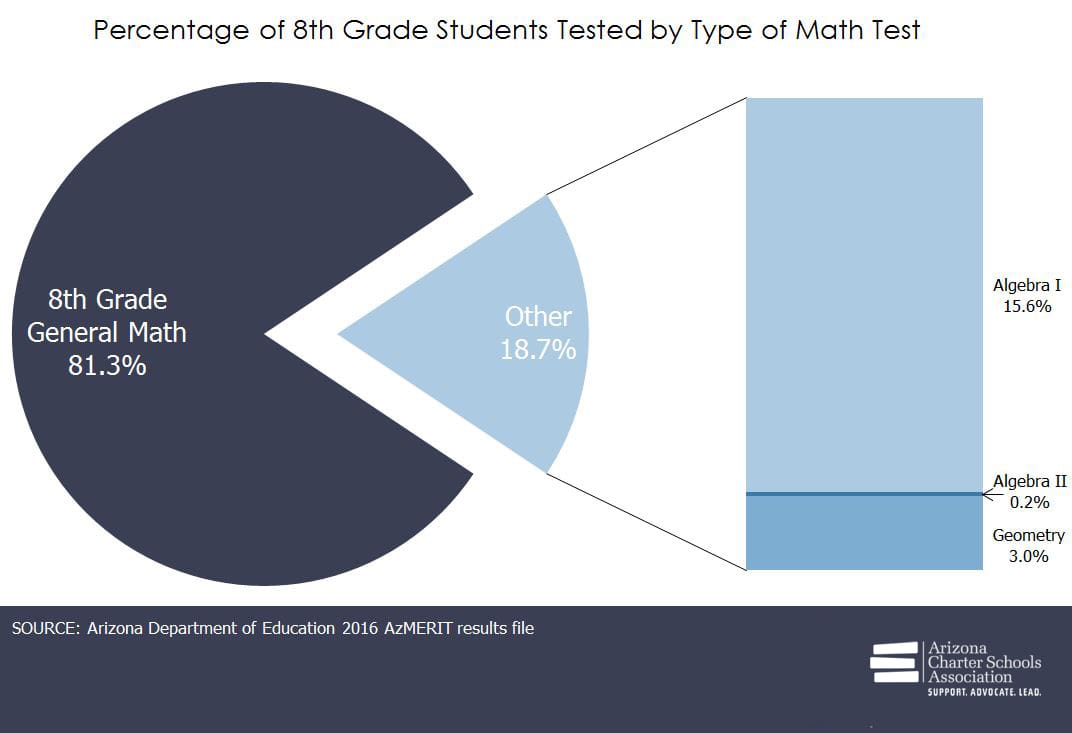
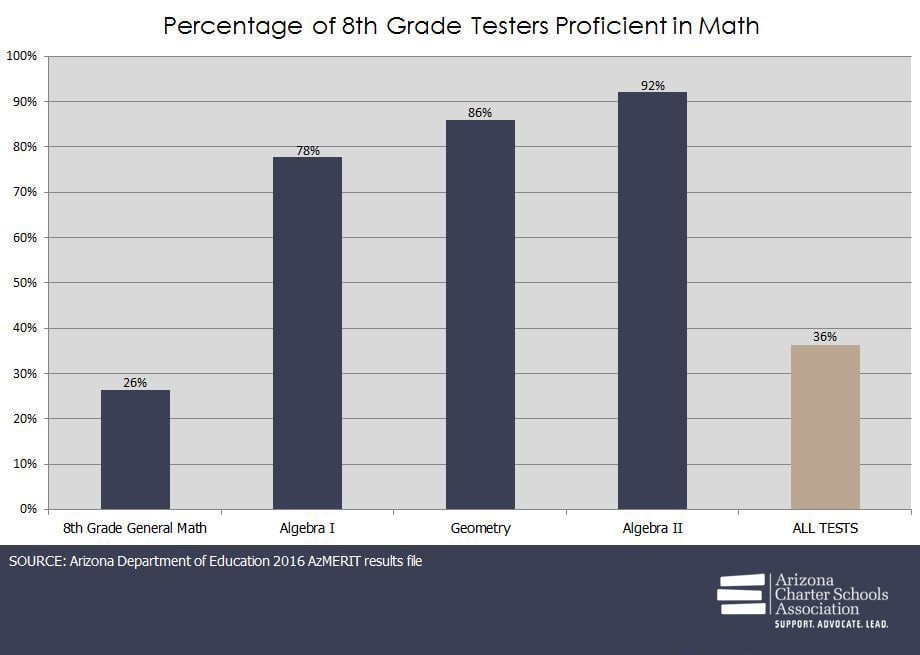
These data indicate that in 2016, almost one out of every five eighth grade students is accelerated in math and taking a high school end of course math exam. The impact on state reporting is significant: nearly 20 percent of eighth graders’ test results were not accounted for in the reported 26 percent pass rate. Taking all math test results into consideration, the overall math pass rate for eigth graders is actually 36 percent. This represents a 10 percentage point increase from the publicly reported eight grade results, and a 2 percent increase from 2015 when all eighth grade students were required to take the eighth grade math exam.

OBSERVATIONS ABOUT ACCELERATED STUDENT PERFORMANCE

The 2016 data show that the majority of advanced math students are accelerated by one course, e.g. Algebra I instead of eighth grade math. Smaller percentages of students are accelerated by two (taking Geometry) or three (Algebra II) courses. However, the average performance of the accelerated students increases significantly the more the students are accelerated. In other words, students who are three times accelerated (taking high school Algebra II in 8th grade) are passing at 92 percent compared to the 78 percent of students accelerated by one course, Algebra I. Students who are accelerated at this rate can certainly be called exceptionally advanced in math and don’t reflect the typical middle school math experience.

PERCENTAGE OF EIGHTH GRADE TESTERS PROFICIENT IN MATH
WHY DOES THIS MATTER?

Researchers, teachers, education advocates and others agree that eighth grade math is a critical indicator of success in high school and college (as well as in career and life). In fact, the Arizona Education Progress Meter, which represents key metrics that support a shared vision for world-class education in our state, includes eighth grade math as one of eight indicators by which to measure the health of education in Arizona.

Arguably, improving the percentage of eighth grade students proficient in eighth grade math is its own laudable goal. Even better, having more students pass high school level content (Algebra I and II and Geometry) in middle school would open them up for advanced studies later in school, and prepare them for more training or education beyond high school. In order to monitor Arizona’s progress towards these goals, we should: encourage any programs or initiatives that address early identification and interventions for students struggling in math (no matter the level) and measure and report the math performance of all eighth grade students, no matter the test they take.

Categories
Education Blog

THE ALGEBRA OPTION IN ARIZONA

By Kelly Powell

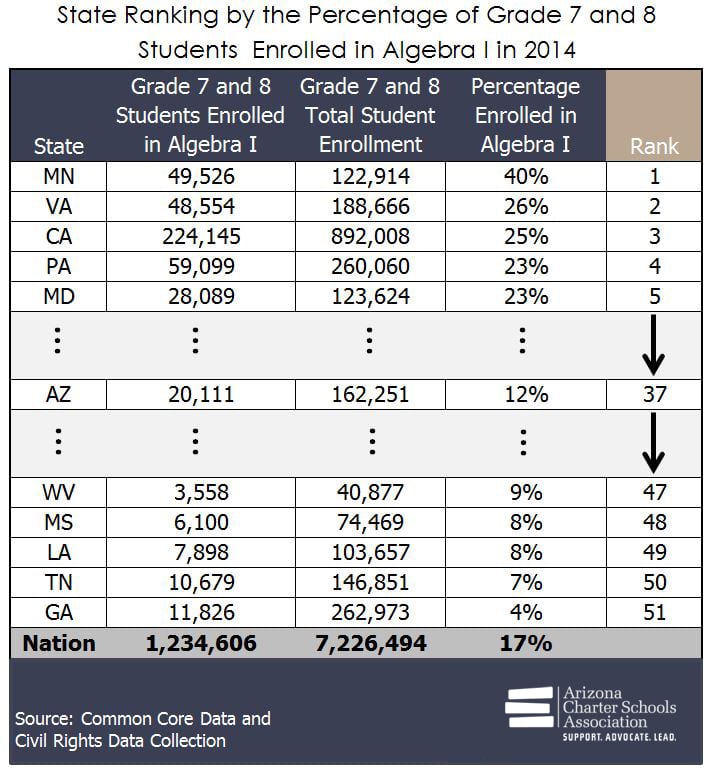
Governor Ducey identified proficiency in algebra skills by the end of eighth grade as a strategic goal for Arizona to ensure a world-class, 21st century education in his “Education Matters Arizona” initiative. But according to 2014 data, Arizona ranks 37th in the percentage of students in seventh and eighth grade enrolled in an Algebra class.

According to data from the 2013-14 Civil Rights Data Collection and 2014 Common Core of Data, about 12 percent of Arizona middle grade students took Algebra I. Though Arizona outpaces Georgia, West Virginia, Tennessee and a few other states, our state has some ways to go to reach the national average of 17 percent of seventh and eighth grade students enrolled in an Algebra I class.

I know, I know…it would be better to just report eighth grade data, but the collection instrument grouped seventh and eighth grade students together and there’s no way to separate out the results by grade. The map (left) shows how Arizona compares relative to other states in the proportion of seventh and eighth grade students enrolled in Algebra I. Click on the map to see details for all states and for every middle school in the country.

California, Virginia and Minnesota lead the country in middle school Algebra I enrollment, with Minnesota markedly ahead of the rest of the country (spurred by MN’s graduation requirements no doubt).

STATE RANKS: PERCENTAGE OF GRADE 7 AND 8 STUDENTS ENROLLED IN ALGEBRA I (2014)

The reality is that in Arizona, like many other states, students begin to accelerate in math in fifth through eighth grade, taking high school courses and assessments. According to AzMERIT data (Arizona’s statewide assessment) about 19 percent of eighth grade students took a higher level end-of-course math exam in 2016—the majority of these students taking the Algebra I exam. Most of you, skeptical readers, do not know this fact because data on eighth grade end-of-course testers is not reported anywhere publicly. These results will be published soon in an upcoming blog, so stay tuned.

To date, Arizona has only focused on AzMERIT scores in eighth grade that exclude advanced middle school math students taking Algebra I and II and Geometry classes. The lack of transparent data on math acceleration creates big hurdles for policy makers who aim to advance policies that will drive academic excellence in math. Arizona could choose (or not) to set Algebra I as the goal for eighth graders like Minnesota. Or we could choose (or not) to follow Governor Ducey’s strategic goal for all students to be “proficient in algebra skills by the end of grade 8.”  Regardless where you land, an informed debate would benefit from a public reporting of number of accelerated math students in fifth through eighth grade along with their performance.

As always, if you want to carp about my use of aphorisms or discuss the proper way to analyze and interpret Civil Rights Data Collection files, drop me a line at kelly@azcharters.org.

Categories
Association Blog

Quality matters

By Yvonne Watterson

What do we look for in a quality school? Test scores? Funding? Class size? The principal’s resume?  Do we know why some schools do a better job than others in helping students learn? At a time when Arizona is facing challenges that include improving literacy, the high school graduation rate, the recruitment and retention of effective teachers and leaders, and ensuring equitable funding for its schools, these are critical questions.

As parents, educators, community members, and business leaders, we want to feel confident that Arizona’s children will emerge from our schools ready for the demands of college or the work-place. We should demand nothing less. In order to achieve it, however, we must share a common understanding of what quality looks like.

Categories
Association Blog

Arizona’s “wild west”approach allowed charters to blossom

By Jamar Younger

Arizona’s “wild west” reputation seems to inject itself into numerous topics, including education.

In the charter school realm, Arizona is known for its massive growth of public charter schools in the early days of charters, leading to the movement’s association with the “wild west” moniker.

Two recent blogs pointed out that Arizona’s somewhat freewheeling attitude towards charters at the time might not have been a bad thing.

Categories
Association Blog

ASU Prep, Tempe Union High School District team up to help students advance

By Jamar Younger

A public charter high school with a college preparatory focus is entering into a unique and potentially groundbreaking partnership with a union high school district to provide more options for students in Tempe.

ASU Prep, a K-12 public charter school network with nine campuses spread across Phoenix and Casa Grande, has joined with the Tempe Union High School District’s Compadre Academy to open a joint school that will integrate ASU Prep’s rigorous college preparatory focus with Compadre’s flexible, self-paced, non-traditional program.

The schools will merge to form ASU Prep Compadre High School in Tempe.

This initiative is designed to provide disadvantaged students equal access to higher level college preparatory classes, regardless of their personal circumstances.

Categories
Association Blog

New York Times publishes Northland Prep student essay

By Jamar Younger

Each year, the New York Times solicits college application essays from thousands of high school seniors around the country who choose to address money, work or social class as their topics.

The newspaper published five essays this year, including a piece authored by Tillena Trebon, an Arizona public charter student who is set to graduate this month from Northland Preparatory Academy in Flagstaff.

In this poetic essay, Trebon describes the intersection of urban and rural existence in her life, how she balances these contradictions and how she’ll continue to “crave experiences only found at the edge” as she enters adulthood.

Categories
Association Blog

Phoenix Collegiate Academy student uses father’s memory as motivation to succeed

By Jamar Younger

Adam Jackson has always been a top-notch student who excelled academically and socially.

However, after Jackson’s father and biggest supporter died unexpectedly from cardiac arrest while being hospitalized for pneumonia, the high school junior lost his motivation.

Normally active and enthusiastic, Jackson descended into a depressive state, which affected his academic performance and caused his grades to temporarily drop.

Jackson grew up without his mother, who wasn’t involved in his life after he moved from the Los Angeles area to Phoenix as a young child, and was now fatherless. His grandparents provided his only familial support.

To make matters worse, his grandmother was diagnosed with breast cancer around the same time, although she was able to conquer the disease and make a full recovery.

“I couldn’t find the motivation to continue in school. I lost a part of me,” said Jackson, 18, now a senior who will graduate from the school on May 23. “I just didn’t feel like doing anything.”

Categories
Press Releases

Association Commends Ducey, Legislature on pro-education budget

Eileen B. Sigmund, Arizona Charter Schools Association President and CEO, released the following statement today on the Fiscal Year 2018 state budget:

“On behalf of public charter schools across Arizona, we commend Governor Ducey for signing into law a pro-education spending plan that makes critical investments in K-12 students, teachers and schools.

“Infused with an additional $163 million, this spending plan builds on Proposition 123 dollars recently approved by Arizona voters and signals a renewed commitment to K-12 education.

“Public charter schools were created by the legislature to improve student achievement, and this budget supports schools that are delivering the best outcomes for Arizona students. This new emphasis on results-based funding rewards high-performing schools, especially those serving disadvantaged students.

“Additionally, legislators and the Governor have prioritized teachers with a commitment that doesn’t end with this budget. Our state is truly beginning to take the steps necessary to support our schools in their work to recruit and retain high quality teachers. Arizona public charter schools, who are delivering strong outcomes for students, will continue to elevate teachers at the local level.

“We thank Governor Ducey for his leadership, as well as legislators who worked hard to get this done for Arizona families.”

Categories
Charters Changing Lives

Beyond survival, charter students build a plan for living in space

By Jamar Younger

“Why not me?”

That’s the question 12-year-old Ruth Cox asked herself before gathering a team to compete in a STEM competition, the Honeywell Fiesta Bowl Aerospace Challenge.

“My oldest brother won the final competition and my other brother made it to the finals, so I always assumed that I would do this,” said Cox, a sixth-grade-student at Challenge Charter School in Glendale. So she called her close friends and fellow sixth graders, sisters Emily and Catherine Taylor, and Ada Stanley, and asked if they wanted to create a team: Team R.A.C.E, one letter for each of their names.

The girls spent six months researching gravity, various methods for growing plants, and other topics, as well as plenty of writing and model building. The goal: build a base on Mars moon Phobos where astronauts could survive in space and conduct experiments, but still live comfortably.

Categories
Press Releases

Arizona Celebrates Charter Schools Week: May 1-5

Gov. Ducey proclamation recognizes contributions of AZ charters to public education

Phoenix (May 2, 2017) – The Arizona Charter Schools Association is proud to join students, families, educators and advocates across the country in celebrating National Charter Schools Week.

In accordance with the national annual event, Gov. Doug Ducey has proclaimed the week of May 1-5 “Arizona Charter Schools Week” in honor of the significant role charters have played in Arizona’s public education system.

“For the past 20 years, Arizona’s charter schools have increasingly become the preferred choice for parents and families seeking an excellent public education that delivers quality options, serves a diverse population, and improves student outcomes across all demographics,” said Eileen Sigmund, President and CEO of the Arizona Charter Schools Association.