Michael Galola faced uncertainty four years ago when both of his sons were diagnosed with autism. Find out how a Phoenix charter school was able to restore hope and ensure a bright future for the boys.
This is Michael’s story.
Michael Galola faced uncertainty four years ago when both of his sons were diagnosed with autism. Find out how a Phoenix charter school was able to restore hope and ensure a bright future for the boys.
This is Michael’s story.
Arizona’s achievement gap is among the smallest in the country and charter schools top many of the rankings.
“Education is not a one-size-fits-all endeavor. The Arizona Charter Schools Association commends lawmakers for their passage of legislation that will give public schools much-needed discretion in selecting the standardized assessment that best aligns with the school’s curriculum and the needs of its students.”
-Eileen B. Sigmund, President and CEO on the passage of HB2544
[pexnivoslider pex_attr_sliderid=”56″][/pexnivoslider]
Representing every legislative district across Arizona, school leaders turned out for ‘Charters at the Capitol’ Wednesday to discuss how charters are changing lives in their unique schools. Governor Doug Ducey met with our leaders and recognized their academic success, as Arizona charter students outperformed nearly every state on the 2015 Nation’s Report Card.
In our 130 meetings scheduled with 27 legislators and the Governor, along with my presentation to the House Education committee, we highlighted how charter students are exceeding the state average in every grade for reading and math. Charter leaders also discussed how the instability of Arizona’s K-12 funding impacted their plans to expand and serve thousands of families on wait lists.
The schools represented have diverse educational philosophies, such as STEM, Waldorf, Arts, and Socratic methods of learning. Our leaders drove from all corners of the state including Sierra Vista, Kingman, Tucson and Bisbee to participate.
With 170,755 students and 556 public charter schools, Arizona’s charter community is committed to student success and strengthening K-12 education, ensuring a vibrant Arizona.
I want to personally thank the Governor, legislators and everyone who made ‘Charters at the Capitol’ a great success.
Sincerely,
Eileen B. Sigmund
President and CEO
Arizona Charter Schools Association
The Association’s first look at statewide enrollment trends over the last nine years shows that despite the overall growth in K-12 enrollment, nine of the fifteen counties in the state have seen an overall decline in student enrollment.
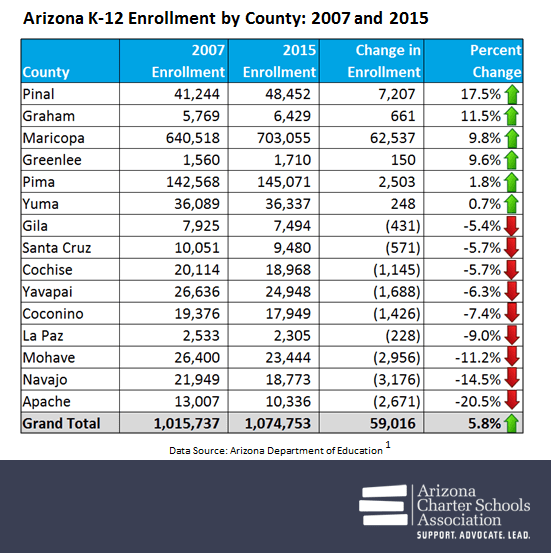
Perhaps not surprisingly, Maricopa County saw the greatest increase in the number of students, adding 62,537 students. In terms of percent change, Pinal County outpaced Maricopa County, increasing by 17.5%, or 7,207 students. Two of the state’s smallest counties, Graham County and Greenlee, also top the list of percent growth at 11.5% and 9.6% respectively.
When we consider the “percent change” column of the above table with a geographical lens, we get a clearer picture of Arizona’s enrollment patterns. The map below shows that the largest enrollment declines are occurring in the northern part of the state, with Cochise and Santa Cruz counties being the exceptions to this trend:
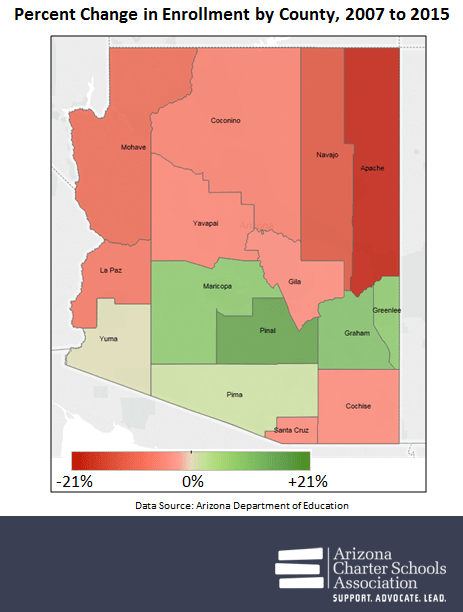
The implications of such enrollment trends are not insignificant. Statewide comparisons, independent of county-specific analyses, paint a positive, growing K-12 environment. As the overall population of students in the state increases, so does our overall K-12 budget allocated from the state’s general fund. However, simply evaluating statewide trends provides an incomplete picture of student enrollment trends that may result in ineffective policy decisions. Evaluating these data by county is pivotal in understanding how enrollment has changed across our state. For example, the declining enrollments in rural counties result in declining school and district budgets, making it even more difficult to find qualified teachers in these counties. Also, as enrollment increases in Maricopa and Pinal Counties, the demand for school facilities will grow while at the same time buildings in Northern Arizona become underutilized.
It is clear from these data that student enrollment patterns vary significantly by county and this will likely complicate future discussions regarding budget, facilities and access to high quality schools. Arizona’s education policy discussions should not assume enrollment growth is occurring statewide. Instead, policymakers would benefit from reviewing differing enrollment patterns across different parts of the state and consider the impact on proposed policies.
